What looks soft isn’t always protective: falls onto playground surfaces account for nearly 70% of playground injuries, according to the Consumer Product Safety Commission. Choosing safe playground surfaces for home means matching the cushioning to the playset’s fall height; the general recommendation for loose-fill material is 12 inches under and around equipment. No surface can prevent every injury, but the right material and upkeep can reduce risk.
When planning a home play area, weigh softness, appearance, maintenance, and budget. Rubber mulch can shift and need raking, while unitary surfaces, such as poured-in-place rubber, tiles, or synthetic turf with protective under-padding, create a more continuous surface. Each option has trade-offs, so the right fit depends on your playset, yard, and priorities.
This guide compares rubber mulch and unitary surfacing for fall protection, drawbacks, affordability, maintenance, and installation. It also explains how to assess fall height and coverage so you can choose a surface suited to your home playground.
Key Takeaways
- Measure the playset’s fall height and use it to guide your surface choice, depth, and coverage.
- Compare rubber mulch’s loose-fill cushioning with unitary surfacing’s continuous finish, factoring in upkeep and the needs of your yard.
- Account for shifting and compression when considering loose-fill materials, since maintenance helps preserve their protective depth.
- Look beyond upfront affordability: drainage, installation, replacement, and ongoing care all affect a surface’s long-term value.
- Use the decision guide to narrow the options to a surface that suits your equipment, play area, and priorities.
Fall-height protection
Fall protection depends on the play equipment’s fall height, the surface material, and its maintained depth. To choose safe playground surfaces for home, match the cushioning to the playset, then keep the full use zone covered and clear.
Loose-Fill Surface Depths
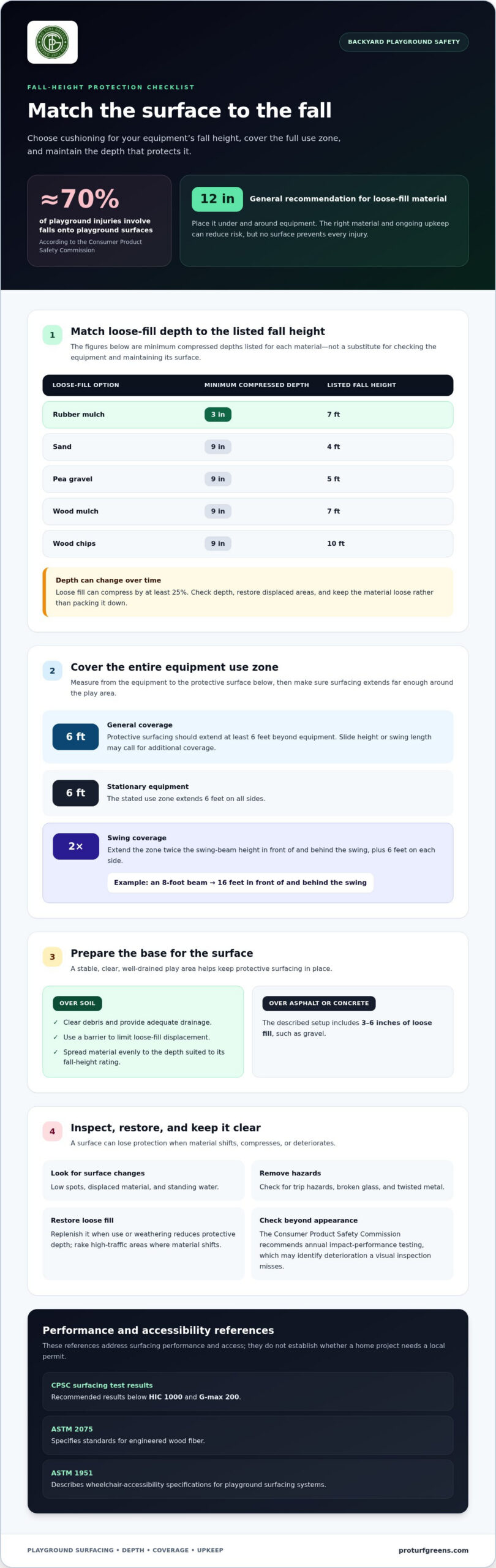
Loose-fill materials cushion falls only while enough material remains in place; the general recommendation is 12 inches under and around equipment. The required depth also depends on material and fall height: the listed minimum compressed depth is 3 inches of rubber mulch for a 7-foot fall, compared with 9 inches of sand for a 4-foot fall. Loose fill can compress by at least 25% over time, so measure depth and restore displaced areas.
Equipment Fall Heights
Fall height is the accessible height of the playset’s uppermost part, measured to the protective surface below. The listed figures show why equipment height and material must be considered together: 9 inches of wood chips is listed for a 10-foot fall, while rubber mulch requires 3 inches for a 7-foot fall. No surface prevents every injury, and protection deteriorates when material shifts or compresses.
In the United States, the Consumer Product Safety Commission recommends playground surfacing safety-test results below a HIC of 1000 and a G-max of 200. ASTM 2075 specifies standards for engineered wood fiber, while ASTM 1951 describes wheelchair-accessibility specifications for playground surfacing systems. These references address performance and access; they don’t establish whether a home project needs a local permit.
Protective surfacing should extend at least 6 feet beyond equipment; additional coverage may be needed for slide height or swing length. Stationary equipment has a stated 6-foot use zone on all sides. For swings, the zone extends twice the swing-beam height in front and 6 feet on each side. A swing beam 8 feet high means 16 feet in front of and behind the swing.
To prepare surfacing over soil, clear debris, provide adequate drainage, and use a barrier to limit loose-fill displacement. Spread material evenly to the depth suited to its fall-height rating, then keep it loose rather than packing it down. Over asphalt or concrete, the described setup includes 3-6 inches of loose fill like gravel.
Inspect the surface for low spots, displaced material, standing water, trip hazards, broken glass, and twisted metal. Replenish loose fill when use or weathering reduces its protective depth. The Consumer Product Safety Commission recommends annual impact-performance testing, which can identify deterioration a visual inspection may miss.
| Loose-fill option | Minimum compressed depth | Listed fall height |
|---|---|---|
| Rubber mulch | 3 inches | 7 feet |
| Sand | 9 inches | 4 feet |
| Pea gravel | 9 inches | 5 feet |
| Wood mulch | 9 inches | 7 feet |
| Wood chips | 9 inches | 10 feet |
For safe playground surfaces for home, choose a material with listed fall-height coverage suited to the equipment, then maintain that protection across the full use zone.
Rubber mulch advantages and drawbacks
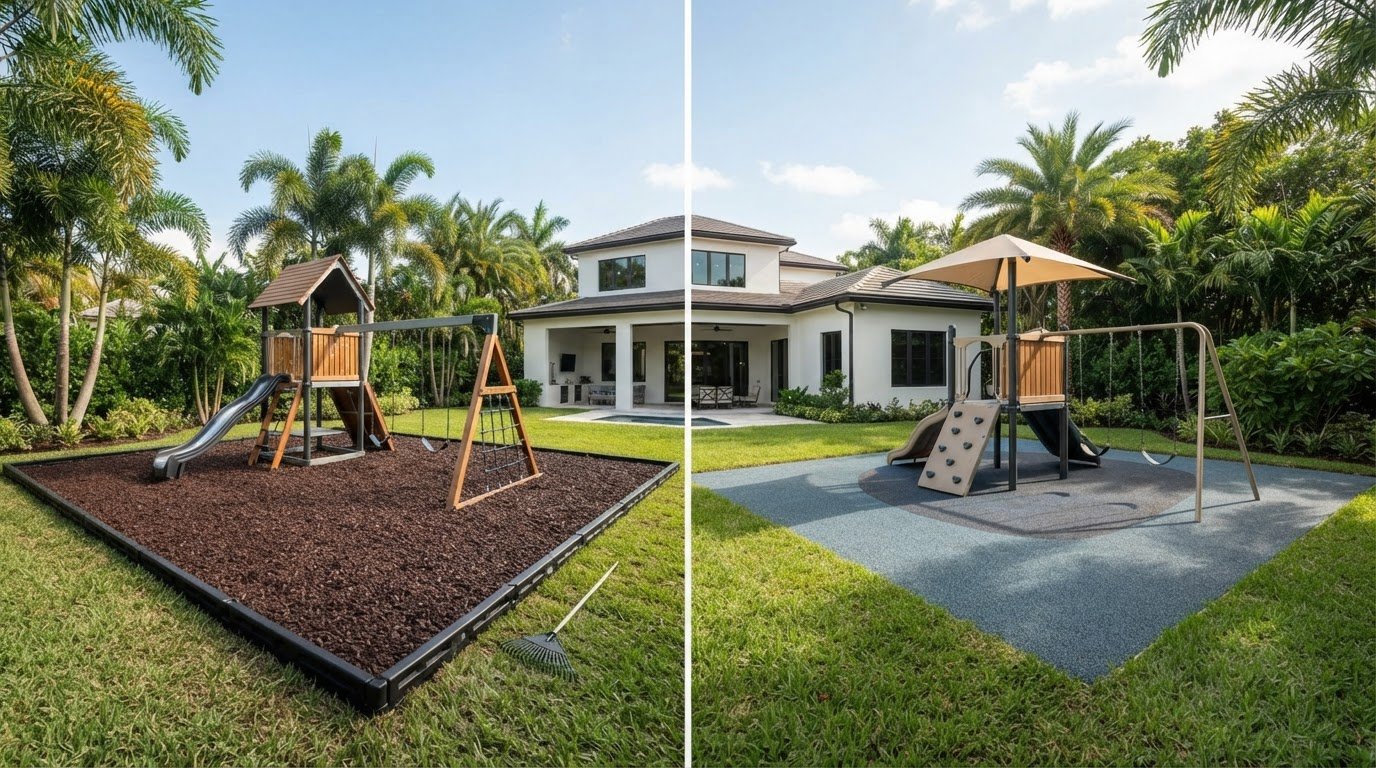
Rubber mulch is loose-fill surfacing made from shredded rubber, often recycled from tires. It can cushion falls when installed at a depth suited to the play equipment, but active play and weather can displace it. Rake high-traffic areas and restore low spots to keep the surface even. Unlike poured-in-place rubber or tiles, mulch needs regular redistribution.
Heat deserves attention in sunny yards. A parents’ group documented a pour-in-place playground surface temperature above 170 degrees F when the air temperature was 75 degrees F. That observation concerns a pour-in-place surface, not every rubber product. Still, rubber surfaces can become hot, so feel the play area before use and consider shade and the time of day.
Material concerns also warrant context. In 2019, the Ecology Center tested playgrounds and found high levels of lead contamination on some pour-in-place surfaces. The finding concerns some tested surfaces, not every rubber material. Separately, a community replaced shredded waste-tire surfacing in seven town playgrounds with engineered wood fiber in 2023. These examples illustrate why material choice and surface condition matter.
Loose rubber pieces can scatter beyond the play zone, exposing the ground underneath. Check for hidden debris, including broken glass or twisted metal. Small loose pieces can also pose a choking risk, particularly for young children who mouth objects, so supervise play and remove debris promptly. Splinters are more commonly associated with wood-based surfacing than rubber.
Poured-in-place rubber creates a continuous surface, unlike mulch that shifts underfoot. It can keep the play area looking uniform, but inspect for worn or damaged spots and consider surface heat in sunny weather. A continuous appearance is no substitute for checking the surface’s condition.
Interlocking tiles are another surfacing option to consider. Their sections create a defined play surface, and rubber mats provide the strongest access advantage for people who use wheelchairs. Check that tiles remain aligned and that damaged or uneven sections do not create trip hazards.
For a practical comparison, consider which maintenance you can keep up with: rubber mulch needs raking and depth checks, while poured rubber and tiles need condition checks. No material eliminates every risk. Keep the play area clear and inspect it before children use it.
Homeowners comparing rubber with synthetic turf can also consider playground and recreational turf as another surface category.
Unitary playground surfacing options
Unitary surfacing forms a continuous layer rather than loose pieces that can shift across the play area. Options include poured-in-place rubber, bond-in-place rubber, interlocking resilient tiles, and synthetic turf with protective under-padding.
Rubber mulch, poured-in-place rubber, turf, and wood chips differ in fall cushioning and upkeep. Loose-fill mulch and wood chips need depth checks and replenishment as they move or compress. Unitary surfaces avoid loose-fill raking but still need inspection for wear, damage, and changes in cushioning.
Compare the surface types
| Surface | Fall protection considerations | Maintenance focus |
|---|---|---|
| Poured-in-place rubber | Unitary surface; protection depends on its tested performance and equipment fall height. | Inspect for wear, damage, and changes across the surface. |
| Bond-in-place rubber | Unitary rubber option; evaluate its cushioning for the play structure’s fall height. | Look for areas that have become damaged or uneven. |
| Resilient rubber tiles | Interlocking units; rubber mats provide the best access for people in wheelchairs. | Inspect tile alignment and condition. |
| Synthetic turf with protective under-padding | The under-padding contributes to cushioning; assess the system as a whole. | Check turf and padding for wear or displacement. |
| Rubber mulch or wood chips | Loose fill cushions when adequate depth is maintained. | Rake, check depth, and replace displaced material. |
The Consumer Product Safety Commission recommends safety-test results below a HIC of 1000 and a G-max of 200. Use test performance alongside fall height, since unitary surfacing materials showed significant safety deterioration at equipment heights above 6 feet. A continuous appearance alone doesn’t establish that a surface provides suitable cushioning.
Weather and drainage matter with every system. Loose fill can compress with use and weathering, while standing water and debris can create hazards on any play surface. Clear away broken glass, twisted metal, and trip hazards, and address pooling water instead of letting it remain beneath or across the play zone.
Choose a system by matching its impact performance to the playset, then consider the upkeep you can manage. If wheelchair access matters, rubber mats have the strongest access advantage among the listed options. To reduce raking, compare unitary systems, but plan regular inspections. Synthetic turf needs protective under-padding for playground use, so turf alone is not the safety system.
Engineered wood fiber has standards specified by ASTM 2075, while ASTM 1951 describes wheelchair-accessibility specifications for playground surfacing systems. These references address different criteria: impact protection and accessibility aren’t interchangeable. A useful comparison checks both the play structure’s fall height and the intended users’ access needs before selecting a surface.
Affordable playground flooring
Affordability involves more than the initial material choice. Compare the full project scope: surface area, ground preparation, drainage, containment, installation, and ongoing maintenance. A smaller play zone may require less surfacing, but the protective area must still cover the equipment’s use zone. Cutting coverage to reduce material can leave landing areas unprotected.
When evaluating rubber mulch, account for the amount needed to reach and maintain the required depth. Include a barrier to limit movement and drainage beneath the loose fill in your plan. Regular raking and replenishment also take time. A thin or displaced layer is not a sound way to cut material costs, because cushioning depends on adequate depth.
With unitary options, the comparison shifts to the prepared base and installed surface. Poured-in-place rubber, resilient tiles, and synthetic turf with protective under-padding are complete systems, not just top layers. Consider how installation will fit around the equipment, edges, and access routes. For synthetic turf, include the protective under-padding needed for playground use.
Wood chips and engineered wood fiber require attention to depth, drainage, and containment. The ASTM 2075 standard specifies requirements for engineered wood fiber used as playground safety surfacing. For another comparison point, the listed minimum compressed depth for wood chips is 9 inches for a 10-foot fall height. Account for material maintenance, not just the initial amount spread.
| Budget factor | Loose fill | Unitary surface |
|---|---|---|
| Material quantity | Calculate depth and full use-zone coverage. | Calculate the complete play area and edges. |
| Ground preparation | Plan drainage and a retaining barrier. | Plan the base and transitions between areas. |
| Upkeep | Allow for raking, depth checks, and replenishment. | Allow for inspections and repairs to worn areas. |
| Appearance | Compare the natural look of wood with rubber. | Compare available colors and how they define play zones. |
Use the table to compare options on equal terms. Apply the same playset footprint, use-zone coverage, and fall-height requirements to each one. Then list materials, preparation, drainage, installation, and upkeep separately. This makes it easier to see whether a smaller initial scope adds work or expense through ongoing maintenance.
Project pricing depends on the area, ground preparation, drainage, selected material, and installation, and is provided after a quote request. To make a practical decision, rank your priorities: required fall protection, manageable upkeep, appearance, then overall affordability. Color can shape the look of a play area, but should not take priority over the cushioning and coverage the equipment requires.
What playground surfacing materials are safest for home use?
The safest choice is a surface rated for the playset’s fall height and kept in good condition. Grass, soil, and packed earth do not reliably protect against falls because weather and wear reduce their cushioning. Concrete and pavers without safety surfacing are also unsafe beneath play equipment.
For home use, compare loose fill with tested unitary materials. Loose-fill options include shredded rubber, wood chips, mulch, sand, and pea gravel. Safety-tested rubber or rubber-like mats are also considered safe. The material name alone does not determine protection: performance depends on its depth or system, the equipment’s fall height, and maintenance.
- Shredded rubber: Loose-fill cushioning depends on maintaining an even depth. Active play can displace pieces, so rake high-traffic areas and restore thin spots.
- Wood chips: Select processed, clean, de-barked chips with a track record of at least 5 years of performance. Avoid chips treated with chromated copper arsenate (CCA), which aren’t recommended for playground surfacing.
- Sand or pea gravel: These loose materials need adequate depth and a barrier to limit movement. Check that the surface stays even and doesn’t expose the underlying ground.
- Safety-tested mats: Rubber or rubber-like mats provide a unitary surface. Rubber mats provide the best access for people in wheelchairs.
- Synthetic turf: For playground use, turf needs protective under-padding as part of the surfacing system. Assess the turf and padding together, rather than treating the turf alone as cushioning.
Wood-based materials need particular attention after wet weather. Wood chips may develop fungus and mold when wet, while loose fill generally needs more frequent maintenance to meet safety and accessibility guidelines. Provide drainage beneath loose fill and use a border to reduce displacement during play or weather.
Before choosing, match the surfacing to the playset and yard. Identify the equipment’s fall height, mark the full use zone, and select material with suitable impact protection. Then consider drainage, access needs, and the care you can consistently provide. No playground surface prevents every injury, so check for standing water, trip hazards, broken glass, and twisted metal.
For a play area designed around synthetic turf, explore playground and recreational turf options as part of your comparison, including the protective under-padding required for cushioning.
Treat the ground beneath the equipment as part of the safety system, not as a harmless backdrop. Dirt, grass, concrete, or pavers without protective surfacing are not safe choices; a fall onto them can be life-threatening. Suitable surfacing must cover the area where falls may occur, and its protection must be maintained rather than assumed from the material’s name.
With loose fill, containment matters: use a barrier to limit displacement during active play or weather. Check for uneven areas and restore thin spots so the ground underneath does not become exposed. Base your choice on the equipment’s fall height, full use zone, drainage, access needs, and the upkeep your household can consistently provide. These checks help keep the system suited to the play area over time.
Pro Turf Greens: Backyard Putting Greens
Pro Turf Greens offers Playgrounds & Recreational Turf for homeowners planning a dedicated play area. Once you’ve compared loose-fill and unitary surfaces, this is a natural next step if you want to explore a turf-based playground design for your yard. The key decision remains the complete safety system: playground turf needs protective under-padding, and the surface must suit the equipment’s fall height and use zone. A putting green serves a different backyard purpose, while playground surfacing is designed around active play and fall protection. Consider how the play area should fit alongside other yard uses, such as a lawn or putting green, before settling on a layout. For a conversation about your project, contact Pro Turf Greens or visit Pro Turf Greens.
Plan a Backyard That Works for Your Family
Next, turn the surface comparison into a layout decision. Consider how children will move through the play area, where adults will supervise, and how play should fit into the rest of the yard. This broader view helps you choose safe playground surfaces for home while keeping recreation spaces purposeful and distinct.
For a cohesive outdoor plan, Pro Turf Greens offers Playgrounds & Recreational Turf, Backyard Putting Greens, and Tee Lines & Driving Ranges. These options can help shape a yard around active play and other ways your household enjoys the outdoors. Choose the project that fits your priorities, then discuss how it can work within your planned space.
Start a conversation with Pro Turf Greens about your playground surfacing project, and take the next step toward a backyard designed for play and lasting enjoyment.
Frequently Asked Questions
How deep should playground mulch, engineered wood fiber, sand, or pea gravel be?
Depth depends on the loose-fill material and the equipment’s fall height. General guidance for safe playground surfaces for home is 12 inches of loose fill under and around equipment. Listed minimum compressed depths include 3 inches of rubber mulch for a 7-foot fall, 9 inches of sand for a 4-foot fall, 9 inches of pea gravel for a 5-foot fall, and 9 inches of wood chips for a 10-foot fall. Follow the specified depth for engineered wood fiber.
What fall height does each playground surface protect against?
Listed pairings include 3 inches of rubber mulch for a 7-foot fall, 9 inches of sand for a 4-foot fall, 9 inches of pea gravel for a 5-foot fall, and 9 inches of wood chips for a 10-foot fall. These figures apply to those specific materials and depths, not every product. For unitary systems, compare impact-test results with the playset’s fall height when choosing safe playground surfaces for home.
How much does home playground surfacing cost per square foot, including installation?
There is no single installed price per square foot for every home playground. Cost depends on the surface, play area size, ground preparation, drainage, containment, and installation scope. Pro Turf Greens provides project pricing after a quote request. Homeowners in Fort Lauderdale, Miami, Palm Beach, Boca Raton, Delray Beach, Jupiter, Palm Beach Gardens, Weston, and Coral Gables can factor site conditions and material choices into their project estimate.
Are there local rules, permits, or accessibility requirements for residential playground surfacing?
ASTM 1951 describes wheelchair-accessibility specifications for playground surfacing systems, and rubber mats provide the best access for wheelchair users. The cited standards do not establish whether a home project needs a local permit.