The lowest monthly payment may not be the lowest-cost way to fund a turf project. If you’re searching for “artificial turf financing options florida,” compare the full repayment commitment, including the term, rate, fees, and total amount due, rather than focusing on the payment alone.
Spreading the upfront cost can help you plan around a household or business budget, but financing does not reduce the project’s price. Florida-specific incentives and property-related financing terms also have eligibility rules that may not apply to every installation. Start with a defined project: the area, intended use, design features, and site preparation involved.
This 2026 guide compares common ways to pay, including cash, personal loans, home-equity financing, and promotional offers. It explains how to assess flexibility, borrowing costs, and risk, and why program eligibility should be verified rather than assumed. Use the framework to match your project scope with a payment approach, whether you’re planning a lawn, pet area, putting green, or another artificial turf application in South Florida.
Key Takeaways
- Compare artificial turf financing options florida by looking beyond monthly payments to APR, fees, promotional conditions, and total repayment.
- Weigh paying cash against borrowing costs and the value of keeping household reserves available.
- Use a simple calculation framework with your project estimate and loan terms to compare repayment commitments.
- Define the turf area, intended use, and site preparation needs before setting a realistic project budget.
- A tailored South Florida turf design can clarify the project scope before you decide how to pay.
Why Consider Financing Artificial Turf in Florida?
Financing can spread payments for an artificial turf project over time, but it doesn’t lower the project’s price. Borrowed funds must be repaid, and interest or fees can increase the total amount paid. The decision is whether scheduled payments fit your plans better than paying the full amount upfront, not whether borrowing makes the project less expensive.
Before comparing artificial turf financing options florida homeowners may consider, define the work involved. The area, intended use, turf type, design details, and condition of the existing ground all affect the project scope. Site preparation, including addressing uneven areas or drainage considerations, can also affect the plan. A clear scope lets you compare a realistic project amount with available payment choices.
A payment that fits your monthly budget doesn’t necessarily mean the project costs less overall. Compare monthly affordability with total repayment.
Which artificial turf projects might prompt a financing decision?
A residential lawn may cover a defined area, while a backyard putting green calls for a more specialized layout. Larger recreational or commercial installations, such as playground or athletic turf, can involve broader planning and a different project scope. In every case, design, existing ground conditions, and preparation needs shape the work to be funded.
For a closer look at one specialized application, the backyard putting green installation guide describes considerations that can influence a putting green’s design. Understanding the range of history and types of artificial turf can also help frame material choices before you settle on a project plan.
When can borrowing fit a home improvement plan?
Borrowing may suit a homeowner who wants to preserve cash reserves instead of using them all at once. Depending on the terms, it can also provide a predictable repayment schedule. That flexibility comes with an obligation that continues after installation, so make sure the payment fits alongside housing costs, savings goals, and other household commitments.
For a business or recreational property, include the payment in the wider operating budget rather than assessing it in isolation. Don’t assume that water savings, increased use, or a possible property-value change will cover loan payments. Those outcomes vary and shouldn’t replace a repayment plan based on your actual finances.
For projects in Fort Lauderdale, Miami, Palm Beach, Boca Raton, Delray Beach, Jupiter, Palm Beach Gardens, Weston, and Coral Gables, a project discussion can clarify the intended use, design, and site preparation before you choose how to pay. Pro Turf Greens designs and installs artificial turf for residential and commercial projects, with a free consultation to discuss the scope. Financing is a separate borrowing decision, so review the written terms and total repayment commitment before accepting an offer.
Artificial Turf Financing Options in Florida: What to Compare
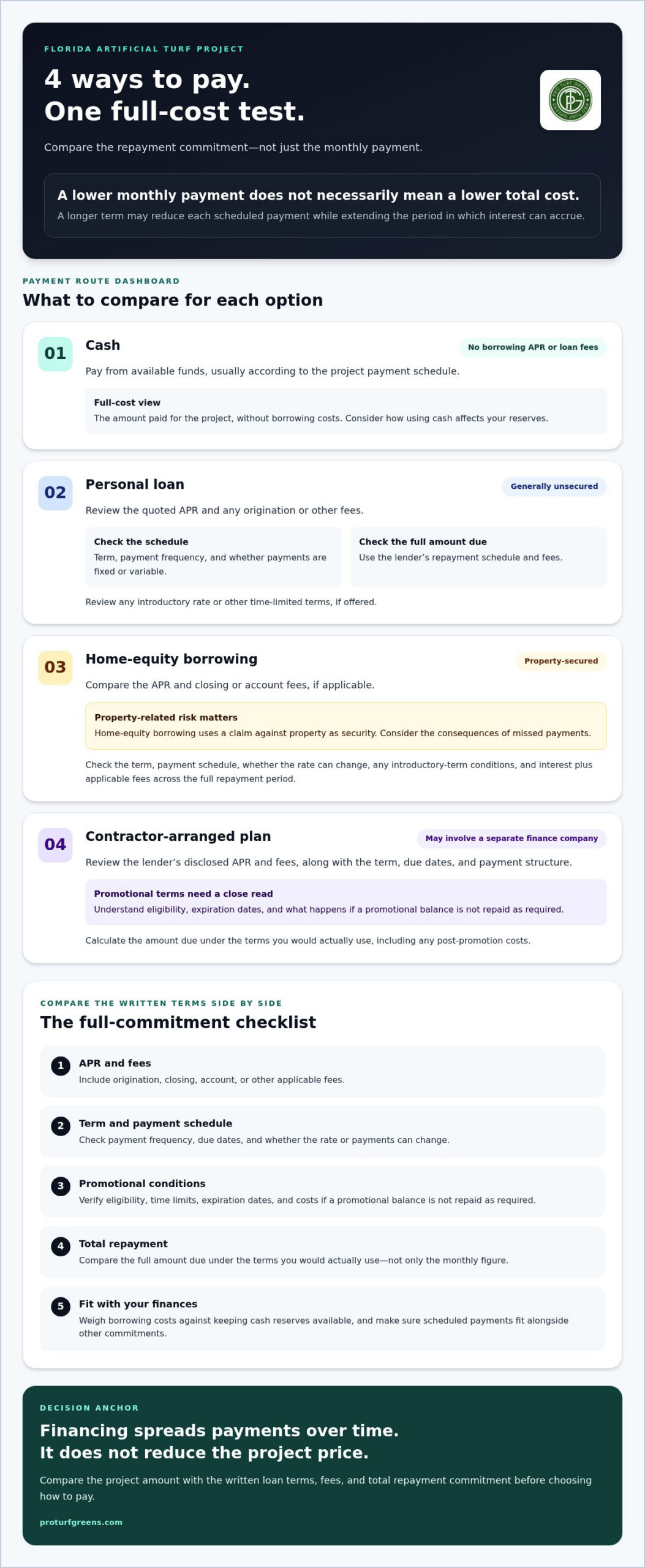
Payment routes can look similar when shown as a monthly figure, but their costs and obligations may differ. Compare the written terms side by side to see which artificial turf financing options florida homeowners are considering fit their circumstances. The table is a comparison framework, not a quote: lender rates, fees, approval criteria, and available plans vary.
| Option | APR and fees | Term and payment schedule | Promotional conditions | Total repayment |
|---|---|---|---|---|
| Cash | No borrowing APR or loan fees. | Paid from available funds, usually according to the project payment schedule. | Not applicable. | The amount paid for the project, without borrowing costs. Consider how using cash affects your reserves. |
| Personal loan | Review the quoted APR and any origination or other fees. | Check the repayment term, payment frequency, and whether payments are fixed or variable. | Review any introductory rate or other time-limited terms, if offered. | Use the lender’s repayment schedule and fees to establish the full amount due. |
| Home-equity borrowing | Compare the APR and closing or account fees, if applicable. | Check the term, payment schedule, and whether the rate can change. | Read conditions attached to introductory terms, if any. | Include interest and applicable fees across the full repayment period. |
| Contractor-arranged plan | Review the lender’s disclosed APR and fees; an arranged plan may involve a separate finance company. | Check the term, due dates, and payment structure. | Understand eligibility, expiration dates, and what happens if a promotional balance isn’t repaid as required. | Calculate the amount due under the terms you would actually use, including any post-promotion costs. |
The lowest monthly payment may not mean the lowest total cost. A longer term can lower each scheduled payment while extending the period in which interest may accrue. Compare APR, fees, payment schedule, and total repayment together instead of choosing by the monthly amount alone.
How do personal loans and home-equity options differ?
A personal loan is generally unsecured, meaning it isn’t backed by your home. Home-equity borrowing uses a claim against property as security. Rates, fees, terms, and qualification depend on the lender’s review and the specific product. Because home-secured borrowing involves property-related risk, consider the consequences of missed payments and read the contract carefully.
What should Florida residents know about property-linked programs?
Property-linked financing is generally repaid through an obligation associated with a property, rather than only through a standard installment loan. Program participation, eligible improvements, property requirements, and local rules can vary. Don’t assume artificial turf qualifies for a Florida or local program. Review current requirements and turf eligibility in the program’s official materials before counting on a benefit.
Once you have a defined project scope, a free consultation with Pro Turf Greens’ South Florida turf design team can help clarify the installation plan you’ll budget around. Financing terms and approval are separate from the design and installation process.
Financing vs. Paying Cash: How to Judge the Full Commitment
Paying cash avoids borrowing costs, but uses funds that might otherwise remain available for emergencies or planned expenses. Financing can preserve more cash upfront, yet adds repayment obligations and may increase the total paid. Make the comparison by considering both the cost of borrowing and the practical value of keeping reserves available for your household or business.
Spreading payments can increase total repayment and extend your financial exposure. A lower scheduled payment may come with a longer term, leaving you responsible for the debt for more time. Compare that commitment with paying from available funds and consider how either choice fits your broader financial priorities.
| Payment approach | Potential advantage | Trade-off to consider |
|---|---|---|
| Cash payment | Avoids loan interest and borrowing fees. | Uses funds that could serve as household or business reserves. |
| Short repayment | Can limit how long the balance remains outstanding. | Scheduled payments may be higher and put more pressure on near-term cash flow. |
| Longer repayment | Can spread payments across a longer period. | May increase total interest and keep the repayment obligation in place longer. |
How can you compare total repayment with a monthly payment?
Use the lender’s written disclosures and enter the same inputs for each offer. Don’t rely on a headline payment alone: it may not include all fees or explain what happens after a promotion ends.
- Amount financed: [enter the amount borrowed]
- APR: [enter the disclosed annual percentage rate]
- Fees: [enter fees, noting which are paid upfront and which are included]
- Repayment term: [enter the number of payments or repayment period]
- Scheduled payment: [enter the required payment and frequency]
Comparison template: [scheduled payment] × [number of scheduled payments] + [fees not included in payments] + [required upfront payment] = [estimated total outlay]. This is a comparison aid, not a lender payoff quote. For a promotional offer, record the deadline, required payment conditions, and post-promotion rate or terms. Compare written disclosures so your estimate reflects the actual offer.
Should expected lawn savings influence the decision?
Potential changes in water, maintenance, or replacement expenses depend on the existing landscape, current bills, and future upkeep. Treat them as estimates, not guaranteed offsets to loan payments. Use actual household expenses where possible, and keep uncertain resale or property-value claims separate from costs you can measure. Don’t treat projected benefits as a return or rely on them to make borrowing affordable.
When assessing artificial turf financing options florida, connect the payment decision to a defined project scope and a budget you can sustain without assuming future savings will cover the debt.
How to Prepare for Artificial Turf Financing in Florida
A well-organized project plan helps you match the work to a realistic budget before reviewing loan offers. When weighing artificial turf financing options florida residents may consider, keep two decisions distinct: what the property needs and what a lender may approve. Design and installation planning can clarify the project scope, but it doesn’t determine financing eligibility.
- Define the project. Note whether the turf is for a lawn, pet area, putting green, playground, or another use.
- Scope the site. Record the approximate area and features that may affect design or preparation.
- Review your budget. Set a payment range that works alongside your other household or business commitments.
- Compare terms. Review complete written offers, including APR, fees, payment schedule, and repayment term.
- Decide deliberately. Choose whether to proceed, adjust the project scope, or revisit payment options based on the full commitment.
What project details should you organize first?
Before discussing the design, gather details about the intended use, approximate area, site access, existing surface, and preferred installation timing. Note visible slopes, areas where water collects, existing landscaping, and other site features that could inform preparation or layout. These details help describe the project clearly without assuming what preparation will involve or assigning it a cost.
Property conditions and intended use matter in South Florida because the design should respond to the specific site, not just its square footage. A Miami project-planning example can help you prepare for a local discussion in the Miami artificial turf consultation guide.
How should you review an application and its terms?
Lenders may request information such as identification, income or employment details, housing obligations, property information, and a project estimate. These are examples only; requirements differ by lender and financing product. Before submitting an application, review what information is requested and whether the lender says a credit inquiry is soft or hard, including its stated effect on your credit.
Compare the final written offer with the terms presented earlier. Check the APR, fees, repayment term, scheduled payment, and any promotional deadline or conditions. If an offer references a Florida or local property-linked program, use current official program materials to verify local availability, property requirements, and whether artificial turf is an eligible improvement. Don’t base the budget on an assumed rebate or financing benefit.
Project planning clarifies the work; only the lender determines whether financing is approved. Keeping that distinction clear helps you prepare a sound project brief without treating an estimate as a loan commitment.
To discuss your intended turf use and design as you organize the project, request a free consultation with Pro Turf Greens.
Plan Your South Florida Turf Project Before Choosing How to Pay
A financing comparison is useful only when it reflects the project you actually want. The intended use, design, area, and preparation needs shape the scope to budget around, whether you’re planning a residential lawn, pet area, or larger recreational surface. Before comparing artificial turf financing options florida homeowners may consider, clarify the installation plan, then assess payment choices against that scope.
South Florida properties vary, so the same turf application can call for different design considerations from one site to another. Existing surfaces, access, layout, and areas where water collects can inform the preparation plan. A tailored scope helps prevent a mismatch between the work you have in mind and the amount you expect to fund.
Match the turf design to the property and intended use
A lawn, pet area, putting green, and playground each serve a different purpose. Commercial athletic or recreational applications have their own layout needs. Use and site conditions guide choices about surface design and preparation. A turf driveway is another specialized application, and these custom turf driveway design examples illustrate how the design can relate to a home’s overall layout.
Before settling on a budget, note the area you want to transform, how the space will be used, and any site details that could shape the installation. Pro Turf Greens designs and professionally installs artificial turf for residential and commercial projects across South Florida. The team develops and installs a turf plan; the lender makes the financing decision.
Take the next step with a project consultation
A consultation gives you an opportunity to discuss your goals, property location, intended surface, and design priorities. Pro Turf Greens offers free consultations by phone or through its website. Bring a rough area estimate and notes about site access or existing conditions to focus the conversation on the scope you’ll use for budgeting.
After clarifying the design and preparation plan, compare your project budget with the full repayment terms of any financing offer. Keep the installation plan and lender decision separate: a consultation can help define the work, while only the lender determines approval and borrowing terms.
Ready to develop a clearer scope for your South Florida property? Request a free turf consultation to discuss your project goals and intended surface.
Make Your Next Step a Clear One
A well-planned turf project gives you a stronger basis for deciding how to pay. Before committing, make sure the scope reflects how you want to use the space and that any repayment fits your budget without relying on uncertain future savings. This groundwork helps you consider the property improvement and payment decision together, without treating them as the same choice.
As you weigh artificial turf financing options florida homeowners may consider, focus on the project you want and the full commitment you’re comfortable taking on. Pro Turf Greens can shape the design and installation plan for your South Florida property, while financing approval and terms remain a separate decision with the lender.
Take a practical next step: start planning your South Florida turf project. Pro Turf Greens offers a free consultation by phone or through its website to discuss your goals and the surface you have in mind. A defined scope and a payment approach that suits your circumstances can help you move forward with confidence.
Frequently Asked Questions
What financing options are available for artificial turf in Florida?
Common ways to fund a project include paying cash, using a personal loan, borrowing against home equity, or using a contractor-arranged plan through a financing company. Each has different approval requirements and repayment terms. For South Florida projects in Miami, Fort Lauderdale, Palm Beach, Boca Raton, Delray Beach, Jupiter, Palm Beach Gardens, Weston, or Coral Gables, don’t assume a local incentive applies to artificial turf without checking current eligibility.
Can I finance artificial turf installation with a personal loan?
Yes, a personal loan may be used for installation if the lender approves the application and its terms allow that purpose. These loans are commonly unsecured, so they aren’t backed by your home, but approval and terms depend on the lender’s review. Before applying, consider whether the funds will be available when project payments are due and whether the required payment fits your budget.
Is artificial turf eligible for Florida PACE financing?
Don’t assume artificial turf is eligible for PACE financing. PACE programs generally fund improvements included in a program’s eligible categories, with repayment connected to the property. Available programs, property requirements, and qualifying work can differ by location and change over time. Review current official program documents for your area and confirm whether the specific turf work qualifies before relying on PACE as a funding source.
How do I compare artificial turf financing offers?
Compare offers using the same project amount, then review the APR, fees, repayment length, scheduled payment, and total amount due. Check whether the rate or payment can change, whether there are charges for late or early repayment, and what happens when promotional terms end. Use the lender’s written disclosures rather than an advertised monthly payment, which may not show the full cost or conditions.
Does a soft credit check affect my credit score?
A soft credit inquiry generally doesn’t affect your credit score, while a hard inquiry may affect it. The lender’s process determines which type is used, and a soft inquiry during an initial review doesn’t necessarily mean later application steps will also be soft. Read the application’s credit-check notice before submitting information, and check whether a hard inquiry may occur and at what stage.
Is it better to finance artificial turf or pay cash?
Neither approach is best for everyone. Paying cash avoids loan interest but uses available funds; financing can leave more cash on hand while adding payments and potentially increasing what you pay overall. Consider upcoming expenses and how much reserve you want to retain, then test whether the scheduled payment remains manageable if other household or business costs rise. Don’t rely on projected savings or resale value to make payments affordable.
Can financing cover artificial turf site preparation and installation?
It may, if the financing agreement permits those project components and the lender approves the amount. Coverage can depend on how the plan defines eligible work and how the project estimate describes preparation, materials, and installation. Before accepting an offer, compare the approved amount with the complete project scope and check how changes to the work are handled. Don’t assume every preparation item is included automatically.