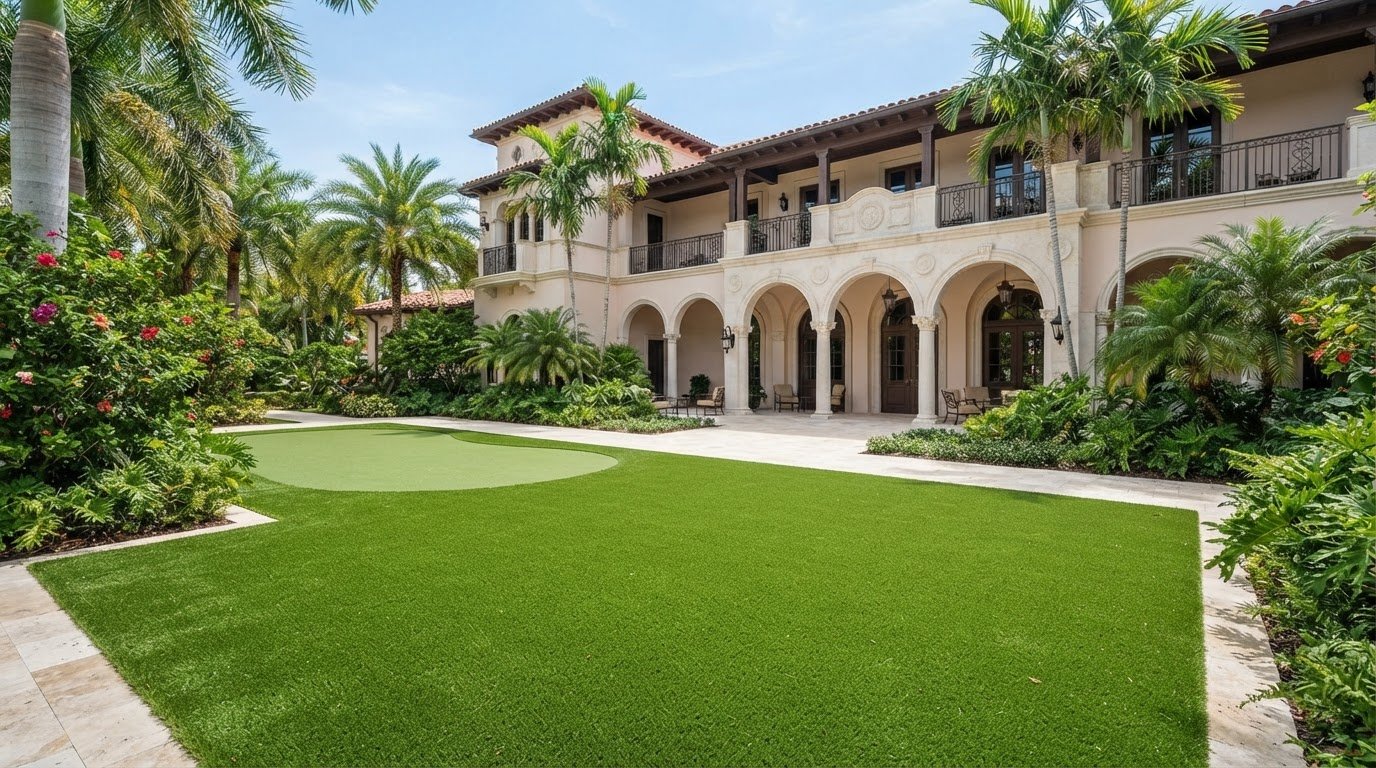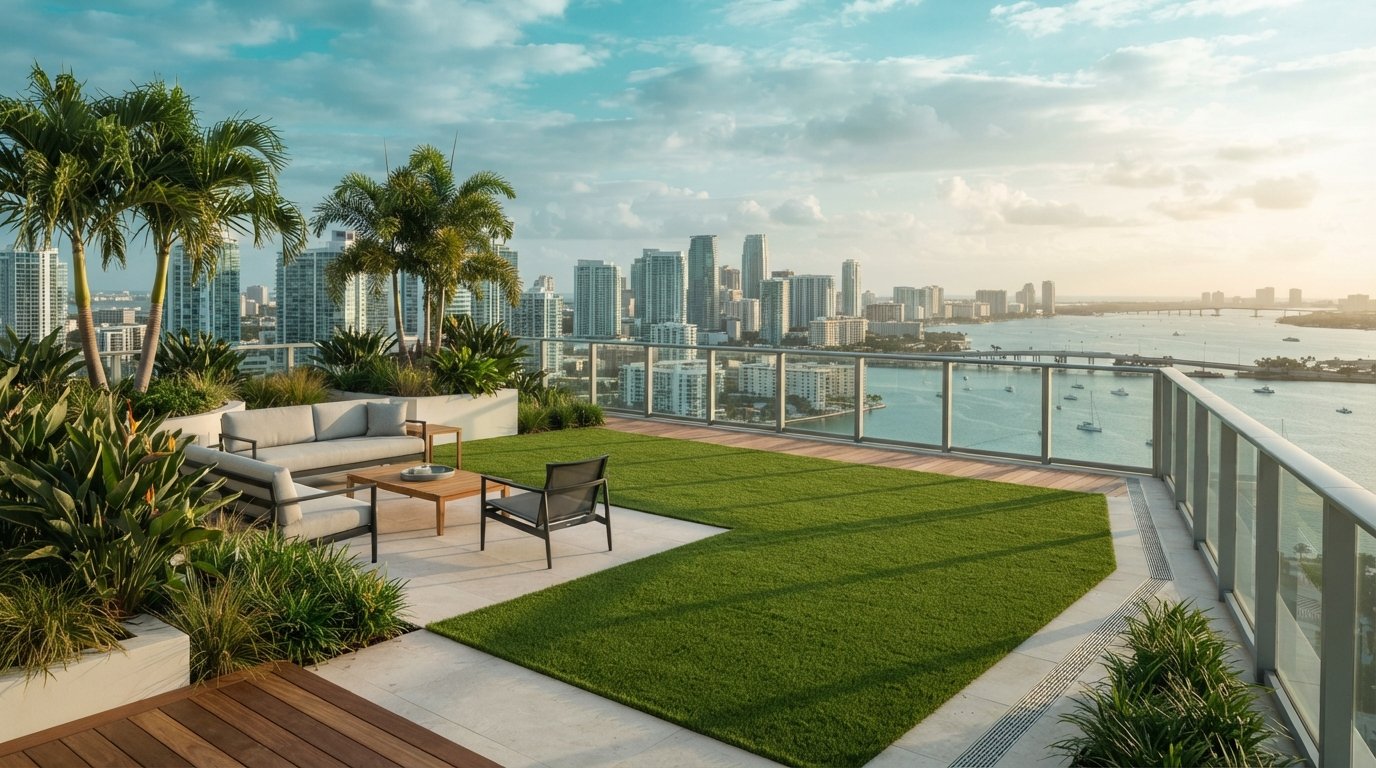
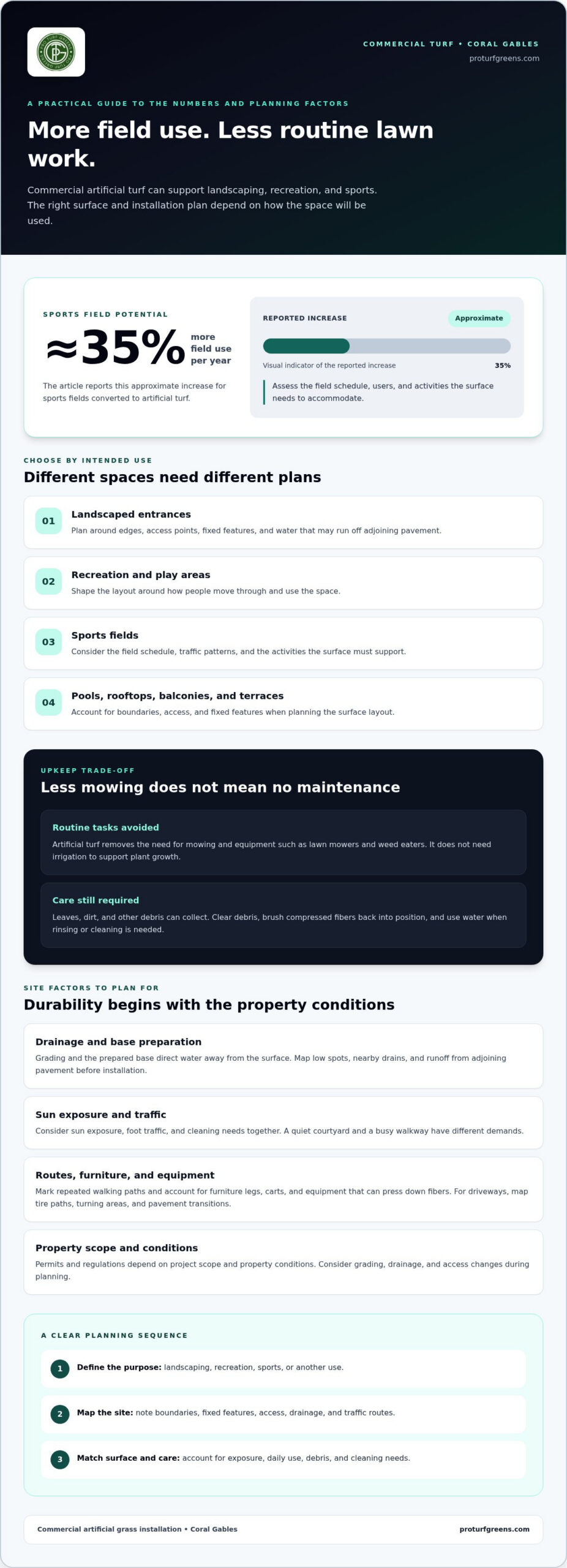
A consistently presentable landscape doesn’t have to depend on regular mowing. Commercial artificial grass installation in Coral Gables can give businesses a durable, low-maintenance surface for outdoor spaces, while avoiding the need for lawn-cutting services and equipment. For sports fields, converting to artificial turf can increase field use by approximately 35% per year.
That practical appeal matters when a business wants well-kept grounds without routine mowing. The result still depends on matching the turf and installation plan to the space, whether it is a landscaped entrance or a recreational area.
This guide explains the benefits of commercial artificial grass installation in Coral Gables, what affects durability and upkeep, how UV exposure relates to color retention, and what installation involves. It also covers project planning and how a consultation can turn site needs into a tailored plan.
Key Takeaways
- Compare artificial turf options by how each commercial space will be used, from landscaping to recreation.
- Weigh reduced mowing and equipment needs against the upkeep required to keep turf clean and presentable.
- Consider site conditions, surface use, and installation preparation when planning a commercial turf project.
- Account for sun exposure and UV stabilization when evaluating how well turf can retain its color.
- Use a project consultation to discuss site needs and explore suitable options, including putting greens and recreational turf.
What are the benefits of synthetic artificial grass in Coral Gables?
Synthetic grass gives Coral Gables properties a consistent surface without relying on living grass. Businesses can use artificial turf for landscaping, recreation, or sports, while homeowners can create a usable lawn without regular mowing. The right application depends on the space, who will use it, and what activities it needs to support.
Commercial and residential turf installations serve different purposes. A business might use artificial turf in landscaping, a playground, or a sports field, while a homeowner may want a lawn for relaxing or play. Turf is also being installed around swimming pools, on rooftops, balconies, and terraces. Each setting calls for a layout that suits its boundaries, access points, and intended use. For example, a terrace needs a surface planned around its edges and fixed features, while a play area should be designed for how people move through it.
Reduced routine lawn care is another practical benefit. Artificial turf removes the need for mowing and equipment such as lawn mowers and weed eaters. That can simplify upkeep for businesses and households alike. Synthetic turf still needs attention: leaves, dirt, and other debris can collect, especially in busy areas. Plan for basic cleaning to keep the surface presentable.
Residential artificial turf creates a defined outdoor area without natural grass. It can suit a small backyard or a shared space where a consistent appearance matters, including narrow areas that are difficult to mow. Before installation, identify the space’s main purpose, note fixed features, and consider how people will enter and use it. These details shape the design.
For commercial properties, the value can extend beyond appearance. Sports fields converted to artificial turf can increase field use by approximately 35% per year. A business considering that option should assess its schedule, users, and the activities the surface must accommodate. A landscaped entrance has different needs from a recreation space, so the intended use should guide product selection and site preparation.
Coral Gables permits and regulations for artificial turf depend on the project scope and property conditions. Planning should account for any changes to grading, drainage, or access, since these affect site preparation and how the area will be used.
Commercial artificial grass installation reviews and references in Coral Gables are most useful when they show comparable work. Look for examples of commercial landscapes, recreation areas, or sports surfaces, and assess the finished appearance alongside the project’s intended use. References can also help clarify how communication and installation planning worked on a similar project.
To assess a potential installation, first match the surface to its purpose. Then consider the site layout, upkeep, and how people will use the area. This helps distinguish a residential lawn from a commercial landscape or active recreation space and clarify project priorities.
Artificial grass durability and maintenance
In Florida, durability depends on turf materials, site preparation, drainage, and daily use. For commercial artificial grass installation in Coral Gables, consider how sun exposure, foot traffic, and cleaning needs interact at the property.
Drainage and Lawn Care
Drainage begins below the turf: grading and the prepared base direct water away from the surface. Before installation, map low spots, nearby drains, and runoff from adjoining pavement. A paved entrance, for example, may channel water toward a turf border, so the layout should account for that flow.
After installation, clear leaves and loose debris before they build up near drainage paths. A landscaped area may collect mostly leaves, while an entrance can gather dirt from foot traffic. Brush compressed fibers back into position and follow the turf’s care guidance for spills or embedded debris.
Water and Maintenance Savings
Synthetic grass does not need irrigation to support plant growth, which can reduce routine watering compared with living grass. Water may still be useful for rinsing dirt or cleaning a frequently used area. Needs depend on site conditions, nearby planting, and how the surface is used.
Turf removes the need for mowing and purchases such as mowers and weed eaters. Weigh those avoided tasks against ongoing care, including debris removal and brushing. On a Florida property with separate lawn zones, identify which areas would benefit most from less routine mowing.
Traffic patterns affect wear. A quiet courtyard has different demands from a busy walkway where people repeatedly follow the same route. Mark those paths during planning and consider how the layout can distribute use. Furniture legs, carts, and equipment can also press down fibers, so account for their placement and movement.
Driveways need careful planning for vehicle movement. For commercial artificial grass installation in Coral Gables, map tire paths, turning areas, and transitions to adjoining pavement. Repeated vehicle use creates different demands from pedestrian traffic, so those routes should guide surface selection and site preparation.
Routine inspections help identify maintenance needs early. After heavy use or a storm, check edges, seams, drainage paths, and areas where debris has collected. Clear the surface and note any changes in water flow. These observations help focus routine care on actual site conditions.
Set a simple maintenance plan for each turf zone. A covered entry may need less frequent debris removal than an exposed courtyard, while a busy walkway may need more brushing. Match the routine to exposure and use, then review it as the property’s needs change.
Commercial artificial grass installation
A commercial installation generally proceeds from site assessment to surface preparation, turf placement, seam finishing, and final inspection. The schedule depends on the area, ground conditions, access, drainage work, and layout complexity.
Installation Process
Start by mapping the work area and identifying entrances, borders, drains, fixed structures, and busy routes. This site plan helps determine where edges and seams should fall and how the finished surface will meet nearby paving. At a business entrance, mark pedestrian routes separately from service access so the layout accounts for each use.
Prepare the surface before laying turf. Remove unsuitable material, establish a stable base, and shape the site to support drainage. Then place and align the turf, secure its edges, and finish the seams. During the final walkthrough, check joins, transitions, surface consistency, and drainage paths before reopening the area.
Project Timeline
Plan the schedule around the work sequence rather than assuming a fixed duration. Preparation may take longer if the ground needs substantial correction, access is restricted, or the project has several separate zones. An open area generally has fewer layout transitions than a site with pathways, structures, and detailed borders.
Business operations also affect scheduling. Identify delivery access, busy periods, and areas that must remain open. A phased plan can separate a main entrance from a secondary landscape zone, coordinating the work with daily activity. Discussing these priorities during planning helps make the schedule fit the site.
Before work begins, prepare a site brief with a marked layout, intended use, and access notes. Include details such as delivery vehicles turning near a driveway or guests crossing a landscaped entrance. This clarifies where turf must meet concrete, paving, or existing planting, and where edges need careful finishing.
Let the intended traffic pattern guide the surface plan. A public courtyard may need clear routes between seating and doors, while a commercial landscape may call for defined borders around planting. Mapping routes helps avoid awkward cuts and makes the finished installation fit the property.
Quality checks should follow the installation sequence. Inspect the prepared base before placing turf, then review alignment and seams as work progresses. At completion, walk the area and look for lifted edges, visible joins, uneven transitions, or water collecting in low spots. Addressing these details before reopening supports a clean, functional finish.
Vehicle access needs a distinct layout discussion. For a turf driveway, map turning paths and tire routes before installation, then plan transitions where turf meets adjoining pavement. This illustrates why site use must guide preparation and finishing rather than treating every commercial area as a simple rectangle.
For a commercial project, a clearly marked site plan and a sequence of preparation, placement, and inspection provide a practical framework for coordinating installation with property operations.
Customer service and project consultations
A useful consultation turns business goals into clear site priorities. Bring a property plan or marked photos showing entrances, walkways, drainage points, and areas that need to stay accessible. A Coral Gables storefront, for example, may need a clear route from parking to the entrance, while a courtyard may prioritize seating and defined borders.
Describe how the space will be used during a typical day. Note whether visitors, staff, deliveries, or equipment will cross it, and identify busy periods that affect access. This helps shape a practical layout and highlights site conditions to address before installation. A clear initial discussion can sharpen decisions about edges, transitions, and work zones.
Commercial artificial turf warranty and installation guarantees in Coral Gables are defined by the written terms for the specific project. Review what the warranty covers, what conditions or exclusions apply, how to report an issue, and whether coverage differs for materials and installation work.
During consultation, ask for a project scope that describes the work plainly. It should identify the installation area, surface preparation, drainage considerations, turf placement, edge finishing, and final inspection. A storefront project, for instance, may need clear notes on how the new surface meets existing paving while keeping the entrance usable.
Customer service also shows in how project information is shared. A useful plan identifies the next decision, who is responsible, and how changes will be documented. If a site walk reveals an unexpected low area or narrow access route, record the observation and its effect on preparation before work proceeds.
- Bring: a site plan, photos, and notes about entrances, access, and daily use.
- Discuss: drainage, surface transitions, work zones, and operational priorities.
- Review: written scope, warranty terms, exclusions, and issue-reporting steps.
References and project examples can show how an installation fits a property’s use. Compare each example with your own setting: a landscaped commercial entrance has different priorities from a vehicle-access area. Focus on visible details such as borders, joins, and transitions, then explain which matter most for your project.
A good consultation makes project priorities clear, without burying them in technical language. Before approving the scope, summarize the intended use, site constraints, and desired finish in your own words. This can uncover mismatched expectations early and give everyone a shared reference for planning the work.
UV stabilization and color retention
Coral Gables receives strong sunlight, so UV exposure matters when planning artificial turf. Ultraviolet radiation can affect synthetic materials over time, making UV stabilization relevant to appearance and service life. Color retention depends on the material, its exposure, and how the surface is used and maintained.
UV stabilizers are incorporated into turf materials to help limit sunlight-related degradation. They do not prevent all fading, and performance varies with product construction and exposure. Turf in an open courtyard, for example, may receive direct sun for much of the day, while an area beside a building may be shaded. Map sun and shade across the site before choosing materials.
Color consistency also depends on installation layout. Turf sections need careful orientation and joining, since differences in pile direction can make adjoining areas appear to be different shades. During planning, identify prominent views from entrances, windows, and walkways. A visitor approaching a Coral Gables storefront may notice a seam differently from someone viewing the same area indoors.
Review product information for details about UV stabilization and color performance. Compare products using the same criteria, such as stated resistance to sunlight and care instructions. Do not treat a color sample as a promise of how the entire installation will look over time. A sample helps assess the initial shade, but the finished appearance also depends on light, pile direction, and layout.
Routine care supports an even appearance. Remove leaves and loose debris before they obscure the fibers, then brush compressed areas so the pile stands consistently. Clean dirt from visible sections according to the turf’s care guidance. These steps address cleanliness and fiber presentation, while UV stabilization concerns the material’s response to sunlight.
For a large commercial area, divide the site into zones by sun exposure and use. Compare an uncovered entrance with a shaded courtyard, then note where people repeatedly walk or place furniture. This review helps separate color priorities from traffic and maintenance needs, making the design discussion more specific than choosing turf by color alone.
Before approving a project, review seams, viewing angles, and exposure conditions together. A polished finish depends on coordinating these details, not simply choosing a shade that looks right on its own. Keep care guidance with the project records so staff can follow consistent cleaning and brushing practices after installation.
For a Coral Gables site, use the exposure map and turf specifications to guide material decisions. Discuss your artificial turf project with a specialist to connect those considerations with the planned space.
Pro Turf Greens: Backyard Putting Greens
Pro Turf Greens designs and installs backyard putting greens for the way the space will be used. A putting area suits golfers who want a dedicated place to practice at home, while a commercial property may be better served by recreational turf or a tee line suited to its activity. The right choice depends on the space and its users.
Pro Turf Greens also installs playground and recreational turf, tee lines and driving ranges, and lawns and pet turf. Discussing the site’s purpose, layout, and priorities helps shape a project plan for the property rather than forcing one surface into every setting.
Contact Pro Turf Greens to discuss your commercial turf project and request a free consultation.
Shape Your Next Outdoor Project
Planning commercial artificial grass installation in Coral Gables is an opportunity to shape how a property welcomes visitors and supports daily use. Before moving forward, identify the experience you want the finished space to create. Whether the goal is a place to gather, practice, or play, a clear purpose gives the design conversation a useful starting point.
Pro Turf Greens offers Backyard Putting Greens, Playgrounds & Recreational Turf, and Tee Lines & Driving Ranges. Each serves a different activity, so consider who will use the space and what they need from it. Sharing those priorities can guide a project discussion toward a suitable option for your property.
Bring your ideas, site priorities, and questions together as you plan the next step. Contact Pro Turf Greens to discuss your project and explore an approach that fits your space. With a thoughtful plan, your outdoor area can become a more inviting and purposeful part of the property.
Frequently Asked Questions
Who installs commercial artificial grass in Coral Gables, FL?
Pro Turf Greens designs and installs artificial turf for commercial venues in Coral Gables and across South Florida. Options include athletic and sports turf, playground and recreational turf, and tee lines and driving ranges. Since each suits different activities, identify how the property will be used before discussing the project. Pro Turf Greens also serves Fort Lauderdale, Miami, Palm Beach, Boca Raton, Delray Beach, Jupiter, Palm Beach Gardens, and Weston.
What drainage does commercial artificial turf need for South Florida rain?
Drainage planning should account for site grading, the prepared base, nearby drains, and runoff from adjoining pavement or roofs. A turf area beside a parking lot, for example, may receive runoff from the paved edge, while a courtyard may collect water at a low point. Mapping these flows helps determine the layout and where water needs a clear path away from the surface.
Which artificial grass works best for commercial landscaping in Coral Gables heat and UV?
Choose turf to suit the area’s sunlight exposure and use. For a landscaped entrance, consider UV stabilization and how the surface will appear from nearby windows and walkways. A sports or recreation area has different demands. Compare product information on sunlight resistance and care, then match the surface to the site’s exposure, activity, and desired appearance.
How does artificial grass compare with natural grass for commercial landscaping costs?
Artificial turf requires an upfront installation, while natural grass needs recurring care such as mowing and watering. Turf removes the need for mowing and equipment like mowers and weed eaters, but cleaning and surface upkeep remain. Project costs depend on factors such as site preparation, drainage, area, and turf selection. Compare those factors with the property’s ongoing maintenance needs.