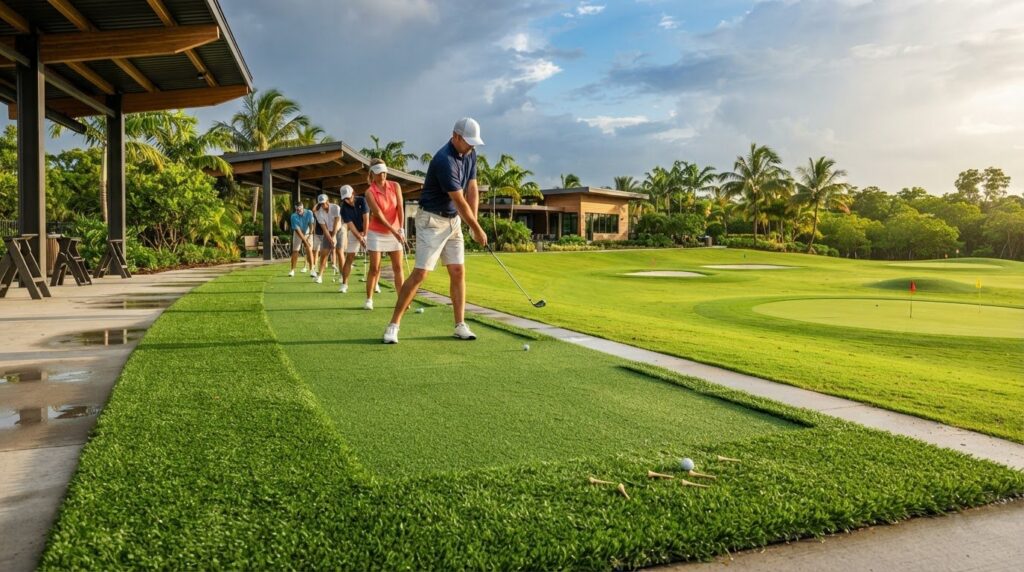
A commercial tee line absorbs more brutal punishment in a single weekend than a typical lawn faces across an entire decade. Selecting the right synthetic turf for driving ranges isn’t just an aesthetic upgrade; it’s the operational backbone of a profitable practice facility. You already know the costly headache of constantly rotating churned-up grass, waiting weeks for sod recovery, and listening to golfers complain about rock-hard hitting mats that jar their wrists and elbows on every strike.
Keeping your bays open and profitable shouldn’t feel like a constant battle against high foot traffic and severe weather. In this 2026 commercial guide, you’ll discover how engineered nylon fibers, free-draining sub-bases, and specialized shock-pad systems deliver authentic divot feedback while holding standard wooden tees. We’ll explore the critical material specifications, drainage standards, and layout configurations required to eliminate weather-related downtime and build a resilient facility built for continuous, 365-day operation.
Key Takeaways
- Explore how commercial-grade synthetic turf for driving ranges eliminates turf recovery downtime, maintaining consistent player capacity throughout peak seasons.
- Discover how dense nylon fiber profiles and heavy face weights replicate natural fairway resistance while securely holding standard wooden tees.
- Learn why engineered target greens and landing zones improve player engagement by offering realistic ball check, rollout, and high visual definition.
- Compare continuous tee lines and modular hitting bays to balance seamless luxury aesthetics with practical, localized maintenance needs.
- Understand the critical role of laser grading and free-draining aggregate sub-bases in withstanding South Florida’s torrential rains and sub-tropical UV exposure.
Why High-Volume Driving Ranges Are Transitioning to Engineered Synthetic Turf
Operating a profitable commercial practice facility requires balancing continuous golfer capacity with demanding ground maintenance. While traditional grass practice facilities once defined the standard, modern high-density surface of synthetic fibers provides an engineered solution that withstands the extreme impact of commercial practice. Transitioning to professional-grade synthetic turf for driving ranges allows facilities to break free from costly maintenance cycles and maintain consistent bay availability throughout the year.
The Operational Bottlenecks of Natural Turf Range Maintenance
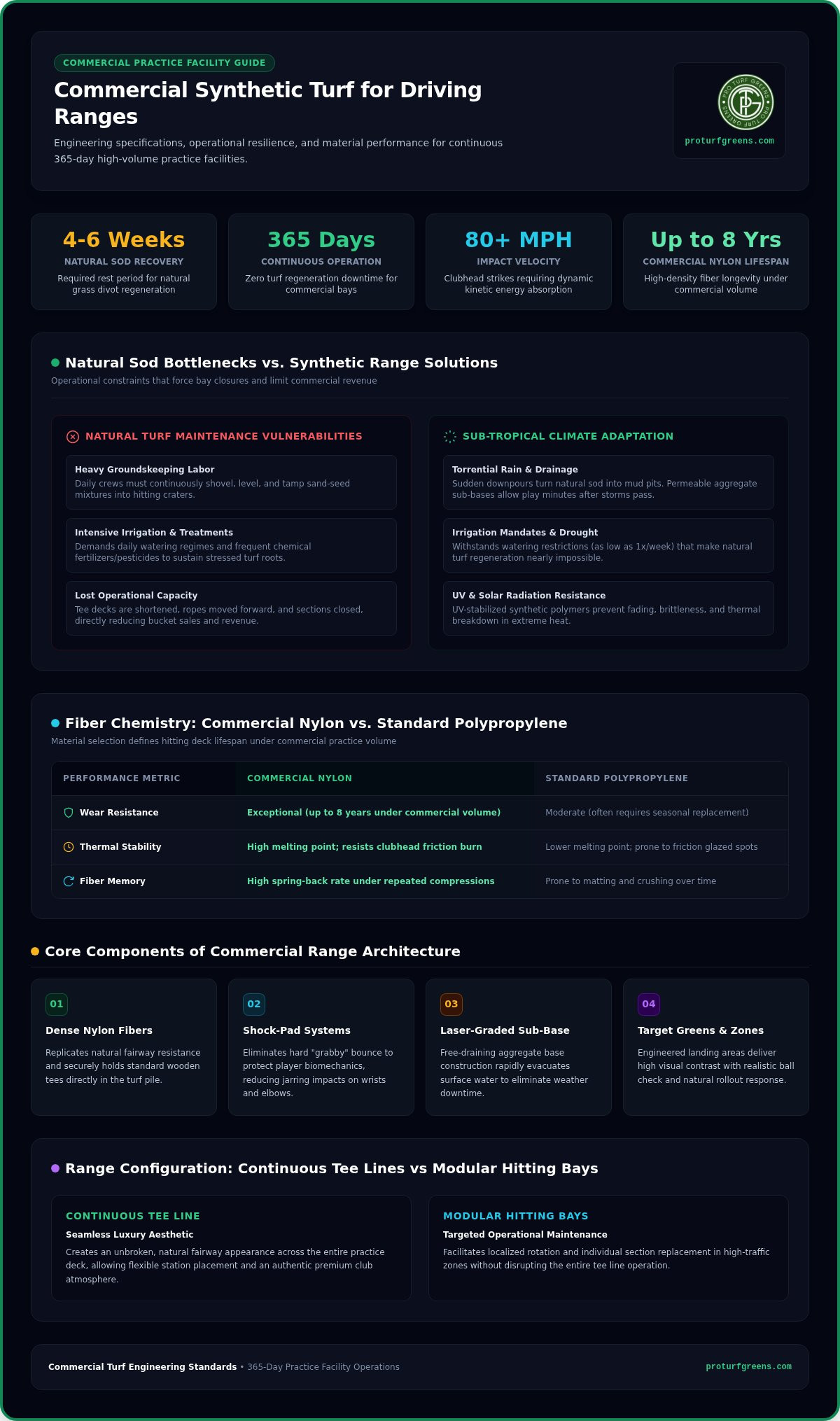
High-volume commercial ranges can see thousands of iron strikes in a single afternoon. On natural sod, this intense foot and club traffic creates concentrated divot patterns that require four to six weeks of rotational rest to regenerate. Facilities are forced to shorten tee decks, push ropes forward, or shut down entire sections. Every closed hitting station translates directly into lost bucket sales, reduced food and beverage revenue, and frustrated patrons waiting in long lines.
Beyond lost operational capacity, natural tees require dedicated groundskeeping labor:
- Constant divot filling: Daily crews must shovel, level, and tamp sand-seed mixtures into craters.
- Irrigation schedules: Intensive daily watering regimes are needed to sprout fragile seedlings before golfers chew them up again.
- Chemical treatments: Frequent applications of costly fertilizers and pesticides are required to sustain stressed turf roots.
Adapting Golf Practice Facilities to South Florida Environmental Demands
In South Florida, climate conditions intensify these agronomic challenges. Sudden sub-tropical downpours can dump inches of rain within an hour, transforming natural grass tee decks into unplayable mud pits. Traditional sod cannot drain fast enough to prevent gouging, forcing managers to close ranges right when afternoon demand peaks. Conversely, during prolonged dry spells, the South Florida Water Management District enforces strict irrigation restrictions. Golf facilities often face mandates limiting driving range and fairway watering to as little as once per week, making natural turf regeneration nearly impossible under heavy play.
Installing commercial synthetic turf for driving ranges solves both environmental extremes. Advanced synthetic systems use UV-stabilized fibers that resist extreme solar radiation and sub-tropical heat indices without fading or brittle breakdown. When paired with permeable base construction, engineered surfaces drain water rapidly, allowing golfers back onto the tee line minutes after a torrential storm passes.
Engineering the Elite Tee Line: Fiber Density, Pile Structure, and Feel
A driving range surface must endure immense dynamic forces without compromising playability. When an iron strikes the turf at over eighty miles per hour, the material must absorb rotational torque, disperse downward kinetic energy, and allow the clubhead to sweep cleanly through impact. Achieving this response requires an exact combination of polymer chemistry, pile weight, and shock-absorbing underlayments.
Nylon Versus Polypropylene in High-Impact Striking Zones
Material selection defines the operational lifespan of commercial practice lines. While polypropylene serves well in low-impact recreational zones, premium driving ranges depend almost exclusively on high-density nylon fibers. Nylon offers superior thermal resistance, preventing the friction melting that occurs when steel soleplates strike plastic yarns. Its natural elasticity provides reliable fiber memory, springing upright immediately after thousands of downward blows.
| Performance Metric | Commercial Nylon | Standard Polypropylene |
|---|---|---|
| Wear Resistance | Exceptional (up to 8 years under commercial volume) | Moderate (often requires seasonal replacement) |
| Thermal Stability | High melting point; resists clubhead friction burn | Lower melting point; prone to friction glazed spots |
| Fiber Memory | High spring-back rate under repeated compressions | Prone to matting and crushing over time |
Eliminating ‘Grabby’ Turf Bounce to Protect Golfer Biomechanics
Traditional driving range mats relied on thin turf glued over hard rubber slabs. When a golfer hits slightly behind the ball on these rigid systems, the clubhead bounces aggressively off the base into the ball. This artificial bounce hides fat shots and sends violent vibration shocks up the shaft, leading to chronic wrist tendonitis and golfer’s elbow. Modern synthetic turf for driving ranges solves this through heavy pile weights and integrated closed-cell foam shock pads. The vertical pile allows the club leading edge to enter the fibers naturally, creating realistic clubhead deceleration and authentic divot feedback without punishing player joints.
True Tee Acceptance Without Fixed Rubber Holders
Standard rubber tee holders force golfers into unnatural tee heights and create awkward obstacles across the bay. Advanced dense-tufted nylon surfaces allow golfers to place a regular wooden tee anywhere across the hitting surface, pressing it down to their exact preferred height. This flexibility builds swing confidence for competitive players and simplifies maintenance by removing loose rubber accessories. Facilities exploring bespoke configurations can consult Pro Turf Greens to evaluate custom fiber densities and shock systems built for commercial demands.
Target Greens and Landing Zones: Visual Contrast and Realistic Ball Reaction
A driving range outfield should function as an engaging practice arena rather than an empty patch of scrub grass. Modern golf facilities are moving away from flat, nondescript landing fields in favor of dynamic synthetic layouts. Utilizing specialized synthetic turf for driving ranges across targets and surrounds transforms the player experience, turning routine target practice into a visual, measurable simulation of real on-course scenarios.
Replicating Authentic Shot Dispersion and Green Reception
Golfers quickly lose interest when well-struck wedge and iron shots bounce wildly off rock-hard targets. Precision-built synthetic target greens resolve this by pairing short-pile fibers with calibrated infill depths that mimic the surface tension of natural bentgrass or Bermuda. This construction allows high-trajectory shots to hit, bite, and release naturally rather than skittering across the outfield.
Thoughtful outfield architecture elevates player engagement through intentional design elements:
- Two-tone color delineation: Crisp chromatic contrast between emerald green target complexes and olive fairway zones clarifies yardage targets from over two hundred yards away.
- Synthetic false bunkers: White and light-sand colored turf fibers outline green complexes, establishing realistic visual hazards without the operational mess of real sand splash.
- Subtle tiering: Mild back-to-front slopes ensure incoming golf shots remain visible to the golfer on the tee deck, confirming quality ball striking immediately.
Optimizing Outfields for Mechanical Ball Picking Operations
Outfield surfaces must endure daily traffic from heavy ball retrieval equipment. Commercial picker reels can snag, rip, or scalp natural sod, especially when wet conditions create deep ruts. Transitioning landing areas to smooth-nap synthetic turf for driving ranges ensures picker discs glide effortlessly across the surface without tearing fiber backing or sinking into mud.
Maintaining long-term durability across the landing field demands specialized installation techniques. Flush transitions between target surfaces and fairway zones prevent picking reels from catching exposed edges. Stabilized base construction prevents subsurface aggregate displacement under the heavy weight of commercial utility vehicles. In regions like South Florida, where intense downpours frequently swamp earthen outfields, engineered synthetic landing zones keep automated or tractor-mounted picker routines running on schedule without leaving tracking ruts behind.
Continuous Tee Lines Versus Modular Hitting Bays: Strategic Selection
Choosing the proper configuration for your practice deck shapes both daily operations and client perception. When investing in commercial synthetic turf for driving ranges, facility managers face an important structural choice: install a continuous monolithic tee line or deploy individual modular hitting stations. Both approaches deliver major durability upgrades over natural sod, but they serve different operational models and spatial configurations.
The Premium Appeal of Unbroken Monolithic Turf Strips
Continuous tee lines stretch unbroken along the entire width of a practice deck, creating the seamless look of a pristine championship tee box. This expansive layout removes the visual clutter of segmented frames, giving the facility an upscale, cohesive atmosphere. Golfers enjoy the freedom to adjust their stance width, angle their alignment toward varied outfield targets, and position balls without feeling boxed into a narrow mat.
For facilities with active instructional programs, unbroken strips offer unmatched flexibility:
- Dynamic bay sizing: Staff can expand or contract individual hitting stations depending on daily volume.
- Group instruction: PGA teaching professionals can run clinics side-by-side without rigid structural dividers getting in the way.
- Even wear distribution: Setting daily movable bag stands allows operators to shift golfer contact zones gradually, preventing localized wear channels.
Tactical Advantages and Wear-Rotation of Modular Bays
Modular systems utilize individual framed stations, commonly built around five-foot by five-foot turf units. This compartmentalized approach excels in facilities operating over existing concrete decks, covered canopy structures, or asphalt slabs where sub-surface excavation isn’t feasible. Modular bays integrate naturally with commercial bay dividers, bag stands, and launch monitors.
The core business advantage of modular synthetic turf for driving ranges lies in its rotational efficiency. Golfers naturally strike balls from a concentrated twelve-inch area within their stance. With square modular inserts, maintenance staff can rotate each hitting mat ninety degrees quarterly. This four-way rotation distributes impact across all four quadrants of the panel, effectively quadrupling surface lifespan before a replacement panel is needed. If a single station experiences heavy usage, crews replace just that hitting strip in minutes without interrupting adjacent bays.
Selecting the optimal layout requires balancing your architectural footprint, traffic patterns, and staff routines. To design the right layout for your practice facility, partner with Pro Turf Greens to engineer a custom commercial hitting deck built to your precise operational specifications.
Designing and Installing Commercial Driving Range Turf in South Florida
The structural lifespan of any practice facility is decided underground long before the first shot is struck. In South Florida, extreme precipitation and native soil conditions quickly undermine installations that rely on generic landscaping methods. Successfully implementing synthetic turf for driving ranges demands civil-grade earthwork, precise laser grading, and specialized aggregate engineering built to withstand sub-tropical conditions.
Sub-Base Engineering for Florida’s Sandy Soil and Heavy Deluges
High water tables and loose, sandy subsoils present unique challenges for heavy commercial tee lines. Excavation crews must strip away all organic turf and root zones down to stable subsoil. Next, technicians lay non-woven geotextile stabilization fabric across the excavated bed to prevent fine native sand from migrating upward into the aggregate foundation.
A multi-layered stone foundation provides structural ballast and rapid drainage:
- Coarse drainage rock: A deep layer of angular crushed limestone creates void space to store and evacuate torrential rainfall.
- Compacted fines: Laser-guided grading equipment shapes a fine aggregate bedding layer to exact planar tolerances, eliminating low spots that harbor standing water.
- Dynamic compaction: Vibratory rollers pack the base to achieve maximum load-bearing strength, preventing base settlement caused by heavy commercial ball picker traffic.
Precision Seaming, Infill Application, and Edge Securing
Intense sun and sudden cloudbursts create drastic thermal expansion and hydraulic pressures across large turf panels. Installers bond commercial turf seams using heavy-duty, high-tensile seaming tapes coated with moisture-cured polyurethane adhesives. This chemical weld prevents delamination even during rapid temperature swings. High-purity rounded silica sand is then mechanically brushed into the pile to ballast the system, secure fiber uprightness, and protect primary backings from UV degradation. Along outer boundaries, crews lock edges into perimeter composite nailer boards or concrete curbing, ensuring wind cannot lift the turf during severe tropical weather events.
Turn-Key Execution with South Florida’s Turf Specialists
Navigating municipal commercial codes, impervious surface ratios, and civil engineering drainage requirements requires experienced local trade partners. Pro Turf Greens delivers end-to-end commercial project management across Palm Beach, Broward, and Miami-Dade counties. Our team handles everything from initial civil earthmoving and laser grading to precision carpet assembly and final clubhead feedback testing. When you’re ready to upgrade your practice decks or design high-performance landing targets, Book an on-site commercial turf consultation with our specialists to review site layouts, player volumes, and technical specifications.
Elevate Your Practice Facility to Tour-Caliber Standards
Transforming your practice grounds from a costly maintenance burden into an uninterrupted revenue center begins below the surface. High-density nylon fibers, realistic shock-pad systems, and laser-graded aggregate bases have redefined modern performance. Upgrading to commercial synthetic turf for driving ranges gives your golfers authentic divot feedback, true tee penetration, and clean landing targets while completely removing grass recovery downtime.
Pro Turf Greens specializes in bespoke athletic surfaces engineered specifically for South Florida’s punishing climate. From precision base compaction that eliminates standing water to UV-stabilized fibers that endure relentless heat, our installations ensure consistent play across Miami, Fort Lauderdale, Boca Raton, and Palm Beach. You don’t have to let weather delays or worn sod dictate your operational capacity. Ready to transform your practice deck? Request a Commercial Driving Range Turf Consultation today, and let’s build an elite golf facility built for year-round success.
Frequently Asked Questions
Can golfers hit off real wooden tees using synthetic driving range turf?
Yes, golfers can insert regular wooden tees directly into dense, commercial-grade nylon tee lines without using fixed rubber grommets. High-density tufted fibers firmly grip the tee shank at any custom height the player prefers. This setup accommodates modern oversized drivers as well as low-profile fairway metals, delivering an authentic practice experience that closely mirrors natural tee box conditions.
How does commercial driving range turf withstand South Florida rain and humidity?
Commercial installations handle tropical downpours through porous backing fabrics placed over laser-graded crushed limestone bases. Water evacuates quickly through vertical drainage perforations, preventing puddling even during intense summer storms in areas like Fort Lauderdale and Miami. Additionally, commercial synthetic turf for driving ranges incorporates UV inhibitors and mold-resistant backings designed specifically to prevent fiber brittleness and mildew buildup in humid coastal climates.
How long does professional synthetic turf last at a high-volume golf range?
A well-built commercial nylon tee line typically lasts up to eight years, depending on overall bucket volume and routine care. Standard modular mats may need quarterly rotation to balance strike wear across all four quadrants. Heavy-duty outfields and target greens endure even longer because they don’t face repeated downward iron strikes, making them durable long-term assets for busy practice facilities.
Does synthetic turf cause wrist or elbow pain during high-repetition practice?
Modern engineered hitting systems do not cause the joint pain historically associated with outdated driving range mats. Premium surfaces pair tall, resilient fiber piles with integrated closed-cell foam shock pads underneath. This specialized layering absorbs downward clubhead energy, reduces vibration shock up the shaft, and allows the club sole to travel smoothly through impact rather than bouncing off concrete.
What routine maintenance is required for a commercial synthetic tee line?
Daily upkeep involves sweeping off broken tees, blowing away loose debris, and inspecting high-traffic striking areas. Maintenance staff should power-broom the fibers monthly to keep the pile upright and replenish sand infill levels where needed. For modular configurations across Boca Raton or Palm Beach facilities, crews simply rotate individual panels every few months to distribute repetitive impact evenly across the surface.
Can synthetic turf be installed over an existing concrete driving range deck?
Yes, synthetic turf for driving ranges can be installed directly over existing concrete or asphalt pads using specialized shock-absorbing underlayments. Crews secure the perimeter with commercial anchors and ensure the underlying slab slopes toward existing drains. Adding a dense foam cushion layer between the hard surface and the turf is essential to protect player joints and deliver realistic clubhead interaction.
How do synthetic target greens respond to high-lofted iron shots?
Target greens engineered with texturized nylon fibers and rounded silica infill react much like well-kept natural greens. The dense surface decelerates ball spin upon contact, allowing high-trajectory wedge and short-iron shots to bounce once, check up, and settle realistically. This responsive surface feedback provides golfers with accurate distance control and shot verification that flat, un-infilled mats simply cannot match.