What if the traditional natural grass field your school relies on is actually the biggest obstacle to your athletic program’s success? In the humid, high-rainfall environment of South Florida, it’s a common sight to see afternoon practices canceled because a sudden downpour turned the 50-yard line into a muddy hazard. You’re likely tired of the relentless cycle of expensive irrigation, constant mowing, and the anxiety that comes with every G-max safety test. Investing in a professional school athletic field turf installation isn’t just about aesthetics; it’s a strategic move to protect your athletes and your budget.
This 2026 guide provides the roadmap you need to plan, budget, and execute a high-performance synthetic surface that withstands the unique Florida climate. You’ll discover how to navigate the latest state standards, such as Florida Administrative Rule 62-308.100, while ensuring your field remains cool and safe under the intense sun. We’ll explore advanced heat-mitigation technologies, multi-sport design strategies that maximize rental revenue, and the meticulous construction standards required to keep G-max readings well below the 165 threshold for years to come. It’s time to build a field that performs as hard as your students.
Key Takeaways
- Understand how advanced shock pads and consistent impact testing keep G-max readings safe to protect your student-athletes from injury.
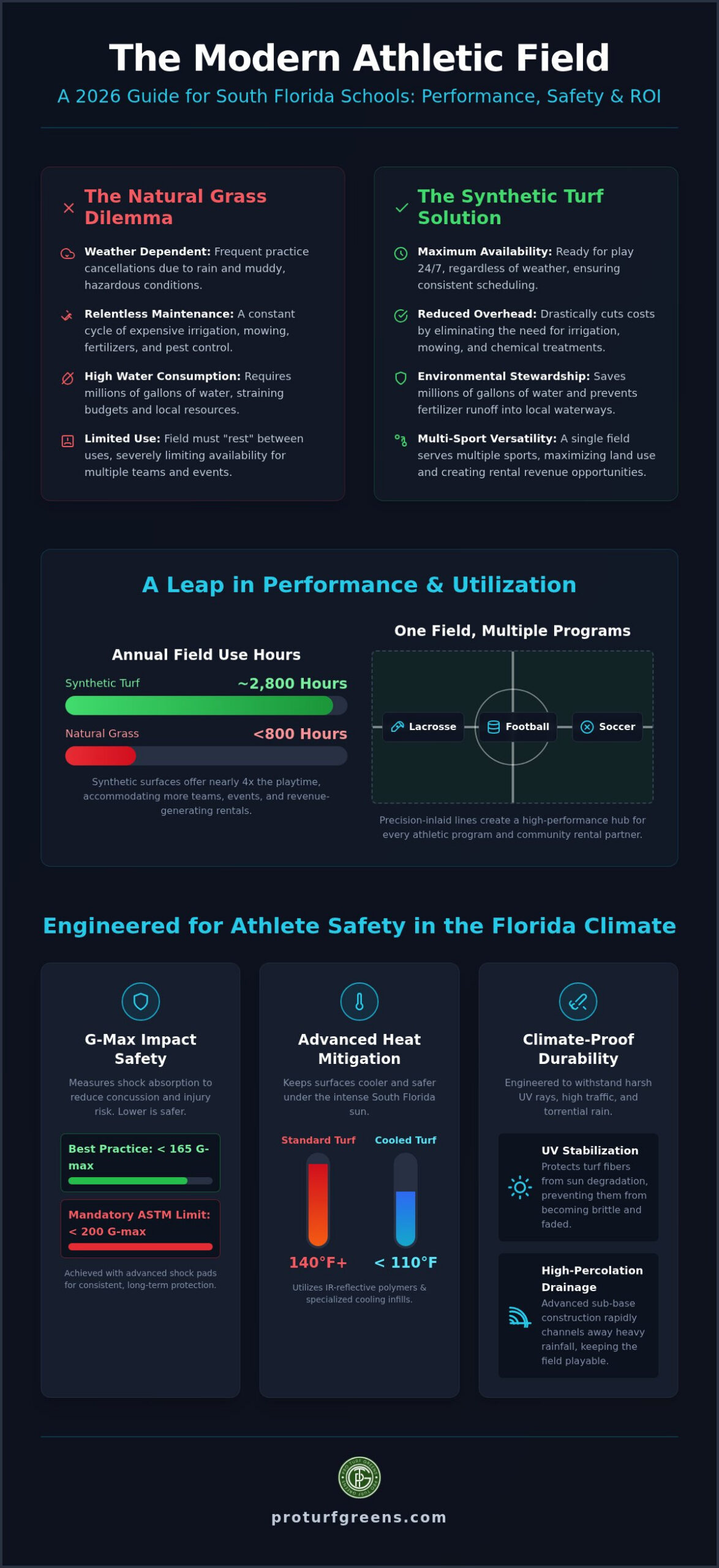
- Explore why synthetic surfaces offer significantly higher utilization rates than natural sod, allowing for nearly 2,800 hours of annual field use.
- Navigate the technical complexities of a professional school athletic field turf installation, including precision grading and high-percolation sub-base construction.
- Evaluate the long-term ROI of your project by analyzing the total cost of ownership compared to the high overhead of traditional irrigation and mowing.
- Identify the essential heat-mitigation technologies and specialized infills required to keep playing surfaces cool and resilient in the South Florida sun.
Why Schools are Switching to Synthetic Athletic Turf in 2026
For decades, South Florida athletic directors struggled with the limitations of natural sod. Today, the choice is clear. The decision to invest in a school athletic field turf installation moved from a luxury to a necessity for programs that demand reliability. While the history of artificial turf began with basic carpet-like surfaces, 2026 technology offers professional-grade systems that outperform grass in every metric. These fields are ready for action 24 hours a day, seven days a week, regardless of the previous night’s weather.
Maintaining a grass field in Miami or Fort Lauderdale is a full-time financial burden. You’re constantly fighting weeds, pests, and the sheer cost of irrigation. Switching to synthetic eliminates the need for heavy fertilizers that can run off into our local waterways. It also saves millions of gallons of water over the life of the field. This environmental stewardship aligns with the community’s desire to protect the South Florida ecosystem while drastically reducing labor costs and equipment overhead.
One Field, Many Sports: The Multi-Purpose Advantage
Land is a premium in our region. Many schools don’t have the space for separate soccer, football, and lacrosse complexes. By using precision-inlaid lines, a single school athletic field turf installation serves as a high-performance hub for every program. This versatility doesn’t just benefit the students; it transforms the field into a revenue generator. Local South Florida sports clubs are always looking for premium, weather-proof venues. Renting out your facility during off-hours can significantly offset your initial investment while providing a valuable service to the community.
Durability Against the South Florida Climate
Our local weather is notoriously harsh on outdoor materials. Between the intense UV index and the torrential summer rains, natural grass quickly fails or turns into a safety hazard. Modern synthetic systems are engineered specifically for these conditions to ensure long-term resilience. UV stabilization refers to the addition of chemical stabilizers during the manufacturing process to protect the turf fibers from the degrading effects of ultraviolet radiation. This technology ensures the blades stay upright and vibrant without becoming brittle. High-traffic areas like the goal mouth or the center of the field maintain their integrity through year-round seasons, providing a consistent playing surface that looks as good in year ten as it did on day one.
Engineering for Safety: G-Max, Drainage, and Heat Mitigation
A professional school athletic field turf installation involves much more than what meets the eye. While the vibrant green surface captures the attention of parents and donors, the sophisticated layers beneath ensure that every student-athlete remains safe during high-impact play. Engineering for the South Florida environment requires a dual focus on impact attenuation and thermal management to handle our unique climate challenges.
Understanding G-Max and Impact Safety
G-max testing is the industry standard for measuring the shock-attenuation properties of a sports surface. It quantifies the field’s ability to absorb impact, which is a critical factor in reducing the risk of concussions and lower-leg injuries. To maintain compliance and ensure long-term protection, schools should look to established playground turf safety standards Florida as a benchmark for excellence. High-quality shock pads are essential here; they provide a consistent layer of protection that doesn’t harden over time or fluctuate with the temperature. ASTM F1936 is the mandatory specification that dictates G-max readings must remain below 200, though best practices suggest keeping levels under 165 for the life of the field.
Heat is another safety variable that national competitors often overlook. On a 90°F afternoon in Miami, standard turf can reach temperatures exceeding 140°F. We address this by utilizing IR-reflective polymers in the turf fibers and specialized infills like HydroChill. These materials use evaporative cooling to keep the surface significantly closer to ambient air temperatures. If you’re concerned about player comfort, you can consult with a local turf specialist to explore the latest cooling technologies.
High-Percolation Drainage Systems
South Florida’s weather patterns demand a drainage system that can handle 2+ inches of rain per hour. Traditional lateral runoff isn’t enough to prevent standing water during a tropical downpour. Instead, we implement vertical drainage systems that pull water directly through the turf and into a dynamic stone base. This multi-layered sub-base acts as a massive reservoir, allowing water to percolate into the ground or move toward dedicated drainage pipes without disturbing the field’s surface. Proper planning during a school athletic field turf installation prevents the “bubbling” effect where water gets trapped under the turf, a common issue in poorly installed fields during hurricane season. This precision grading ensures the substrate remains stable and erosion-free for decades.
Planning and Budgeting for Your School’s Turf Project
The transition from a natural sod field to a high-performance synthetic surface is a significant capital project that requires meticulous administrative and financial planning. While the upfront investment is the most visible figure, savvy school boards evaluate the long-term total cost of ownership. A professional school athletic field turf installation is a strategic asset that pays dividends over a decade by eliminating the heavy overhead associated with traditional field management. The numbers tell a compelling story. By shifting from a surface that requires constant recovery time to one that’s always ready, you’re investing in the future of your athletic department and the safety of your students.
Lifecycle Cost Comparison: Synthetic vs. Natural Grass
When you analyze the annual budget, natural grass is surprisingly expensive to maintain at a competitive level. You’ve got to account for daily irrigation, weekly mowing, and the constant application of expensive fertilizers and pesticides. Then there are the hidden costs, like the labor required for line painting before every game and the periodic full-scale resodding of high-wear areas. An artificial turf field can be used for approximately 2,800 hours per year, compared to just 800 hours for a natural grass field. This increased capacity, combined with the drastic reduction in maintenance labor and materials, allows the project to maximize field ROI by significantly lowering long-term operational overhead.
Custom Design and Site Evaluation
Every successful project begins with a deep dive into the specific physical characteristics of your campus. A Miami artificial turf consultation is critical because it identifies potential site-prep challenges before the first shovel hits the dirt. We assess soil stability and map out existing utility lines to ensure that excavation doesn’t lead to costly surprises. During this phase, we also tailor the turf pile height and density to your school’s primary sports. Whether you need the fast ball-roll required for elite soccer or the superior impact-absorption needed for football, the design must be custom-tailored to your athletes.
Planning also involves navigating the latest regulatory landscape. Florida Administrative Rule 62-308.100, which became effective in May 2026, established state-level standards that streamline the approval process by preempting many local restrictions. We guide school boards through these requirements while identifying potential athletic facility grants or community funding sources. From the initial design to the first kickoff, you can expect a structured timeline that prioritizes quality and safety at every milestone.
The Professional Installation Process: From Site Prep to Final Seams
A professional school athletic field turf installation is a feat of engineering that requires meticulous attention to detail. While the green blades are the most visible component, the longevity of the field depends on the foundation. It’s a structured process that moves from heavy excavation to the fine art of invisible seaming. Every stage of construction is designed to ensure the surface remains safe, level, and resilient for years of high-intensity competition.
Base Construction and Grading
The sub-base is the most critical part of high performance sports turf. We begin with precision excavation to remove existing organic material and prepare the ground for a multi-layered stone foundation. Using laser-grading technology, our team creates a perfectly level playing surface that incorporates subtle drainage slopes. We also integrate specialized geofabrics. These membranes serve a dual purpose by preventing weed growth and ensuring the base remains stable without shifting over time. This solid foundation is what allows the field to maintain its integrity through years of heavy use.
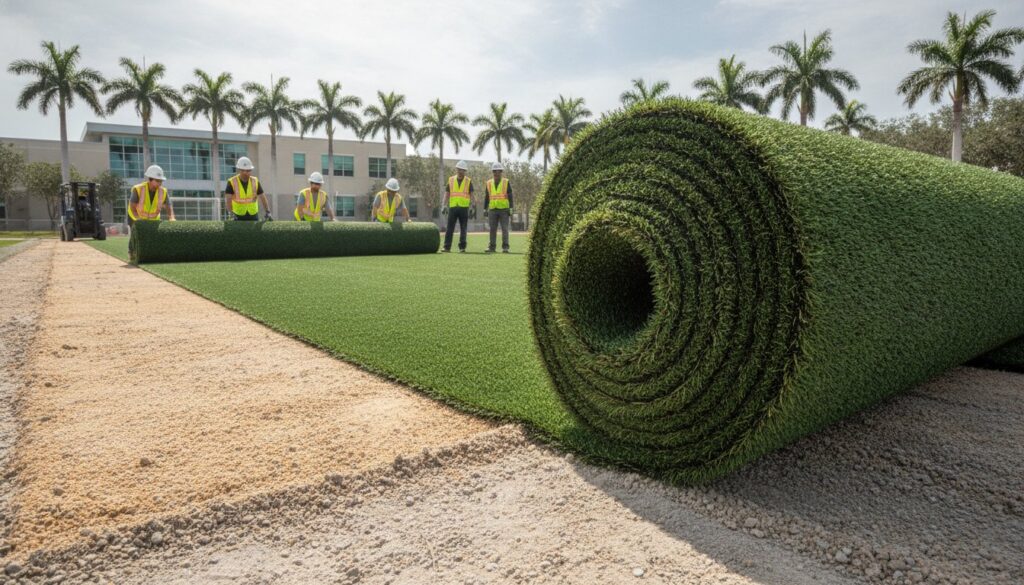
Once the base is cured and tested, the turf is carefully rolled out according to a master design plan. This stage requires a steady hand and an eye for detail. Achieving invisible seams is both a science and an art. We choose the strongest seaming methods, often opting for specialized industrial adhesives or industrial-grade sewing, to ensure the turf remains a single, cohesive unit during high-intensity athletic maneuvers. This precision prevents tripping hazards and ensures a uniform aesthetic across the entire complex.
Turf Attachment and Line Marking
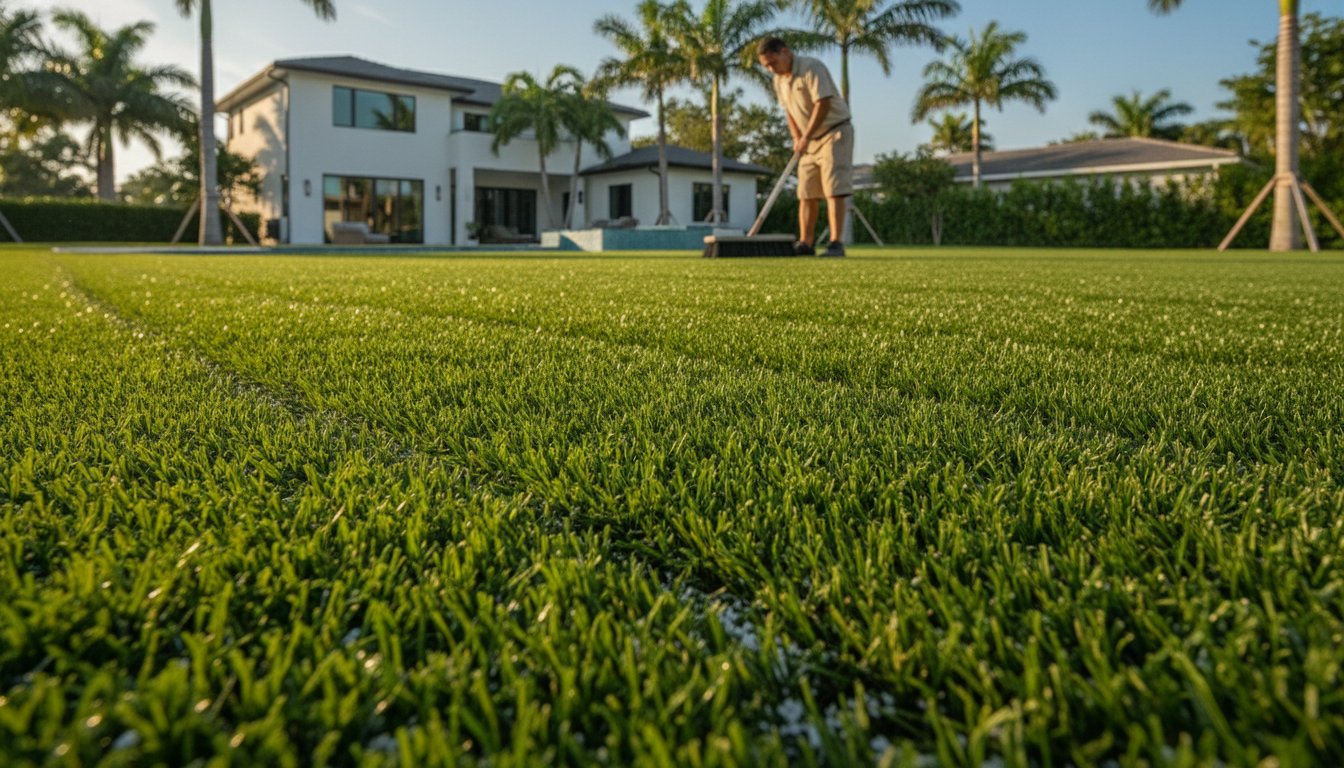
Unlike residential lawns, athletic fields require permanent markings that won’t fade or peel under the South Florida sun. We use a precision inlay process for custom school logos and sport-specific boundary lines. This means the lines are part of the turf itself, not painted on top. It creates a professional look that stays vibrant for the life of the surface. After the lines are set, we focus on final grooming. Industrial fiber brushing ensures an upright pile orientation, which is essential for consistent ball roll and player traction.
The final step in a school athletic field turf installation is the distribution of infill. This material provides the necessary ballast to keep the turf in place while adding a layer of cushioning for student-athlete safety. We calibrate the infill depth to achieve the perfect balance of playability and impact absorption. If you’re ready to transform your campus, you can request a professional site assessment to see how our meticulous process fits your facility’s specific needs.
Partnering with Pro Turf Greens for South Florida Athletic Excellence
Pro Turf Greens stands as the dedicated partner for educational institutions across Fort Lauderdale, Miami, and the Palm Beaches. We understand that a school athletic field turf installation is a generational investment. It requires a specialist who doesn’t just provide a product but serves as a meticulous guide through the complexities of design, permitting, and long-term maintenance. Our team treats every project with a sense of quiet pride, ensuring that the final outcome reflects the high standards of your school’s athletic program and the safety of your students.
Local knowledge is indispensable in South Florida. Navigating the specific building codes and municipal requirements of Miami-Dade or Palm Beach County can be daunting for school administrators. Our deep roots in the community allow us to streamline these processes, ensuring your project meets every regional regulation without unnecessary delays. We focus on materials engineered for the extreme UV exposure and high-moisture environment that defines our region, providing a surface that maintains its aesthetic and functional excellence despite the harsh climate.
The Pro Turf Greens Difference
Our expertise extends beyond the stadium. While we are leaders in large-scale athletic complexes, our diverse portfolio includes high-end residential projects like backyard putting green installation and specialized commercial recreational spaces. This breadth of experience allows us to bring a unique level of craftsmanship to every turf fiber we lay. You’ll have direct access to our expert design and installation team, moving away from distant corporate structures toward a reliable local authority that values the customer experience above all else. We pride ourselves on being dedicated partners who stay invested in your field’s performance long after the final seam is secured.
Ready to Transform Your Campus?
Initiating your transformation is a straightforward, collaborative process. It begins with a comprehensive site visit where we evaluate your existing infrastructure and discuss your program’s specific goals. We’ll walk the grounds with you, identifying potential drainage improvements and discussing the best multi-sport layouts for your space. This initial consultation is designed to provide clarity and build a foundation of trust before any construction begins. We provide a transparent roadmap that helps school boards make informed decisions about their athletic future.
If you’re ready to provide your student-athletes with a professional-grade, safe, and resilient playing surface, the next step is simple. Call us today at 561-221-1010 to start your field transformation. We’ll provide the specialized engineering and custom-tailored solutions your school deserves, ensuring your new school athletic field turf installation becomes a source of pride for the entire community for decades to come.
Building the Future of South Florida Athletics
Transforming your campus with a professional school athletic field turf installation is a decision that impacts your students and your community for a decade or more. By prioritizing specialized South Florida climate engineering, you ensure that your field remains a safe, high-performance asset even during the most intense summer heat and tropical rain. We’ve explored how modern synthetic surfaces provide nearly triple the utilization of natural grass, allowing your programs to grow without the constant burden of high-overhead maintenance.
Safety remains the cornerstone of every project. Utilizing professional-grade athletic surfaces and maintaining strict G-max standards protects your athletes while maximizing your facility’s ROI. Whether you’re looking to consolidate sports onto a single multi-purpose field or generate revenue through community rentals, our custom multi-sport design expertise provides the technical foundation you need.
Your journey toward a more resilient athletic program starts with a conversation. We invite you to Schedule Your Free School Athletic Field Consultation to discuss your facility’s unique needs. Let’s work together to build a field that inspires pride and excellence for years to come.
Frequently Asked Questions
How long does a school athletic field turf installation typically take?
A standard school athletic field turf installation typically takes between 60 and 90 days from the initial excavation to the final grooming. This timeline accounts for site preparation, multi-layered sub-base construction, and the precision rollout of the synthetic surface. While South Florida’s frequent afternoon rain can occasionally impact the schedule, our local teams in Miami and Fort Lauderdale manage these variables to ensure your project stays on track for the season.
What is the average lifespan of a high-performance synthetic sports field in Florida?
High-performance synthetic fields in Florida generally have a lifespan of 10 to 15 years. The longevity of the surface depends heavily on the quality of the UV-stabilized materials and the consistency of the maintenance program. Because our local sun is particularly intense, we use specialized polymers that resist fiber degradation. Regular brushing and infill management help the field maintain its resilience through thousands of hours of competitive play.
Is synthetic turf safe for student-athletes in the extreme South Florida heat?
Modern synthetic turf is safe for athletes in the South Florida heat when engineered with advanced cooling technologies. We utilize IR-reflective fibers and specialized infill systems like HydroChill to lower surface temperatures. On particularly hot days in Palm Beach or Weston, a quick 30-second rinse with water can further reduce the field’s temperature by up to 50 degrees, ensuring a comfortable environment for afternoon practices and game days.
Does artificial turf increase the risk of ACL or other joint injuries?
Research indicates that modern synthetic systems featuring high-quality shock pads provide impact absorption comparable to well-maintained natural grass. The primary factor in injury prevention is the surface’s consistency and its G-max rating. By maintaining proper infill levels and ensuring a level sub-base, a professional school athletic field turf installation reduces the risk of the uneven patches and mud holes that often cause joint injuries on traditional natural sod fields.
How much maintenance does a school turf field actually require?
While synthetic fields don’t require mowing or irrigation, they still need routine care to maximize their lifespan. Maintenance involves periodic brushing to keep fibers upright and occasional infill top-offs in high-traffic areas like goal mouths. Schools in Coral Gables or Jupiter should also plan for annual safety testing and deep cleaning to remove organic debris. This proactive approach is significantly less labor-intensive and expensive than managing a traditional grass field.
Can we install turf over our existing natural grass field directly?
You cannot install synthetic turf directly over existing natural grass if you want a safe and durable playing surface. A professional installation requires the complete removal of sod and several inches of soil to make room for a dynamic stone base. This sub-base is essential for stability and high-percolation drainage. Skipping this step would lead to uneven surfaces, poor drainage, and a field that fails safety impact tests within months.
What kind of warranty comes with a professional school turf installation?
Professional turf installations typically carry a manufacturer’s warranty of 8 to 10 years covering the turf fibers and backing. These warranties protect against premature wear and UV degradation, which is vital in our sunny climate. We also provide specific craftsmanship guarantees on the installation itself, including the integrity of the seams and the sub-base construction. We’ll review the specific terms with your school board to ensure long-term peace of mind and protection.
How does synthetic turf handle heavy tropical rain and potential flooding?
Our synthetic systems are engineered to handle the torrential rains common in Boca Raton and Delray Beach. The vertical drainage design allows water to pass through the turf and into a specialized stone reservoir at a rate of over 30 inches per hour. This rapid percolation prevents standing water and “bubbling,” allowing the field to be playable almost immediately after a heavy tropical downpour. It’s a significant upgrade over natural grass fields.