Most athletes assume that all synthetic grass is created equal until they step onto a surface that has been baking in the South Florida sun for six hours. You’ve likely felt the frustration of a field that turns into a heat trap or a swamp after a typical afternoon thunderstorm. It’s disappointing when a significant investment in your property doesn’t live up to the demands of daily, high-intensity training. Choosing a high performance sports turf is about more than just aesthetics; it’s about engineering a system that withstands the elements while protecting the people who play on it.
In this guide, you’ll discover how specialized synthetic surfaces transform athletic play and provide the ultimate professional-grade training environment for homes and facilities. We’ll explore how modern materials stay resilient under heavy foot traffic and how new 2026 Florida regulations, such as Rule 62-308.100, have streamlined the installation process for residential properties. From understanding the latest PFAS safety standards like ASTM F3782-26 to mastering drainage solutions, we’re providing the roadmap you need to build a durable, low-maintenance surface that enhances both your performance and your property value.
Key Takeaways
- Understand why high performance sports turf is a specialized, multi-layered system engineered for athletic resilience rather than just aesthetic appeal.
- Learn how advanced drainage technology and UV-resistant fibers allow synthetic surfaces to withstand South Florida’s intense heat and tropical downpours.
- Discover the essential metrics, including fiber shape and density, that ensure your athletic surface provides professional-grade safety and speed.
- Explore the versatility of custom-tailored turf solutions for everything from high-capacity commercial arenas to private backyard training facilities.
- Gain insight into the professional design and installation process that guarantees a durable, low-maintenance surface with lasting property value.
What Defines High Performance Sports Turf?
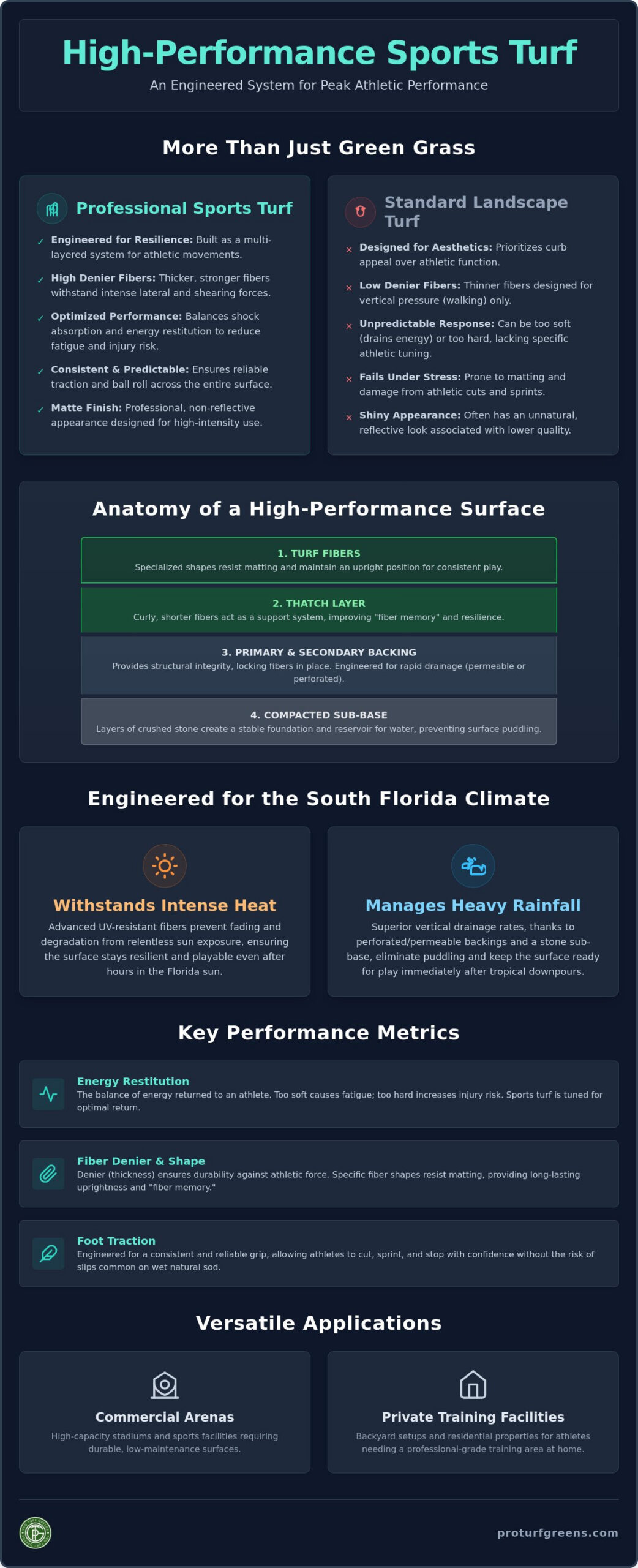
High performance sports turf isn’t just a product; it’s a meticulously engineered system designed to facilitate specific athletic movements. While standard synthetic grass prioritizes look and feel for curb appeal, a professional athletic surface focuses on how a player interacts with the ground. This involves a complex balance of shock absorption and energy restitution. Energy restitution refers to the amount of energy the surface returns to the athlete’s foot. If a surface is too soft, it drains a player’s energy, leading to premature fatigue. If it’s too hard, it increases the risk of joint injury over time.
The Anatomy of an Athletic Surface
The foundation of any superior athletic build starts with the primary and secondary backing. These layers provide the structural integrity required to hold fibers in place under extreme stress. Fiber geometry is equally important; high performance sports turf utilizes specific shapes designed to stand upright and resist matting. A layer of “thatch”-curly, shorter fibers tucked between the tall blades-acts as a support system to maintain this uprightness. This “fiber memory” is what allows the surface to bounce back after being compressed by heavy foot traffic or equipment, ensuring the field remains playable for years without losing its shape.
Professional Grade vs. Residential Landscape Turf
Homeowners often ask why they can’t simply use their standard landscape grass for a backyard training area. The answer lies in the denier, or fiber thickness. Sports-grade products feature a much higher denier to withstand the lateral force of athletic drills. Standard landscape turf is designed for vertical pressure, such as walking or lounging; it often fails when subjected to the shearing forces of a soccer player changing direction at full speed. Beyond durability, professional surfaces offer a sophisticated matte finish. This avoids the shiny, “fake” appearance often associated with lower-quality products. By partnering with Pro Turf Greens, you’re investing in a custom-tailored surface that supports both your lifestyle and your specific athletic goals with technical precision.
Engineering for the South Florida Environment
South Florida’s climate is unforgiving. Between the relentless ultraviolet exposure and the sudden, heavy tropical downpours, a standard lawn often becomes a liability rather than an asset for training. While natural grass in Fort Lauderdale or Miami quickly turns into a muddy, puddled mess after a storm, high performance sports turf is engineered to remain functional regardless of the weather. This resilience is the result of a specialized system that addresses the two biggest threats to South Florida athletic surfaces: moisture and heat.
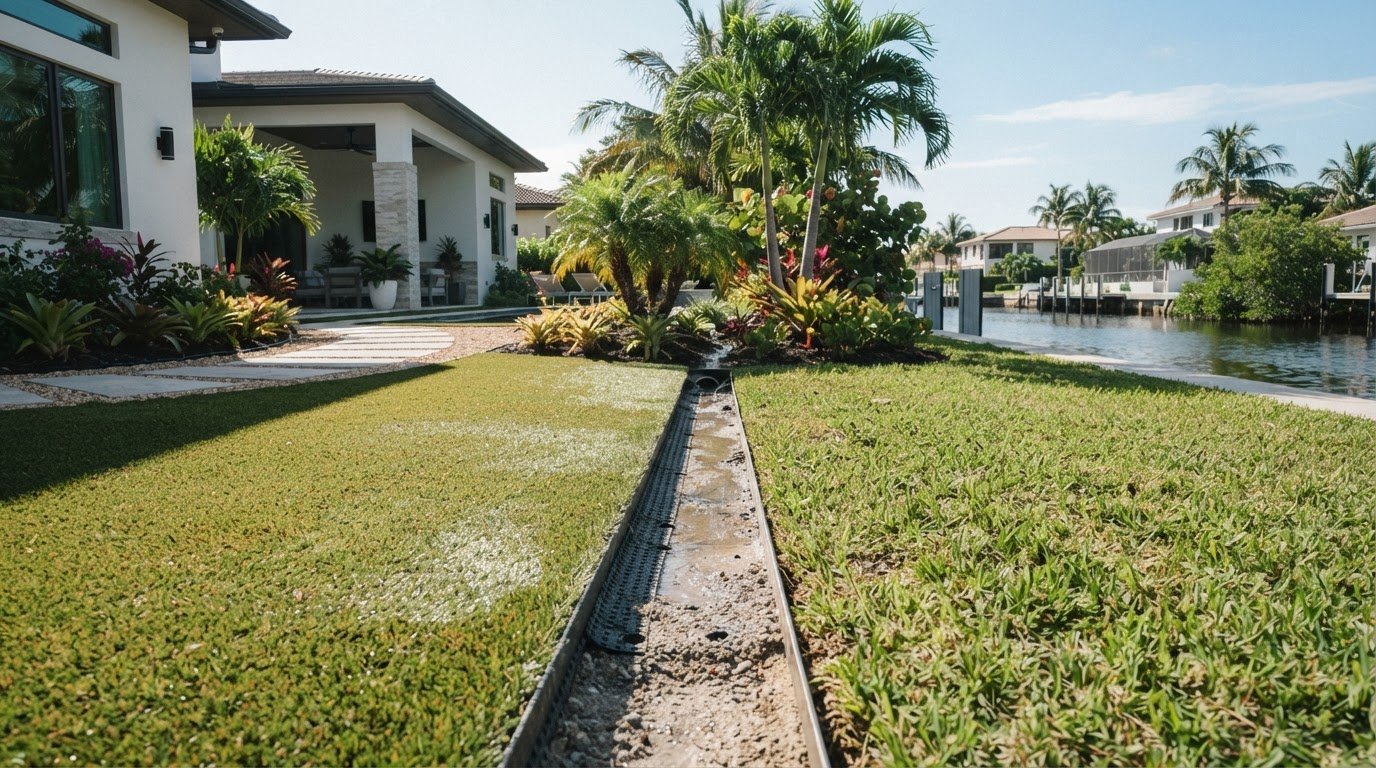
Traditional Florida lawns often suffer from “puddling” because the sandy soil reaches a saturation point, leaving standing water that breeds insects and creates slip hazards. Engineered sports surfaces bypass this issue entirely. By utilizing a multi-layered drainage system, these surfaces ensure that water moves away from the play area immediately. If you’re looking for a surface that stays cool and dry, you can explore our athletic and sports turf options designed specifically for this region.
Advanced Drainage for Heavy Rainfall
The secret to rapid water shedding lies in the backing and the sub-base. We typically choose between “perforated” backings, which feature regularly spaced drainage holes, or “permeable” systems that allow water to pass through the entire fabric. In Miami and Fort Lauderdale, the turf is only as good as the ground beneath it. A professional installation includes a meticulously compacted sub-base of crushed stone layers. These layers act as a reservoir, holding and then slowly releasing water into the water table without ever letting it reach the surface. Vertical drainage rate is the essential metric for Florida turf safety, as it determines how quickly a field returns to a playable state after a tropical storm.
Heat Mitigation and UV Resilience
The “Miami heat” factor can make standard synthetic grass uncomfortable for midday use. To counter this, high-end athletic builds incorporate heat reduction technologies. Specialized infills are used to lower surface temperatures by reflecting sunlight rather than absorbing it. Additionally, the fibers themselves are engineered with specific “U” or “W” shapes. These geometries provide a larger surface area for heat dissipation, preventing the blades from trapping thermal energy. To ensure longevity, every fiber is UV-stabilized during the manufacturing process. This prevents the grass from becoming brittle or fading under the intense Florida sun, maintaining a professional aesthetic and safe playing texture for years to come. Homeowners who want a deeper understanding of the science and strategies behind temperature management can explore our comprehensive guide on how to keep artificial turf cool in Florida, which covers the latest 2026 innovations in infrared-reflective fiber shapes and high-performance cooling infills.
Versatile Applications: From Arenas to Backyard Training
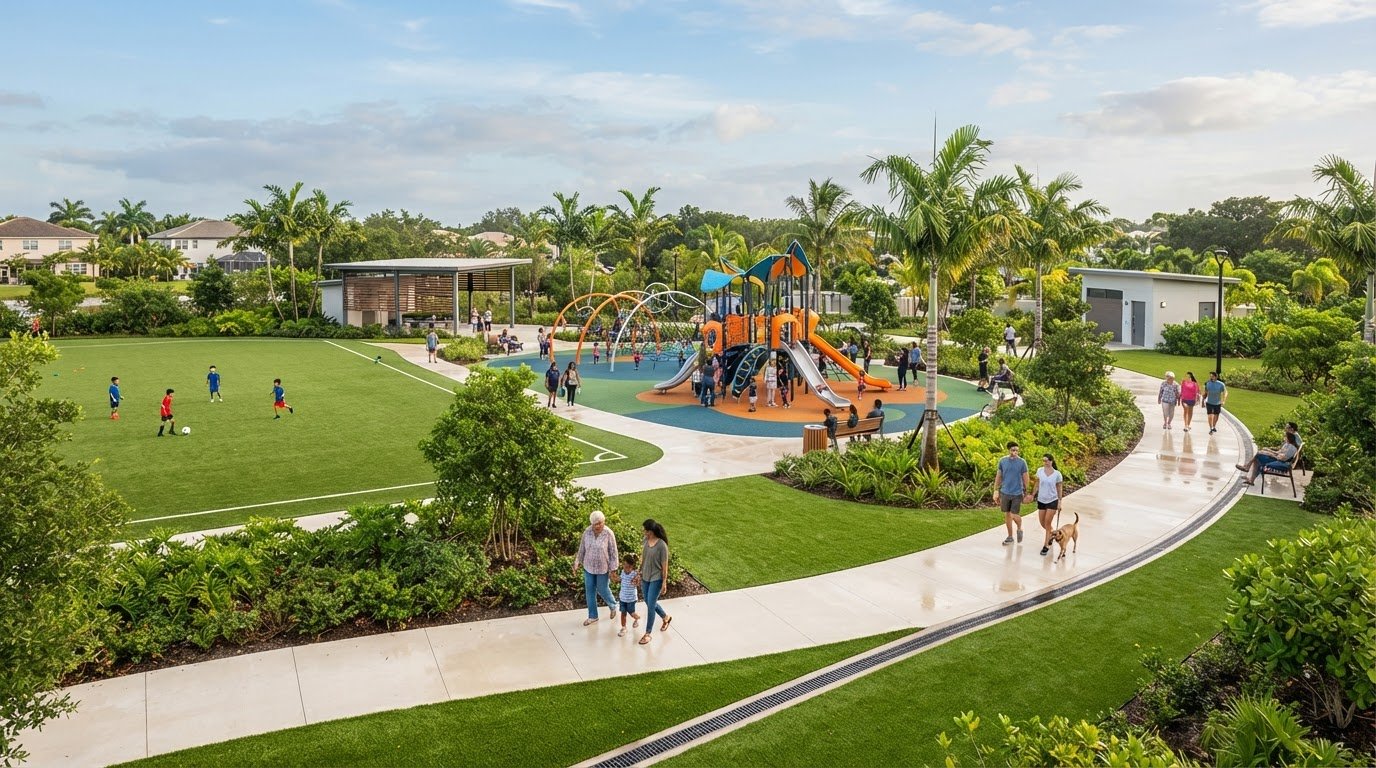
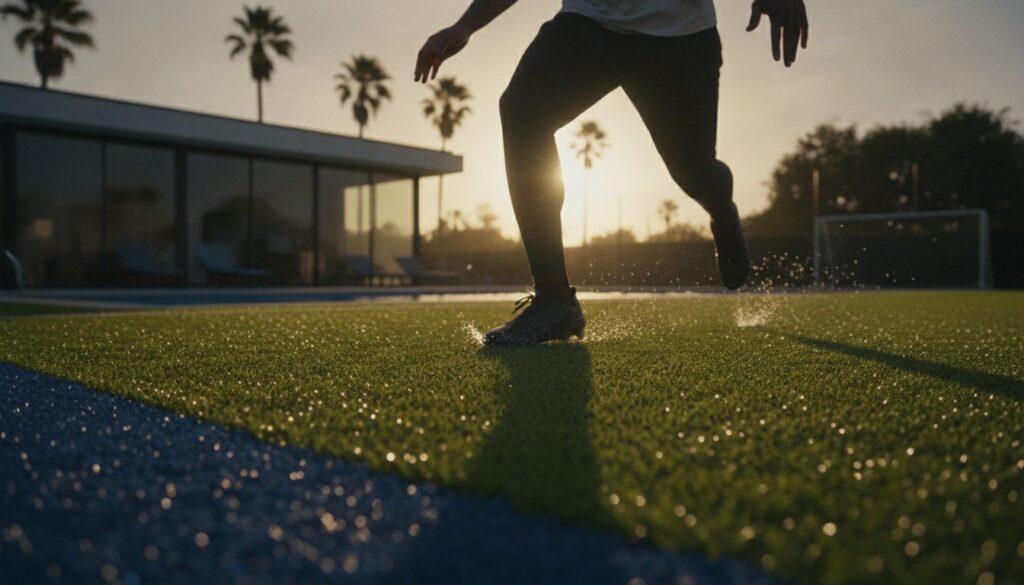
The adaptability of high performance sports turf allows it to serve as a high-functioning foundation across a variety of South Florida environments. While it remains the standard for professional arenas, it’s increasingly found in specialized commercial gyms and private residences. These surfaces are designed to support a wide range of activities, from heavy sled pushes in CrossFit areas to the high-speed agility drills required for soccer and lacrosse. This multi-sport versatility ensures that a single installation can meet the diverse needs of multiple athletes without the downtime required by natural grass. It’s a transformation that moves beyond utility, offering an aspirational upgrade to any property, appealing to the same demographic that appreciates the fusion of culture and performance found in luxury streetwear Chicago.
Commercial Facilities and Athletic Complexes
For commercial venues and educational institutions, the transition to synthetic surfaces is often driven by a clear return on investment. Schools and daycare centers require play areas that are not only safe but capable of withstanding constant, heavy use. Unlike natural sod, which requires regular mowing, irrigation, and pesticide treatments, high-performance systems offer year-round playability with minimal upkeep. This is particularly beneficial for high-traffic “hot spots” where natural grass typically fails, such as:
- Goal mouths and penalty boxes where turf often wears down to bare dirt.
- Batting cages that experience repetitive foot pivoting and high-impact ball contact.
- Sidelines and entrance ways where spectators and athletes frequently congregate.
Commercial gym owners also benefit from the extreme durability of sports-grade turf. Sled tracks and functional training areas demand a surface that won’t tear or bunch under the weight of hundreds of pounds. By installing a surface with a high-density backing, facility owners ensure their investment survives the lateral forces of sprinting and the abrasive friction of heavy equipment movement.
Luxury Residential Sports and Training Areas
In communities like Palm Beach and Boca Raton, we’re seeing a significant trend toward “backyard training camps.” Homeowners are no longer satisfied with simple lawns; they want professional-grade environments that allow for serious athletic development at home. This custom turf design integrates seamlessly with high-end landscaping and modern pool decks, creating a cohesive and sophisticated outdoor living space. A specialized athletic surface provides a “clean” play area that natural grass simply cannot match. You won’t have to worry about mud being tracked into the house, allergens affecting the family, or pests like fire ants and ticks nesting in the grass.
The transformation of a backyard into a dedicated training zone changes how a family utilizes their outdoor space. It’s no longer just a patch of green to look at; it’s an active part of the home’s functional footprint. Whether you’re running sprints on a professional-grade strip or practicing agility drills, the surface remains consistent and reliable. Families looking to maximize their outdoor space with a surface that supports everything from soccer to basketball should explore multi sport game court turf systems that allow seamless transitions between multiple athletic disciplines on a single installation. Many South Florida homeowners also find that the same drainage and UV-resilience technology that powers athletic turf makes it an ideal solution for their pets; those interested can explore specialized artificial turf for dog runs in South Florida that keeps four-legged family members comfortable and clean year-round. Golfers in the area are also discovering that the same engineering principles behind athletic turf can be applied to a professional backyard putting green installation, creating a tour-level practice space just steps from the home. Homeowners looking to extend that same level of craftsmanship to their entire property’s entrance can explore custom turf driveway designs for South Florida homes that combine permeable drainage technology with luxury curb appeal. It’s a controlled, pristine environment that prioritizes both performance and the aesthetic excellence of the property.
Key Performance Metrics: How to Evaluate Your Turf
Selecting the right high performance sports turf involves analyzing technical specifications that dictate playability and safety. While aesthetics matter, the true value of an athletic surface lies in its measurable performance. You need a framework to compare products effectively, ensuring the system you choose aligns with your specific training goals. This process begins with understanding that more material doesn’t always result in a better experience. In fact, over-engineering a surface without considering the sport can lead to a field that feels sluggish or unstable.
Face weight is a common point of confusion. It represents the weight of the synthetic yarn per square yard, excluding the backing. While a high face weight suggests a lush look, sports applications require a balance. If the density is too high, the infill cannot move freely, which can lead to a surface that is too firm for joint safety. Similarly, pile height, the length of the blades, directly impacts ball speed and foot stability. Shorter pile heights are ideal for speed and agility work, whereas longer fibers are necessary for sports involving cleats. Finally, think of infill as the engine of the system. It’s the material dispersed between the blades that provides the necessary ballast and cushioning for every stride.
Material Selection: Nylon vs. Polyethylene
The choice between Nylon and Polyethylene depends on how you plan to use the area. Nylon is prized for its extreme durability and high melting point, making it excellent for indoor gym sled tracks. However, it can be abrasive against the skin. Polyethylene is the preferred choice for most outdoor high performance sports turf because it’s softer and offers a more realistic feel. Most modern athletic fields utilize a Polyethylene and Nylon blend to capture the benefits of both. If your athletes wear cleats, a softer Polyethylene fiber is essential to prevent “turf burn” during slides and falls. For those using turf shoes or sneakers in a high-intensity interval training (HIIT) setting, a more resilient Nylon-heavy blend provides the necessary grip. Homeowners and facility managers who want their space to accommodate multiple sports on a single surface can learn more about the technical advantages of a purpose-built multi sport game court turf installation that balances fiber softness with the durability needed for diverse athletic activities. You can request a custom turf specification review to determine which material blend fits your facility’s needs.
Safety and Impact: Understanding Gmax Ratings
Safety is non-negotiable in professional-grade builds. The primary metric for measuring surface safety is the Gmax rating. This value measures shock attenuation, or the surface’s ability to absorb the force of an impact. A lower Gmax rating indicates better shock absorption, which is critical for protecting athletes against concussions and chronic joint injuries. Over time, all surfaces harden; starting with a system engineered for a low Gmax is vital. To enhance this protection, many high-performance installations include specialized shock pads underneath the turf. These pads provide a consistent layer of protection that doesn’t rely solely on the infill, ensuring the field remains safe even after years of heavy use.
Designing Your High-Performance Surface with Pro Turf Greens
A professional-grade athletic field is only as good as the team that installs it. At Pro Turf Greens, we approach every project as a meticulous partnership, ensuring that your vision for a high performance sports turf surface is executed with technical precision. We don’t just roll out synthetic grass; we engineer a complete system from the sub-base up. This dedication to craftsmanship is what separates a standard backyard lawn from a professional training environment that adds genuine value to your property. Our goal is to provide a seamless transition from your initial concept to a finished, high-performance reality.
The Pro Turf Greens Installation Process
Our method is structured and logical, designed to handle the specific geographical challenges of South Florida while meeting the highest industry standards. We follow a rigorous three-step progression to ensure longevity and safety:
- Step 1: Precision site preparation and drainage excavation. We begin by removing existing sod and excavating to the required depth. This allows us to install the drainage infrastructure necessary to handle tropical rainfall without surface pooling.
- Step 2: Base layer compaction for a stable athletic foundation. Using laser-leveling technology, we create a perfectly flat or expertly pitched surface. We then compact layers of crushed stone to provide a stable, porous base that won’t shift under the lateral force of athletic drills.
- Step 3: Custom turf fitting and industrial-grade seaming. Once the foundation is set, we fit the turf with surgical accuracy. We utilize industrial-grade seaming techniques and secure anchoring to ensure the surface remains tight and safe, preventing the trips and stumbles caused by loose edges.
Service Areas: Serving the South Florida Athletic Community
We take quiet pride in being a reliable local authority for Fort Lauderdale, Miami, Palm Beach, and Boca Raton. Our team understands the specific drainage requirements and heat mitigation needs of our community because we live and work here. This local expertise allows us to navigate regional soil conditions and weather patterns with confidence. Whether you’re a facility manager in Miami-Dade or a homeowner in Palm Beach County looking for a professional-grade training zone, you can expect a sophisticated level of service that respects your time and your investment.
Our commitment to quality and long-term satisfaction means we remain a dedicated partner long after the final grooming is complete. We invite you to experience the Pro Turf Greens difference and see how a custom-tailored athletic surface can transform your training routine. If you’re ready to upgrade your property, call 561-221-1010 for a professional site evaluation. Let’s work together to build a high performance sports turf environment that elevates your game and your lifestyle.
Elevate Your Game with a Professional Athletic Surface
Investing in high performance sports turf is a strategic commitment to both athletic excellence and long-term property value. Throughout this guide, we’ve examined how technical specifications like Gmax safety ratings and specialized drainage systems create a foundation for superior play. A professional-grade surface doesn’t just improve the look of your facility; it transforms how athletes train by providing consistent traction and reliable shock absorption. In our unique South Florida climate, these engineering details are the difference between a surface that fails and one that thrives for years.
Pro Turf Greens takes pride in being a dedicated partner for those who demand the highest standards in craftsmanship and reliability. We combine modern material innovation with meticulous installation techniques to deliver custom designs for both home and commercial use. If you’re ready to upgrade your training environment with a resilient, low-maintenance solution, we invite you to Request Your Free High-Performance Turf Consultation. Our experts are ready to guide you through the site evaluation process and help you realize the full potential of your athletic space. It’s time to build a surface that matches the intensity of your training.
Frequently Asked Questions
How long does high performance sports turf last in the Florida sun?
Professional grade athletic turf typically lasts between 8 and 15 years in the intense South Florida climate. While the UV index in Fort Lauderdale is high, modern fibers are treated with UV stabilizers during the manufacturing process to prevent fading and brittle breakdown. This ensures the surface remains pliable and resilient even after years of exposure. Regular grooming and maintaining proper infill levels will further extend the functional lifespan of your investment.
Is synthetic sports turf safe for children and pets?
Yes, professional synthetic surfaces are non-toxic and safe for both children and pets. Modern products adhere to strict safety standards, such as the ASTM F3782-26 standard published in May 2026, which ensures consistent testing for PFAS and other substances. Because the surface doesn’t require pesticides, fertilizers, or heavy irrigation, it creates a pristine environment free from the common allergens and pests often found in natural Florida sod. Pet owners specifically looking to create a dedicated outdoor space for their animals can find detailed guidance in our guide to artificial turf for dog runs in South Florida, which covers odor control, drainage, and pet-safe material selection.
What kind of maintenance does an athletic turf field require?
Maintenance is significantly lower than natural grass but does require occasional attention to preserve playability. You should regularly brush or power-broom the fibers to keep them upright and prevent matting in high-traffic zones. Additionally, clearing organic debris like leaves and occasionally rinsing the surface will keep the drainage pores clear. This minimal effort ensures the field remains in professional-grade condition without the need for mowing or chemical treatments.
Can I install high performance sports turf over an existing concrete pad?
You can install athletic turf over concrete provided you include a specialized shock pad or drainage tile between the layers. Installing directly onto concrete is often too firm for high-impact sports and can increase the risk of joint injuries. A shock pad provides the necessary Gmax attenuation for safety while allowing water to flow horizontally toward a drainage point. This configuration is common for rooftop training areas and commercial gym conversions.
Does artificial sports turf drain well during heavy Florida rainstorms?
Engineered sports turf systems are designed to handle heavy tropical rainfall far better than natural soil. High-quality backings are either perforated or fully permeable, allowing water to pass through to a crushed stone sub-base. This base acts as a temporary reservoir, preventing the puddling and mud common on Florida lawns. A properly installed system can drain dozens of inches of rain per hour, returning the field to a playable state almost immediately after a storm.
What is the difference between infill and the turf itself?
The turf refers to the synthetic grass fibers and the backing they’re tufted into, while the infill is the material dispersed between those fibers. Infill serves as the engine of the system, providing the ballast to keep the turf in place and the cushioning for athlete safety. Common infill materials include silica sand, coated rubber, or organic alternatives. Each is chosen based on the specific athletic requirements and the desired feel of the project.
How does sports turf affect player safety compared to natural grass?
High performance sports turf enhances player safety by providing a perfectly consistent surface without the divots or holes found in natural grass. Because the shock absorption is measured through Gmax ratings, you can ensure the field meets specific safety thresholds for concussion prevention. This predictability allows athletes to make sharp cuts and sprints with confidence. They know the traction and impact response will be uniform across the entire playing area.
Can I use cleats on high-performance residential sports turf?
Yes, you can use cleats on residential sports turf if the system is engineered with a sufficient pile height and fiber density. Most athletic-grade products use high-denier polyethylene fibers that are specifically designed to withstand the shearing force of lateral movements. If you plan on using cleats regularly, your installer will help you select a turf and infill combination that provides the appropriate bite and release for your specific sport. Homeowners concerned about surface temperatures during peak summer hours can also review our detailed resource on how to keep artificial turf cool in Florida to ensure their athletic surface remains comfortable and safe during intense midday training sessions.