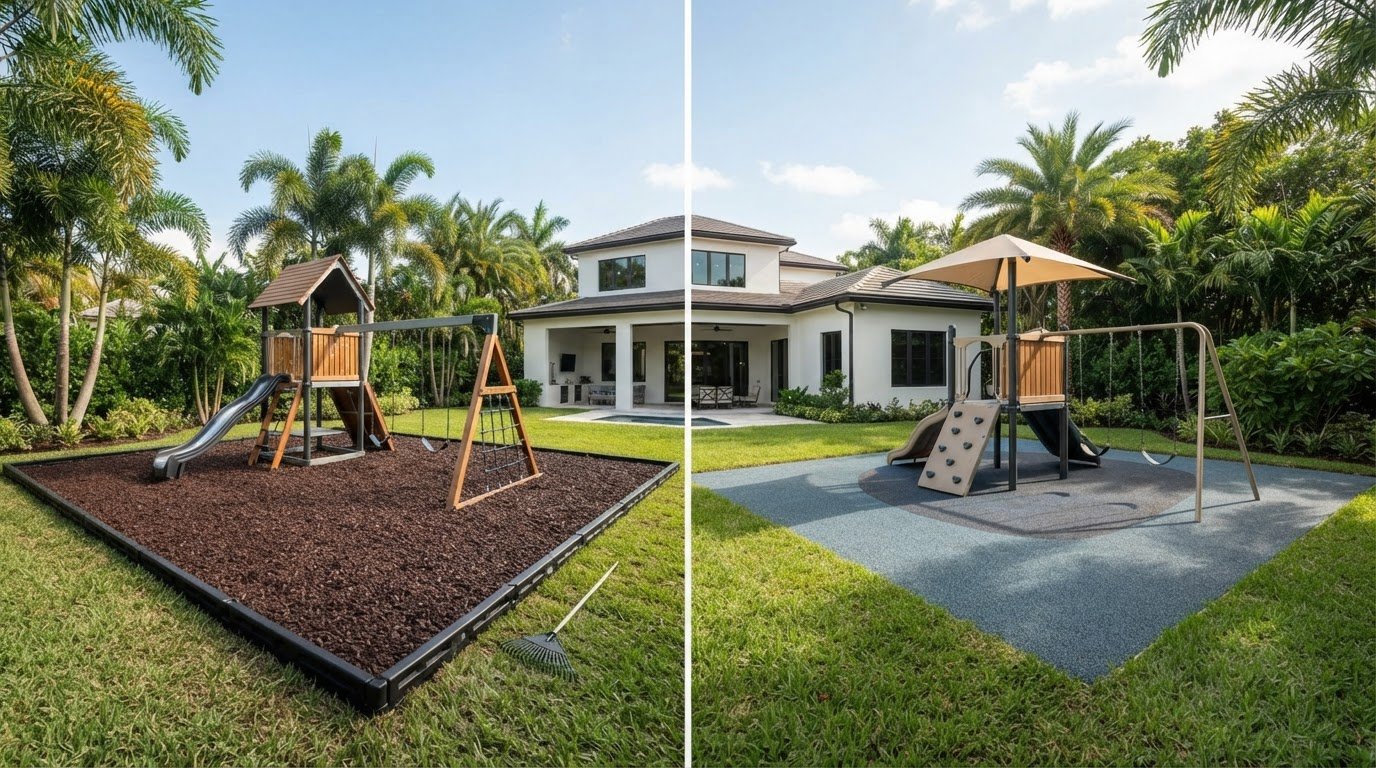
A softer-looking playground isn’t automatically a safer one. For school leaders considering artificial grass for schools, the key question is whether the complete surface system suits the equipment, expected use, and site, not simply whether the turf feels cushioned underfoot.
It’s reasonable to ask how a surface may perform during falls, whether it could become uncomfortably hot in South Florida, and how different systems compare for drainage and upkeep. Turf alone can’t answer those questions. The shock-absorbing layer, infill or infill-free design, base preparation, and ongoing care all contribute to how a play area performs.
This guide explains potential safety benefits and limitations of school playground turf, and what to look for in applicable standards and system specifications. You’ll also learn which site conditions, including fall zones, drainage, heat exposure, and maintenance needs, deserve attention before installation. With a clearer understanding of these factors, your school can assess whether a professionally designed surface is a good fit.
Key Takeaways
- Assess artificial grass for schools as a complete surfacing system, not just a turf product. Compare how each component supports the intended play area.
- Match impact-protection requirements to the playground equipment, fall height, and designated fall zones. Don’t assume one surface suits every activity.
- Compare artificial turf, natural grass, and hard surfaces against the same play activities and fall-height assumptions, while weighing upkeep, drainage, and heat.
- For a South Florida site, evaluate sun exposure, surface temperature, rainfall, drainage, and available shade before choosing a system.
- Request system specifications, relevant test documentation, drainage plans, and maintenance guidance so you can compare proposals on more than appearance.
Artificial Grass for Schools: What Safety Benefits Can It Offer?
Artificial grass can create a tidy, usable outdoor area for students, but its appearance alone says little about safety performance. School playground turf is a complete surfacing system designed for a specific site and use. The grass-like fibers are only its visible top layer. The full system may include infill, a shock-attenuating layer, and a prepared base. Each component, along with installation and upkeep, affects how the surface performs.
That distinction matters because artificial grass for schools can serve very different purposes. A quiet lawn for gathering doesn’t necessarily meet the needs of a play area beneath climbing equipment. General background on Artificial turf, including its types and potential health and environmental concerns, can help frame the material choice. Schools still need to assess the specific system and site.
Where schools use artificial grass
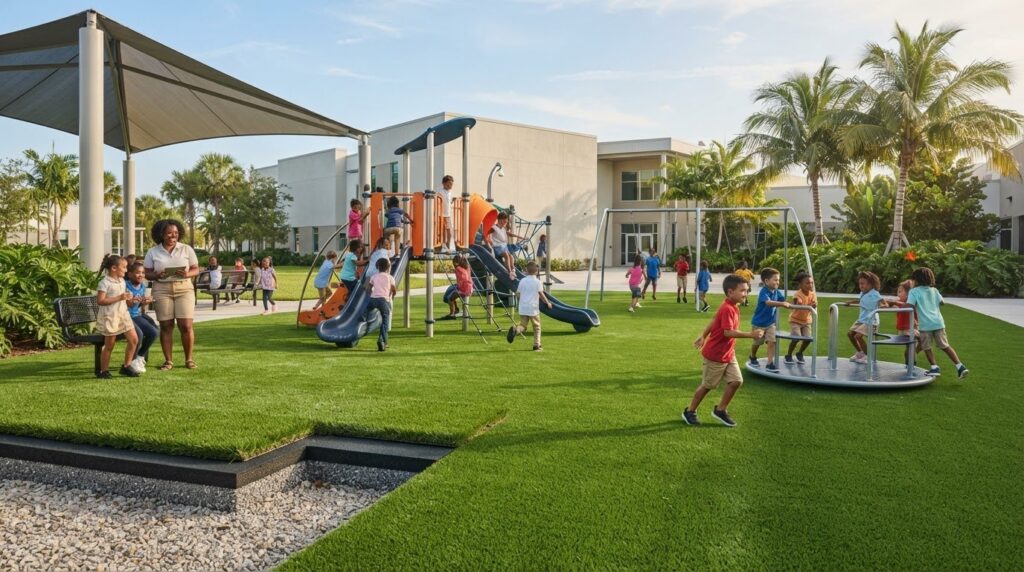
Schools may use turf in playgrounds, recreation areas, and selected outdoor learning spaces. The intended activity should guide the design: a space for supervised lessons or sitting may have different demands from an area where students run, play games, or use equipment with fall zones. Age groups matter, too. Consider how children are likely to move through the space, which equipment they’ll use, and whether different activities need clearly designated areas.
Potential benefits and realistic limitations
A well-designed turf surface may offer a more consistent playing area than ground that becomes uneven or worn with heavy use. It may also reduce mud, helping students move between outdoor and indoor areas with less soil tracked inside. These are practical benefits, not guarantees that falls or other injuries will be prevented.
There are trade-offs to assess. Surface temperature under South Florida sun, fall cushioning, drainage after rain, and the maintenance needed to keep the system in suitable condition all depend on the site and chosen design. Regular inspections matter, too. Check for visible wear, displaced infill where used, seams or edges that need attention, and areas where water collects. A professional assessment can help match the intended activities to appropriate system choices instead of treating all school turf as interchangeable.
How the Complete School Turf System Affects Playground Safety
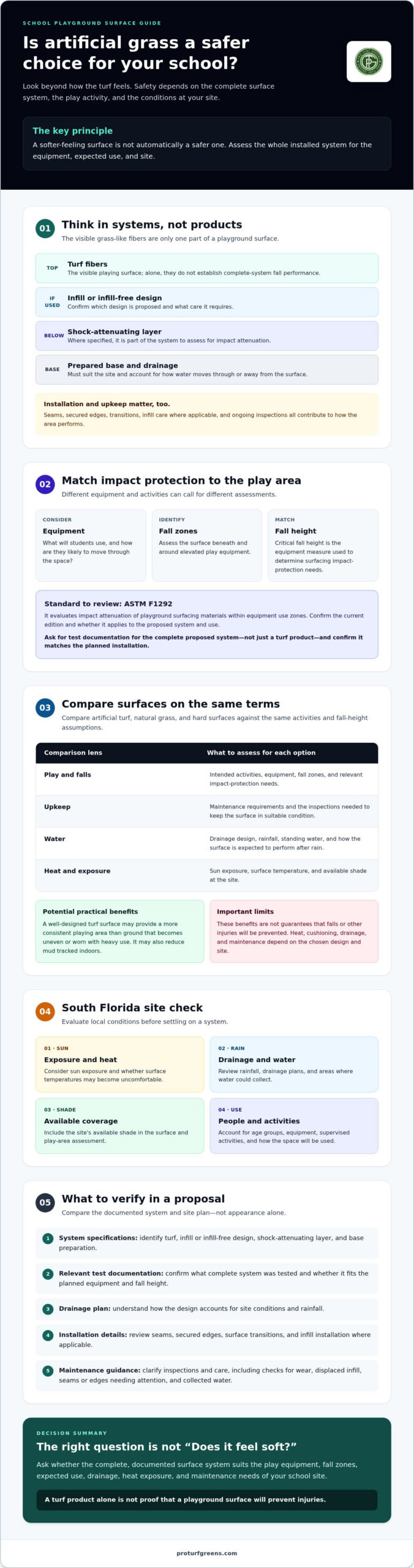
Playground safety isn’t determined by the grass fibers alone. Turf, infill when specified, any shock-attenuating layer, and the prepared base work together as a surface system. Changing one component can affect performance, so test information for a single turf product may not establish how the complete installation performs.
ASTM F1292 evaluates the impact attenuation of playground surfacing materials within equipment use zones. Grass fibers alone cannot demonstrate how the complete installed surface will perform during a fall. Schools should confirm the current edition and whether the standard applies to the proposed system and use.
Impact attenuation and fall zones
Critical fall height is the equipment’s fall-height measure used to determine how much impact protection the surfacing needs in the relevant fall area. In practical terms, the surface beneath and around elevated play equipment must be assessed in relation to the height from which a child could fall. The required performance may differ between an open play area and a zone below climbing equipment.
Ask for documentation showing that the proposed complete surface system was tested for impact attenuation and is appropriate for the intended equipment and fall height. Check that the documentation identifies the system components and matches the planned installation. A turf product by itself isn’t proof that the play area will prevent injuries.
Materials, drainage, and installation quality
Impact performance is only one part of a dependable system. The base must be prepared for the site, and the drainage design should account for rainfall so water can move through or away from the surface as intended. Poor drainage can leave standing water or affect surface stability, making the area less practical after rain.
Review installation details closely. Seams should be properly joined, edges secured, and transitions between surfaces considered to reduce uneven changes underfoot. Where infill is specified, confirm how it will be installed and maintained. Request clear guidance on inspections and upkeep so wear, separation, or drainage concerns can be addressed.
For a deeper review of applicable criteria and selection considerations, see this Florida playground turf safety standards guide. Schools in South Florida can also discuss project questions and the intended play area with Pro Turf Greens, which designs and installs playground and recreational turf.
Artificial Grass vs. Other School Play Surfaces: Compare Safety Trade-Offs
No surface is the right choice for every school area. A fair comparison starts with the same intended activities, equipment, and fall-height assumptions, then considers upkeep, drainage, heat, and access. A general lawn used for gathering should not be judged by the same criteria as surfacing beneath climbing equipment.
| Surface | Impact and activity | Upkeep and drainage | Heat and access |
|---|---|---|---|
| Artificial grass | Impact performance depends on the complete system and its suitability for the play area. | May reduce mud; base and drainage design affect how the area performs after rain. | Assess sun exposure and surface temperature. Review transitions and access routes. |
| Natural grass | May suit general lawn use, but shouldn’t be assumed to provide required fall protection for play equipment. | Care and weather affect condition; wet or heavily used areas may become muddy or worn. | Consider shade, ground conditions, and whether routes remain usable in wet weather. |
| Hard surfaces | Can suit activities designed for firm ground, but impact protection must be considered where falls are possible. | Evaluate water runoff, pooling, and surface condition. | Assess sun exposure, accessible routes, and changes in level at adjoining surfaces. |
Artificial grass and natural grass
Turf may offer a more consistent-looking play area and reduce mud, while natural grass provides a living surface whose condition can vary with weather, traffic, and care. Neither option is automatically safe for every activity. A lawn suitable for outdoor lessons or informal gathering isn’t necessarily designed to cushion falls from playground equipment. Compare each surface for its intended use, not just its appearance.
Artificial grass and hard play surfaces
Hard surfaces may be appropriate for activities that call for firm footing, while turf may suit recreation or play areas where a different surface is desired. Don’t infer impact performance from material labels alone. For areas with fall risks, verify that the selected system has relevant performance documentation for the equipment and use. Also compare how accessible routes connect to the surface, whether transitions are even, and how drainage is managed.
Compare surfaces against the same activities and fall-height assumptions, then weigh site-specific sun exposure, rainfall and drainage, maintenance capacity, and accessibility. This helps schools assess artificial grass for schools alongside other options without declaring one material universally safest.
How Schools Can Assess Turf Safety in South Florida
A South Florida site assessment should consider how the play area will be used and how local conditions may affect it throughout the school year. Use this sequence to organize your review of artificial grass for schools before comparing proposals:
- Define activities and users. Record planned play, recreation, and learning activities, along with equipment, student age groups, and expected daily use. Note where falls could occur and identify the relevant equipment height and use zones.
- Review the site. Walk the proposed area and note slopes, existing drainage patterns, access routes, edges, transitions, and locations that receive direct sun or shade. Consider where students enter and exit, including connections to nearby buildings and other surfaces.
- Check heat conditions. Ask how the school can assess surface temperatures during hot, sunny conditions and which times and locations to include. Consider how shade and activity scheduling fit the site, but don’t assume these measures will keep turf cool.
- Assess rain and drainage. South Florida rainfall makes water management a practical project consideration. Ask how the base and drainage design are intended to handle water at this specific location, and how the school can check for pooling after rain.
- Review evidence and requirements. Request documentation for the proposed system and its intended application. Have qualified playground or surfacing professionals help verify which current standards, school or district requirements, and project-specific criteria apply. Don’t assume one set of requirements automatically covers every school or site.
- Plan inspections and upkeep. Ask what staff should check routinely, including the surface, seams, edges, transitions, drainage, and infill if used. Clarify what maintenance the system requires and who will be responsible for tracking concerns.
Questions to ask before selecting a system
Ask suppliers to connect their proposal to the school’s documented activities, equipment, fall heights, and expected use. What testing or other documentation supports the complete system for that application? How does the design address accessible routes and transitions between surfaces? What drainage approach is proposed, and what inspection or maintenance guidance will the school receive? Clear answers make proposals easier to assess for performance and practical fit, not appearance alone.
Sun, shade, rainfall, and drainage vary across a campus, so evaluate the actual play area rather than relying only on general product information. A professional site assessment can help identify relevant questions before installation. To discuss a South Florida school playground project, request a site assessment from Pro Turf Greens.
Planning a School Artificial Grass Project: From Assessment to Installation
A well-planned project moves from educational needs to a site-specific design, then to installation and ongoing care. Schools considering artificial grass for schools can use this sequence to keep safety, practical use, and documentation central throughout the decision:
- Define the intended use. Identify activities, equipment, student age groups, expected use, and any areas where falls are a concern.
- Assess the site. Document existing conditions, including sun and shade, slopes, access routes, transitions, and drainage concerns.
- Verify requirements. Check applicable current standards and school or district requirements with qualified professionals. Confirm that the proposed system is appropriate for the intended use.
- Compare proposals. Review complete system specifications, site preparation, performance documentation, drainage plans, project scope, and the responsibilities included.
- Plan for upkeep. Request maintenance guidance and establish who will inspect the surface and how concerns will be recorded and addressed.
What to review in an installer proposal
A useful proposal should describe the system as a whole, including turf, infill if specified, any shock-attenuating layer, base preparation, edges, transitions, and drainage. Ask which tests or documents support the proposed system and what each one establishes. A test result for one component shouldn’t be treated as proof of performance for the complete installation. Clarify the project scope, expected maintenance, and who is responsible for future inspections.
Compare proposals against the same school needs and site information. If a document or specification is unclear, ask the installer to explain how it relates to the planned activities and conditions. This helps decision-makers evaluate the design and proposed work instead of relying on surface appearance alone.
Next steps for South Florida schools
Before speaking with an installer, gather site photos, an approximate area, intended activities, and notes about known drainage or access issues. Share where the area receives direct sun and where shade is available. These details make an initial discussion more specific, though an on-site assessment is needed to understand each campus. Don’t assume one design will fit every school.
Pro Turf Greens designs and professionally installs school, playground, and recreational turf in South Florida. Schools can review the Miami artificial turf consultation guide to understand what a local consultation may involve. For a low-pressure next step, request a free artificial turf consultation and confirm service availability for your school’s location.
Make Your School’s Next Surface Decision with Confidence
The right choice for artificial grass for schools starts with the needs of students and the site, not the turf’s appearance alone. Assess the complete surface system, including impact protection, drainage, and installation details. Then compare options against the same activities, equipment, and fall-height requirements.
In South Florida, include sun exposure, surface temperature, rainfall, and maintenance planning in the evaluation. Request system specifications and relevant test documentation, and confirm applicable standards and school or district requirements with qualified professionals. A site-specific plan gives decision-makers a clearer basis for comparing proposals and preparing for upkeep.
Pro Turf Greens designs and installs playground and recreational turf for schools and commercial venues in South Florida. For a school in Fort Lauderdale, Miami, Palm Beach, Boca Raton, Delray Beach, Jupiter, Palm Beach Gardens, Weston, or Coral Gables, request a free artificial turf consultation for your school to discuss your project.
Frequently Asked Questions
Is artificial grass safe for school playgrounds?
Artificial grass can be suitable for a school playground when the complete surface system is designed for its intended activities and installed and maintained appropriately. Safety depends on more than the turf fibers: the infill, any shock-absorbing layer, base, drainage, edges, and transitions all matter. Schools should review relevant test documentation and check current standards and district requirements with qualified professionals before choosing a system.
Can artificial grass help reduce playground injuries?
Artificial grass may provide a more consistent surface, and a properly selected system can be designed to provide impact attenuation for specified play areas. It can’t guarantee that injuries will be prevented. Falls, equipment design, fall height, supervision, installation quality, and maintenance all influence playground safety. Ask for documentation that applies to the complete proposed system and the equipment and use planned for the site, rather than relying on a general product claim.
Does artificial grass get too hot for children in South Florida?
Artificial turf can become hot in direct sun, so schools shouldn’t assume the surface will stay comfortable during South Florida’s sunny conditions. Plan to assess surface temperatures at the actual site during hot, sunny periods, including areas with different exposure and shade. Consider available shade and activity scheduling as parts of site planning, but don’t treat them as guaranteed cooling measures. Establish a practical process for staff to monitor conditions before children use the area.
What should schools check before installing artificial grass?
Start by documenting activities, equipment, fall heights, student age groups, and expected daily use. Then assess sun exposure, drainage, access routes, edges, transitions, and maintenance capacity. Request complete system specifications, applicable impact-test documentation, a drainage plan, and clear upkeep guidance. Schools in Fort Lauderdale, Miami, Palm Beach, Boca Raton, Delray Beach, Jupiter, Palm Beach Gardens, Weston, and Coral Gables should verify current project and district requirements for their specific site with qualified professionals.
How does artificial grass compare with natural grass for school play areas?
Artificial turf may offer a more consistent surface and reduce mud, while natural grass conditions can vary with weather, use, and care. Neither surface is automatically suitable for every play activity. A lawn for outdoor lessons or informal gathering has different considerations from a playground fall zone. Compare both options using the same intended activities and fall-height assumptions, and include upkeep, drainage, accessibility, and site conditions in the decision.
Does school playground turf need a shock-absorbing layer?
Not every turf area has the same shock-attenuation requirements. The answer depends on the equipment, fall height, use zone, and proposed surface system. A shock-absorbing layer may be one component of a system intended to meet relevant impact-performance criteria. Ask the installer for test documentation that identifies the complete system and confirms its suitability for the planned application. Have qualified professionals verify applicable standards and school or district requirements.
How should schools maintain artificial grass playground surfaces?
Follow the maintenance guidance for the specific installed system and arrange routine inspections. Staff should look for visible wear, loose or separated seams, unsecured edges, uneven transitions, drainage problems, and displaced infill if the system uses it. Keep a record of observations and follow the provider’s recommendations for addressing concerns. Agree on inspection responsibilities before installation so the school knows who monitors the surface and how issues are reported.