Your driving range tee line shouldn’t be a liability that fails under the South Florida sun; it should be the most reliable revenue generator on your property. Every facility manager understands the frustration of watching natural grass wither from heavy foot traffic and relentless humidity. It’s exhausting to handle member complaints about inconsistent hitting surfaces or muddy patches after a typical afternoon thunderstorm. You’ve likely spent years balancing high maintenance costs for seeding and irrigation against the need for a pristine, professional practice environment.
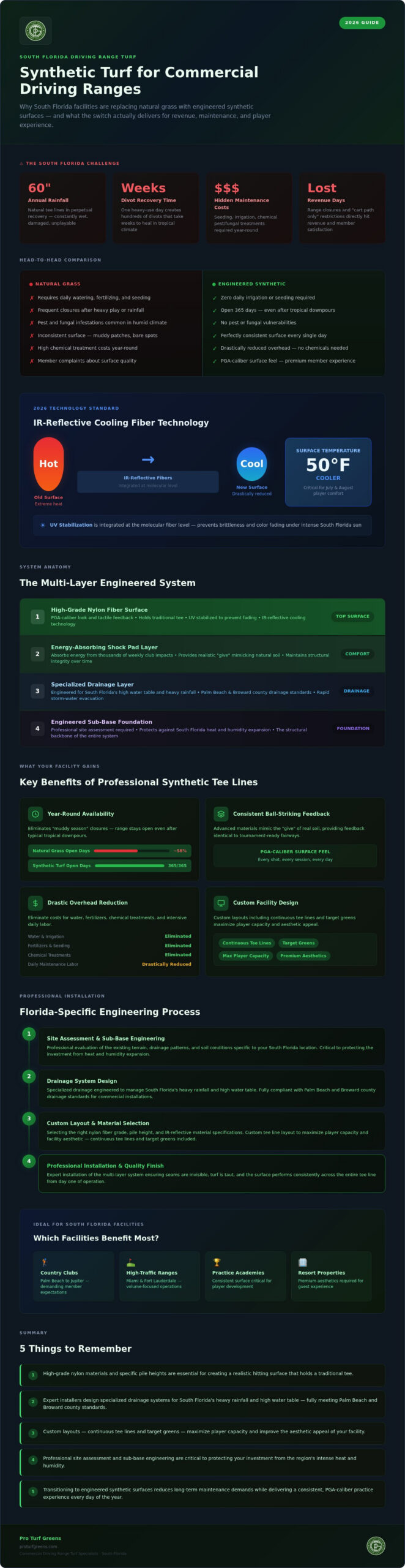
Choosing the right commercial driving range turf installers is about more than just sourcing a product. It’s about partnering with experts who understand that a modern facility requires an engineered system capable of mimicking PGA-caliber surfaces while resisting the local climate. This 2026 guide shows how professional-grade synthetic turf transforms high-traffic ranges into durable, low-maintenance assets that enhance player experience. We’ll examine the latest IR-reflective cooling technologies that lower surface temperatures by up to 50 degrees, discuss updated drainage standards for Palm Beach and Broward counties, and outline the steps to create a high-performance practice environment that thrives in our unique tropical landscape.
Key Takeaways
- Learn why high-grade nylon materials and specific pile heights are essential for creating a realistic hitting surface that holds a traditional tee.
- Discover how expert commercial driving range turf installers design specialized drainage systems to manage South Florida’s heavy rainfall and high water table.
- Explore custom layout strategies, including continuous tee lines and target greens, to maximize player capacity and improve the aesthetic appeal of your facility.
- Understand the importance of professional site assessment and sub-base engineering in protecting your investment from the region’s intense heat and humidity.
- Identify how transitioning to engineered synthetic surfaces reduces long-term maintenance demands while providing a consistent, PGA-caliber practice experience for members.
The Evolution of Driving Range Surfaces: Why South Florida Facilities are Switching
The transition from traditional grass to synthetic surfaces isn’t just a trend; it’s a strategic response to the harsh realities of the South Florida environment. For decades, facility managers viewed artificial options as a compromise. However, The Evolution of Driving Range Surfaces has transformed the industry, moving away from thin mats glued to concrete toward complex, multi-layered engineered systems. These modern installations provide the same tactile feedback as a well-manicured fairway while offering the resilience needed to survive 365 days of heavy use.
In South Florida, the “Florida Factor” presents a unique set of challenges. With over 60 inches of annual rainfall and punishing humidity, natural tee lines are often in a state of perpetual recovery. When you factor in the intense heat, it’s clear why many country clubs are now seeking specialized commercial driving range turf installers to overhaul their practice areas. The goal is to eliminate the cycle of seeding, watering, and waiting that drains both budgets and member patience. Today’s facilities are shifting toward integrated, professional-grade landscapes that look as beautiful as they perform.
The Problem with Natural Grass in High-Traffic Zones
High-volume facilities in Miami and Fort Lauderdale face a losing battle with recovery times. A single day of heavy play can create hundreds of divots that take weeks to heal in our tropical climate. During this period, tee lines must be rotated or closed, leading to “cart path only” restrictions or complete facility downtime. These closures represent a direct hit to revenue and member satisfaction. Additionally, the porous soils of South Florida are breeding grounds for specific pests and fungi that thrive in the moisture. This requires expensive chemical treatments that natural grass simply cannot survive without, adding another layer of cost and complexity to daily operations.
Benefits of Professional Synthetic Tee Lines
Working with experienced commercial driving range turf installers allows facilities to bypass the vulnerabilities of organic turf. Professional-grade synthetic surfaces offer several key advantages that impact the bottom line and the player experience:
- Consistent ball-striking feedback: Advanced materials mimic the “give” of real soil, providing feedback identical to tournament-ready fairways.
- Year-round availability: Synthetic systems eliminate “muddy season” closures, ensuring the range remains open even after a typical tropical downpour.
- Drastic overhead reduction: Facilities save on water, fertilizers, and intensive labor by removing the need for daily grass maintenance.
By choosing a synthetic landscape, clubs from Palm Beach to Jupiter are creating a steady, reliable environment where golfers can hone their skills on a surface that looks and feels premium every single day.
Engineering Performance: The Anatomy of High-Quality Commercial Turf
High-performance driving ranges rely on sophisticated Engineering Performance to deliver a surface that stands up to thousands of club impacts every week. Unlike residential lawns, commercial hitting areas require specific structural integrity to maintain their shape and functionality. Professional-grade turf is a multi-layered system designed to absorb energy, manage heat, and provide the same resistance as natural soil. When you partner with experienced commercial driving range turf installers, they focus on the material science that ensures your investment doesn’t degrade after a single season of heavy use.
The South Florida sun is particularly brutal on synthetic fibers. By 2026, advanced cooling technologies like IR-reflective fibers have become a standard requirement for local facilities. These specialized materials can lower surface temperatures by 30°F to 50°F, which is critical for player comfort during July and August. UV stabilization is also integrated into the fiber at the molecular level, preventing the turf from becoming brittle or fading under intense solar radiation. This ensures the facility maintains its lush, professional aesthetic for years rather than months.
Nylon vs. Polyethylene for Driving Ranges
Heavy-duty nylon remains the gold standard for commercial hitting surfaces because of its high melting point and superior resilience. While polyethylene is often used for residential lawns due to its softness, it can suffer from “friction burn” when a clubhead strikes it at high speeds. Nylon resists this melting effect, making it the better choice for facilities with 100 or more daily users. It also provides the structural stiffness needed to hold a real wooden tee. If you aren’t sure which material fits your specific player volume, you can reach out to commercial driving range turf installers for a detailed material comparison.
Advanced Base Systems and Shock Absorption
The foundation beneath the turf is just as important as the fibers on top. Modern installations often utilize modular base panels and multi-layered shock pads to prevent “Golfer’s Elbow” and other repetitive strain injuries. These systems mimic the natural compression of turfgrass, allowing the club to “thump” into the surface without jarring the player’s joints. Pile density is the measurement of fiber concentration within the turf backing that dictates how well the surface maintains its upright structure under the stress of repeated commercial wear cycles. Using specialized sand or rubber infill further enhances this effect by providing the weight and stability required to keep the turf perfectly level across the entire tee line.
Designing Your Facility: Custom Layouts for Maximum Player Capacity
Facility design in 2026 has moved beyond simple utility. A well-conceived range acts as a visual centerpiece for a country club, reflecting the high standards of the property. Experienced commercial driving range turf installers focus on creating a “total facility” aesthetic that integrates hitting areas with realistic target zones and hazards. This comprehensive approach maximizes player capacity while providing an immersive training environment that members expect from elite South Florida venues. By treating the entire range as a cohesive landscape, facilities can improve both the functionality of the space and the overall property value.
Continuous Tee Lines vs. Individual Hitting Mats
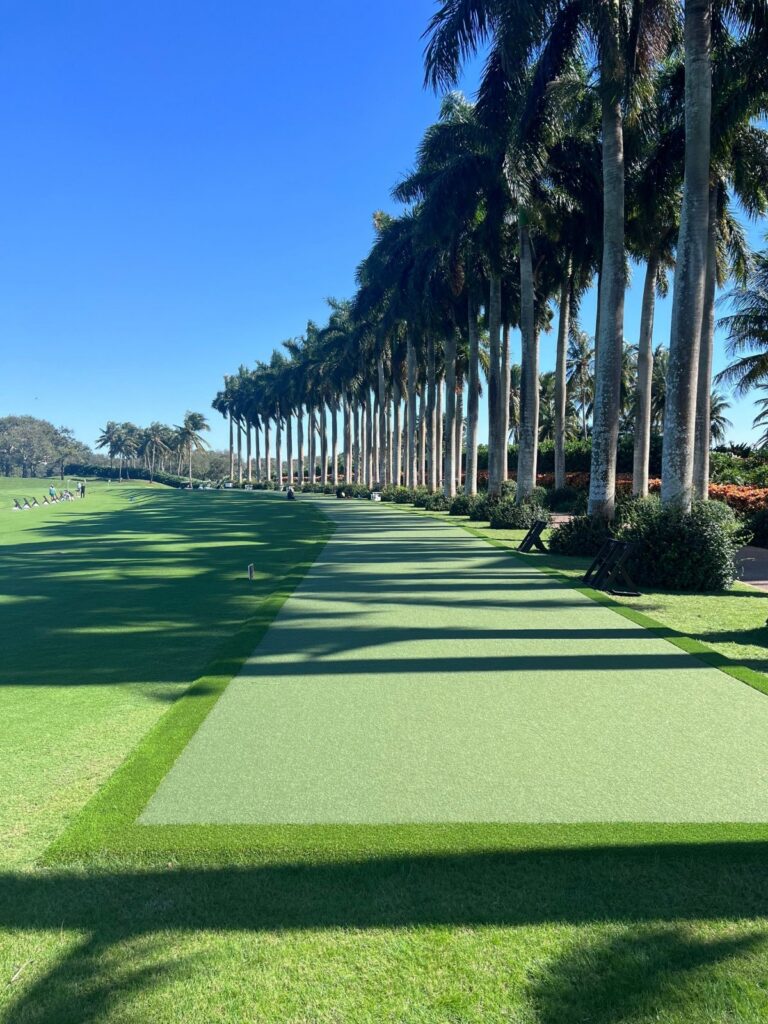
High-end venues in Palm Beach and Boca Raton increasingly favor continuous tee lines over individual mats. These long, seamless strips of professional-grade turf allow instructors to host large-scale clinics and group outings without being restricted by mat boundaries. It’s a flexible solution that accommodates players of all sizes and stances. In contrast, boutique facilities or residential clubs in Weston might opt for individual mats to fit smaller, more defined footprints. While individual mats allow for easy rotation to manage wear, continuous lines offer a cleaner, more upscale appearance and significantly more versatility for daily operations and special member events.
Landing Zone Optimization
The landing area is where the visual feedback happens for the golfer. By using varied turf heights and color tones, installers create distinct target greens that mimic real on-course scenarios. High-visibility turf for these greens makes ball retrieval significantly more efficient, as balls don’t disappear into deep, unkempt grass. Designing the surrounding “rough” with specific fiber density helps stop balls quickly, preventing bounce-back issues that can be a safety concern on crowded ranges. These landing zones provide the necessary targets for data-driven practice, which has become a primary trend for modern golfers.
To achieve a truly cohesive look, many facilities incorporate custom putting green design elements into their range layouts. This often includes synthetic fringe and rough that frame the hitting area, blending the artificial surfaces seamlessly into the surrounding natural landscape. Integrating practice bunkers and hazards further elevates the training experience. This transforms a simple practice range into a comprehensive short-game facility that caters to every aspect of a golfer’s development, ensuring your facility remains a top-tier destination for serious players.
The Installation Process: Florida-Specific Engineering and Drainage
Successful driving range upgrades in our region require a deep understanding of the local geology. Professional commercial driving range turf installers don’t just roll out green carpet; they engineer a drainage system capable of handling the state’s unique environmental pressures. The process begins with a meticulous site assessment to evaluate soil stability and water table levels, which vary significantly from the limestone ridges of Miami to the sandy soils of Palm Beach Gardens. Without this initial step, even the most expensive turf can fail as the ground shifts or saturates over time.
Durability starts with proper excavation. We remove all organic material, such as old sod and roots, to prevent the decomposition that causes sinking or “waves” in the finished surface. After clearing the site, we install and compact layers of crushed aggregate to create a rock-solid, long-term base. This foundation is what determines the ultimate life of the turf, ensuring it remains stable despite the heavy foot traffic and mechanical equipment used on commercial ranges.
Managing South Florida Rain: Drainage Solutions
South Florida is famous for its 3:00 PM summer deluges that can drop inches of rain in under an hour. Implementing artificial turf drainage solutions is non-negotiable for facilities that want to remain playable minutes after a storm. In coastal areas like Delray Beach, we utilize highly permeable base materials that allow water to move vertically through the turf and into a sub-surface drainage network. This prevents the “ponding” effect that often plagues natural grass tee lines, keeping your range open and generating revenue while competitors are still drying out their practice areas.
Site Preparation and Laser Grading
Once the base materials are in place, we utilize advanced laser-grading technology to fine-tune the surface. Laser-grading is critical because it ensures a perfectly level hitting surface that provides golfers with the accurate ball flight feedback they need to improve their game. This precision eliminates the subtle slopes and dips that can cause inconsistent strikes, providing a tournament-quality experience for every member. The final phase involves the art of seaming and infilling, where our crews use high-strength adhesives and specialized materials to ensure the surface feels natural underfoot. If you’re ready to modernize your facility with a climate-resilient solution, contact the expert commercial driving range turf installers at Pro Turf Greens by calling 561-221-1010 for a consultation.
Choosing Your Partner: Why Pro Turf Greens for South Florida Facilities
Selecting commercial driving range turf installers is a decision that impacts your facility’s reputation and operational budget for years. While national franchises offer brand recognition, they often lack the localized knowledge required for the specific environmental demands of the Miami to Jupiter corridor. We understand that a country club in Boca Raton faces different soil stability issues than a boutique range in Coral Gables. Pro Turf Greens positions itself as a dedicated partner, providing the technical precision and aesthetic excellence necessary for high-end South Florida estates and commercial venues.
Our process is entirely turn-key. We guide facility managers from the initial design phase through final grading and specialized maintenance training. This comprehensive oversight ensures that every detail, from drainage to fiber resilience, meets our stringent quality standards. Investing in these systems offers a clear financial advantage for the property. By analyzing the long-term value in our driving range turf cost guide, it’s easy to see how the reduction in chemical treatments, labor, and water consumption creates a rapid return on investment.
The Pro Turf Greens Advantage
We’re committed to delivering PGA caliber surfaces for every project we undertake. This isn’t just a marketing claim; it’s a standard of craftsmanship that ensures your members enjoy a professional-grade experience every time they step onto the tee line. Because we’re local, we provide rapid response times and support that national competitors can’t match. If a facility manager in Palm Beach Gardens has a question about their sub-base after a major storm, we’re just a phone call away. Our ability to customize every layout allows us to work around existing landscape features, creating a seamless blend between synthetic and natural areas that national franchises often overlook.
Ready to Upgrade Your Range?
The first step toward transforming your practice facility into a world-class destination is a Miami artificial turf consultation. During this session, we map out the specific requirements of your project and evaluate the unique challenges of your site. You’ll receive a free site assessment where we inspect soil conditions, drainage paths, and player flow. This meticulous planning prevents costly surprises during the installation phase and ensures the final result exceeds expectations. When you’re ready to speak with a commercial turf specialist about your vision, call us at 561-221-1010 to begin your facility’s transformation.
Elevate Your Facility’s Standard for 2026 and Beyond
Modernizing your driving range is a strategic investment that pays dividends in both member satisfaction and operational efficiency. By moving beyond basic hitting mats and embracing engineered synthetic systems, you ensure your facility remains playable through South Florida’s most challenging weather cycles. High-performance nylon surfaces and advanced sub-surface drainage aren’t just luxuries; they’re essential components for any competitive club in the 2026 market. These systems protect your bottom line by reducing maintenance downtime and providing a consistent experience that keeps golfers returning to your tees.
Partnering with specialized commercial driving range turf installers like Pro Turf Greens provides you with the local expertise needed to navigate high water tables and intense UV exposure. We take pride in delivering turn-key, PGA-caliber practice environments that mirror the look and feel of a championship course. Whether you’re managing a luxury estate in Boca Raton or a high-volume facility in Miami, our team is ready to guide you through every step of the transformation with climate-resilient solutions tailored to your unique landscape.
Take the first step toward a more resilient and profitable practice area. Request Your Free Commercial Turf Consultation today or call 561-221-1010 to discuss your project with our specialists. We’re excited to help you build a facility that truly stands out in the South Florida golf community.
Frequently Asked Questions
How long does commercial driving range turf typically last in South Florida?
Commercial-grade turf systems in South Florida typically maintain their performance for 8 to 15 years, depending on the volume of daily players. High-quality nylon fibers are specifically engineered to resist the melting caused by friction and the brittleness often triggered by intense UV exposure. While residential lawns might last longer, the heavy mechanical wear of a commercial facility requires a system designed for longevity. Regular grooming and proper infill maintenance help extend this lifespan significantly.
Can synthetic tee lines actually hold a real golf tee?
Yes, professional-grade synthetic tee lines are designed with enough pile density to support a standard wooden golf tee. This feature is a hallmark of the high-end surfaces installed by commercial driving range turf installers. It allows golfers to practice with their own equipment just as they’d on a natural grass tee box. The fibers grip the tee securely, providing a stable platform for driver practice without the need for rubber mats or specialized accessories.
How does the drainage system handle heavy Florida rain and hurricanes?
Our drainage systems are engineered to manage the vertical flow of water at a rate that exceeds South Florida’s heaviest tropical downpours. By using a highly permeable aggregate base and sub-surface perforated pipes, we ensure that water moves away from the hitting surface instantly. This prevents ponding and saturation even during hurricane-season storms. Your facility can return to full operation almost immediately after the clouds clear, maintaining your revenue stream without weather-related delays.
Is synthetic turf safe for golfers joints compared to natural grass?
Synthetic turf is often safer for a golfer’s joints than natural grass because it provides consistent, predictable shock absorption. Professional installations include multi-layered shock pads that mimic the give of healthy soil. This technology reduces the impact transferred to the wrists, elbows, and shoulders during a strike. It effectively prevents common injuries like Golfer’s Elbow, making it an ideal choice for members in communities like Boca Raton who practice frequently.
What maintenance is required for a commercial synthetic driving range?
Maintenance for a synthetic range is remarkably low compared to the intensive care required for natural grass. You won’t need to worry about seeding, irrigation, or chemical treatments. The primary tasks involve periodic brushing to keep fibers upright and clearing organic debris like leaves or twigs. Occasionally, you may need to top off the specialized infill to maintain the proper surface weight and compression. This simple routine ensures a pristine practice environment year-round.
Can I install synthetic turf over an existing concrete hitting area?
While it’s possible to install turf over concrete, we generally recommend a specialized aggregate base for professional-grade facilities. Concrete doesn’t allow for the vertical drainage necessary in cities like Miami or Fort Lauderdale. An engineered base provides better shock absorption and prevents the surface from feeling too hard or jarring on impact. If you have an existing concrete pad, our team can evaluate the best way to integrate a high-performance system that meets modern standards.
How does the heat of the Florida sun affect the turf temperature?
Modern synthetic turf utilizes advanced IR-reflective technology to manage the intense South Florida heat. These specialized fibers can lower surface temperatures by 30 to 50 degrees compared to older, traditional turf products. This cooling effect is essential for player comfort during the humid summer months in Palm Beach Gardens and Jupiter. By reflecting solar radiation rather than absorbing it, the turf remains comfortable for golfers even during the peak afternoon sun.
Do you provide custom target green designs for the landing area?
We specialize in creating custom-tailored landing zones that include realistic target greens, synthetic bunkers, and framing rough. These designs provide essential visual feedback for golfers and help facilities in Coral Gables and Weston stand out. Our commercial driving range turf installers work with you to map out a layout that maximizes player capacity while enhancing the aesthetic appeal of your property. This total facility approach transforms a standard range into a comprehensive training center.