Artificial turf can drain through its backing and still leave water pooling at the edges. Troubleshooting poor turf drainage starts with checking whether the base near the borders is compacted or uneven, then tracing the slope and stormwater flow. Water should move away from the turf, not collect on it. Persistent pooling may call for a drainage pipe or another route for runoff.
It’s understandable to focus on the turf when a lawn stays wet, but the cause can lie below the surface or in the water flowing onto it. This guide explains how to inspect border compaction, grading, runoff paths and drainage exits, then how to tell when a drain or pipe may help. You’ll have a clearer way to distinguish a surface-flow issue from a problem that needs a deeper drainage solution.
Key Takeaways
- Look for settling or soft spots along turf borders, where uneven support can point to a base-preparation issue.
- Trace the ground’s grade to see whether runoff moves away from the turf or collects in low areas.
- Follow stormwater from nearby surfaces to the turf, then identify whether it has a clear exit path.
- Consider a French drain, catch basin, or drainage pipe when correcting surface flow alone doesn’t resolve persistent pooling.
1. Compaction and settling around turf borders
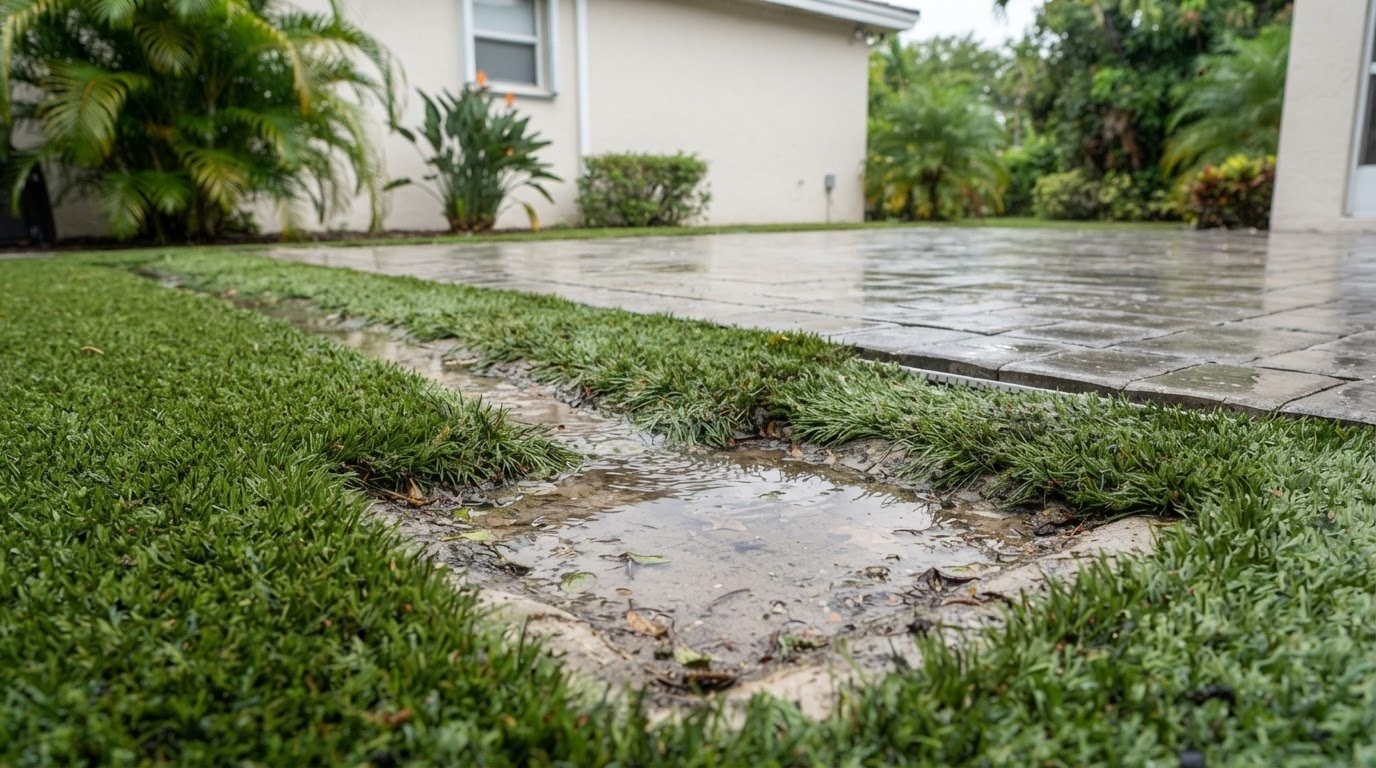
Inspect turf borders after rain, where shallow depressions can reveal settling beneath the surface. A low seam or soft edge may indicate uneven support, compacted backfill, or water trapped beside the installation. Compare the affected border with a firm, level section nearby. Note whether the dip follows a pipe trench or extends across a wider area.
Artificial turf backing can drain at 30+ inches per hour per square yard, but that capacity doesn’t mean water moves through the sub-base equally quickly. A dense or poorly prepared base can hold water beneath the turf. Inadequate preparation can also contribute to uneven surfaces and premature wear. Look for changes in level along turf ribbons, seams, and perimeter edges.
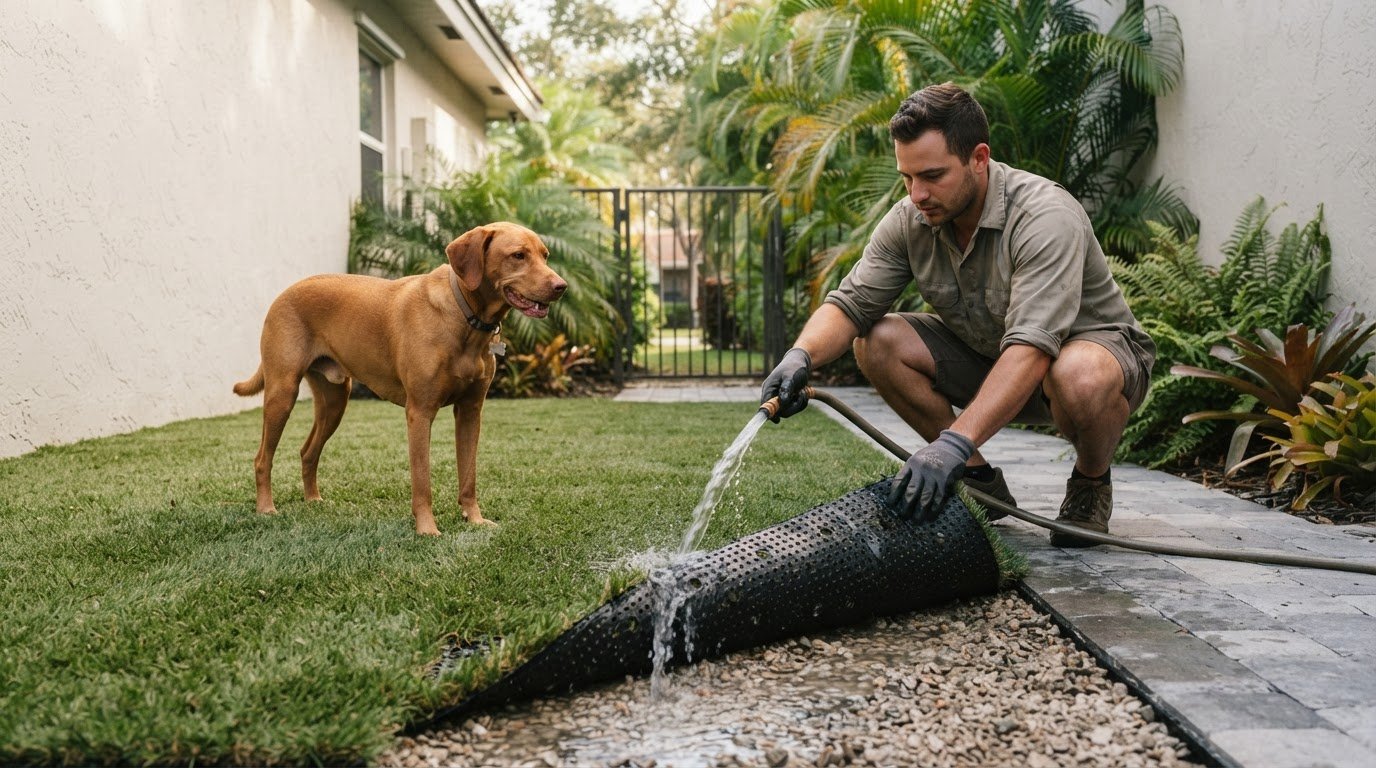
To improve drainage, first determine whether the problem is in natural soil or the artificial turf sub-base. If the turf base material is unsuitable, it may need to be removed and replaced with drainage material, then properly compacted and leveled.
A stable artificial turf base commonly uses compacted crushed stone or decomposed granite. The sub-base should be compacted to 80% or higher to reduce saturation and settling near borders. If pipes or drains cross the area, compact their trench backfill firmly. Loose backfill can settle later, creating a low channel that collects water along the turf edge.
Core aeration is for compacted soil beneath living grass, not artificial turf. It can help when natural soil is dense and water struggles to enter; topdressing can then fill the aeration openings. Soil amendments are appropriate for a diagnosed soil issue, not as a universal fix. They will not correct a poorly graded or compacted artificial turf base.
When troubleshooting poor turf drainage, connect the symptoms on the surface to the layer causing them. A depression beside a trench may point to settling, while broad soft areas suggest a base problem. If the repair requires lifting turf, excavating the base, and rebuilding its support, surface aeration or soil amendments will not fix the installation issue.
2. Slope and grading for runoff
Artificial turf should be graded so water flows away rather than pooling. After rain, trace runoff across the surface and note where it slows, changes direction, or collects. A shallow dip beside a patio, wall, or turf edge can interrupt an otherwise clear flow path. Compare wet areas with nearby ground to see whether the slope directs water toward the turf.
To reduce standing water during heavy rain, correct low spots and grade the area to carry runoff away. Also identify water arriving from nearby roofs, paving, or higher ground. Grading the turf alone will not address an outside source.
Roof runoff can overwhelm a small turf area. A rooftop with 10,000 square feet of surface area produces approximately 8,000 gallons of runoff from 1 inch of rain. If a downspout discharges beside the lawn, that concentrated flow may reach the turf faster than its surface can shed it. Check where each downspout releases water and whether the discharge crosses the turf.
During a storm, follow the water from roof edges and paved areas toward the lawn. Water flowing from a driveway onto one corner suggests incoming runoff, while a puddle in a low central area points to a grading issue. Note where water leaves the turf, too. A clear, lower route helps runoff move through instead of remaining trapped.
Redirecting runoff without considering its full route can move the problem elsewhere. A new flow path may send water toward another low area, a turf border, or another part of the property; concentrated flow can also erode the underlying material. Trace the intended path before changing the grade, and make sure the exit can carry water away without creating another pool. For effective troubleshooting poor turf drainage, distinguish water falling on the surface from runoff entering it, then address the cause.

3. Assessing slope, stormwater flow, and drainage exits
Diagnose the route water takes, not just where it pools. After rain, note where runoff enters, crosses, and leaves the turf. Compare a wet patch with a nearby dry area, then check whether the wet spot is at a low point or beside an obstruction. A puddle near a blocked outlet suggests a different cause from water entering along an entire edge.
Check each drainage exit for debris, a crushed opening, or water backing up. Follow the flow beyond the turf to see whether it reaches a lower, open area. If the exit leads to a basin, observe whether water remains there after the surrounding surface clears. These observations help distinguish a local obstruction from a grading or drainage-system problem.
DIY fixes are suitable for visible, limited issues, such as clearing leaves from an accessible outlet. Bring in a drainage professional when water keeps pooling, the route is unclear, or the repair requires excavation near buried pipes. A professional assessment can trace the flow and evaluate how a proposed outlet connects to the site.
For residential drainage projects, permit requirements depend on the work and local rules. Before changing grades or installing buried drainage in Miami, check applicable requirements with the local permitting office. Do not direct runoff toward a neighboring property or create a new low spot; changes in one area can shift pooling elsewhere.
The cost of professional lawn drainage installation in the United States depends on the site and proposed work, and is provided after a quote request. Factors include the area involved, excavation, materials, and whether drains or pipes are needed.
When troubleshooting poor turf drainage, record each puddle’s location, the incoming flow path, and the condition of every exit. Water that enters from a paved side yard but stops at an outlet, for example, points to two separate flow issues. A simple site map can clarify whether the problem involves surface grading, a blocked exit, or drainage below the turf.
4. French drains, catch basins, and drainage pipes
When surface grading cannot move water away, an underground system may provide a collection and exit route. A French drain uses perforated pipe beneath the turf to collect water moving through surrounding aggregate. Drainage tiles can serve a similar purpose. The pipe must lead to a place where water can discharge, or the system will simply relocate the pooling problem.
A catch basin collects surface runoff at a low point through a grated opening. It can suit a patio edge or a spot where paved areas meet. The connected pipe carries collected water toward an appropriate exit. Check the basin opening for debris and trace its outlet; a clear grate will not help if the route downstream is blocked.
Aggregate around a perforated pipe creates space for water to reach the openings. Options include crushed or decomposed granite, limestone chat, a 3/8-inch-minus mixture, and ¾ washed limestone. Material choice depends on the drainage design and site conditions. The pipe, surrounding aggregate, and outlet need to function as one continuous path.
Before adding a drain, determine whether water collects across a broad area or at a distinct low point. A French drain may address water moving through soil toward a problem area, while a catch basin collects surface runoff. Neither replaces correcting a poor grade or controlling concentrated roof flow. Match the system to the water’s source and route.
Installation requires planning the trench route, pipe position, aggregate placement, and discharge point. Poorly compacted backfill can settle above a trench, while an unsuitable exit may send water back toward the turf. For persistent pooling that remains after surface-flow issues are addressed, a designed perforated drainage system may be appropriate. Explore artificial turf options as you plan a durable outdoor surface.
A perforated drainage system, such as a French drain or drainage tiles, can be installed beneath artificial grass to address drainage problems.
Pro Turf Greens
Pro Turf Greens is a natural next step when drainage concerns affect a planned artificial turf project or an existing area needs a broader redesign. Its installations include artificial turf lawns and pet turf, backyard putting greens, playgrounds and recreational turf, and tee lines and driving ranges. Considering the site’s grade, runoff route, and drainage exits as part of the project helps the surface work with its surroundings.
If pooling continues after you trace the flow, or you are planning a new turf area, share where water collects and how it moves across the site. That context provides a useful starting point for discussing the project and the right turf application for your space.
Contact Pro Turf Greens to discuss your turf project and drainage concerns.
Plan the surface around the way water moves
Use your drainage observations to guide the next design decision, not just the next repair. When planning a new outdoor space, consider how its intended use and the site’s water flow should work together. Troubleshooting poor turf drainage can inform plans for a backyard putting green, a playground or recreational area, or tee lines and driving ranges, with a layout suited to the property.
Pro Turf Greens designs and installs artificial turf projects for the space and its intended use. A clear description of where water collects and how it reaches the area gives the project discussion a useful starting point. The right next step may be to discuss the overall design rather than make another surface-level adjustment.
Contact Pro Turf Greens for help with your turf project and take a confident step toward a space designed with its surroundings in mind.
Frequently Asked Questions
What are the common causes of poor drainage in lawns?
Compacted soil, an uneven base, low areas, and blocked outlets can all leave water standing. The pattern offers useful clues: a wet patch beneath a downspout points to concentrated roof runoff, while a soggy strip along a border may suggest settling. In Miami yards, trace where water enters and exits before choosing a repair, since the visible puddle may not mark the source.
How do French drains, dry wells, and catch basins work for lawn drainage?
Each system handles water differently. A French drain collects water below ground through perforated pipe; a catch basin gathers surface runoff through an opening and directs it into a connected pipe. A dry well receives runoff and allows it to disperse into surrounding soil. For example, a basin can collect water at a paved low point, while a dry well may suit a site with suitable soil and placement.
How much slope is needed for proper lawn surface drainage?
The required slope depends on the area’s size, surrounding grades, surface, and available drainage exit. The practical test is whether the finished grade creates a continuous path that moves water away without forming a new low spot. In a Miami yard bordered by a patio, wall, or planting bed, the route beyond the lawn matters as much as the lawn’s surface.