A small putting green doesn’t need natural grass to deliver purposeful practice. The best putting green design for small yards makes efficient use of available space: about 100 to 150 square feet can accommodate a simple green, while 200 to 400 square feet allows putts of 10 to 25 feet from multiple angles. Synthetic turf can also be shaped with varied breaks and contours, so the challenge comes from thoughtful design as much as size.
Choosing the best putting green design for small yards means balancing surface speed, hole placement, elevation, and how the green fits beside a patio or entertaining area. This guide explains how to weigh those choices, including how turf materials affect play and what a compact layout can offer. You’ll learn how a green can support focused short-game practice while feeling like a natural part of your backyard.
Key Takeaways
- Match the green’s footprint and hole layout to how you’ll use the yard, from focused putting practice to entertaining.
- Thoughtful contours and elevation can add putting challenges without requiring a large space.
- Turf material affects putting speed and the kind of practice the surface supports.
- A stable base and effective drainage are essential parts of a well-planned synthetic green.
Putting greens for backyard entertaining
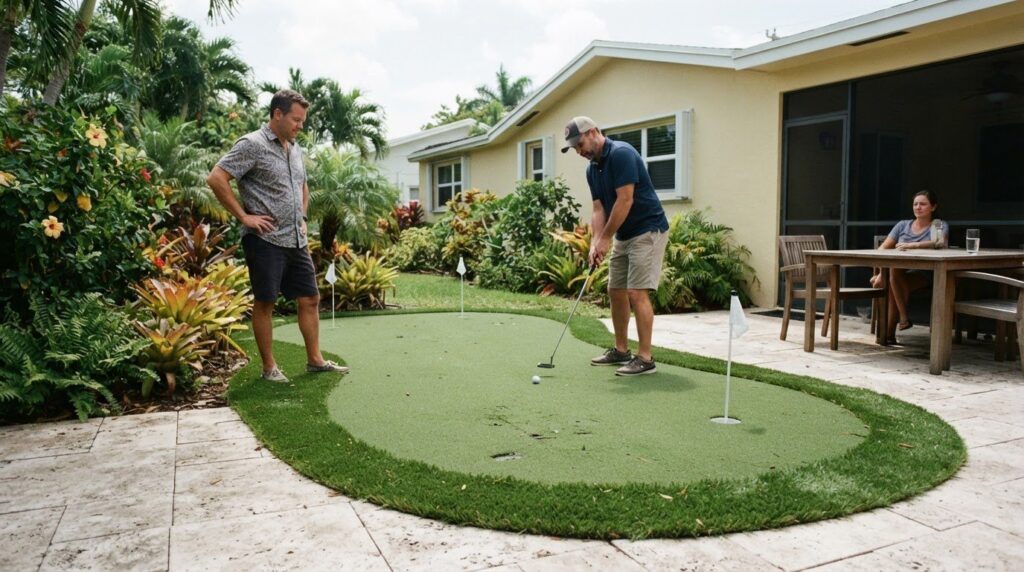
A green beside a patio or outdoor kitchen adds an activity without separating guests from the gathering. The layout, access, drainage, and practice goals all affect how well the space serves both uses.
Compact Backyard Layouts
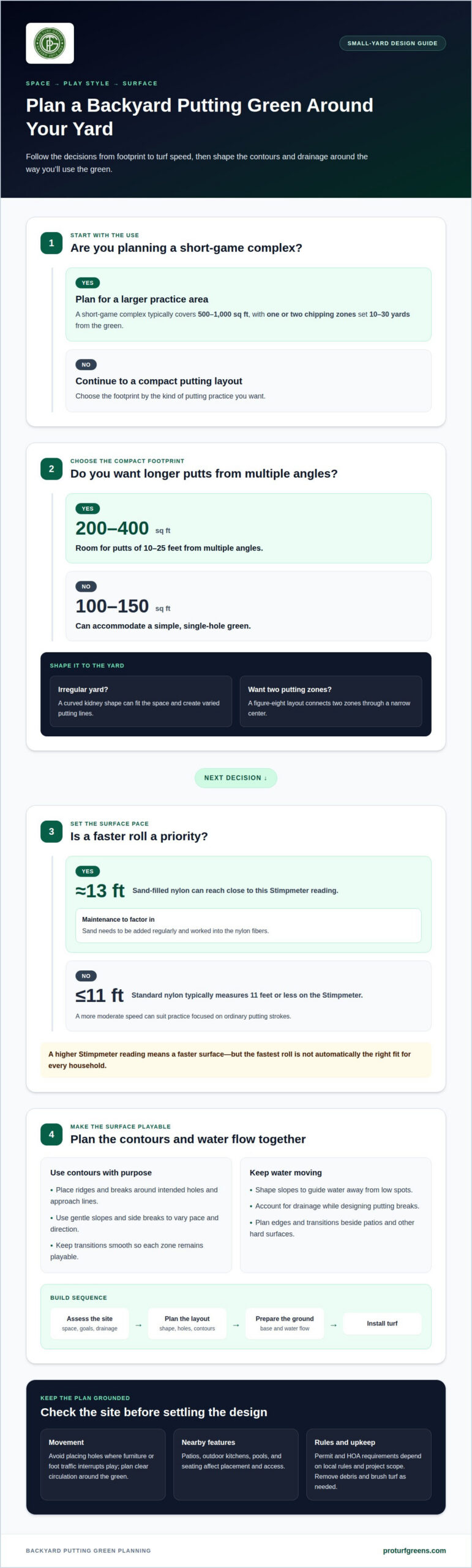
A compact layout uses a limited footprint for putting practice and social play. About 100 to 150 square feet can accommodate a single hole, while 200 to 400 square feet allows putts of 10 to 25 feet from multiple angles. Curved kidney shapes fit irregular yards and create varied putting lines. A figure-eight layout separates two putting zones with a narrow center connection.
Site Conditions and Design Goals
Site conditions are the yard’s existing features and constraints; design goals determine how people will use the green. A good plan accounts for available space, ground preparation, drainage, landscaping, and desired difficulty. A green near a patio can support entertaining, while varied angles can prioritize practice. Pool edges, outdoor kitchens, and seating areas also affect circulation and placement.
Permit and HOA requirements depend on the property’s city or county, zoning, and community covenants. Professionals account for applicable rules and the project scope, including excavation, drainage changes, or lighting, during planning.
Start with a site assessment and a discussion of practice and entertaining goals. Then plan the green’s shape, holes, contours, and drainage before preparing the ground and installing the turf.
Artificial greens need routine care to keep the surface clear and playable. Remove leaves and debris, and brush the turf as needed. Sand-filled nylon also requires regular sand worked into its fibers.
Common mistakes include placing holes where furniture or foot traffic interrupts play, and overlooking drainage or uneven transitions. Professionals plan clear movement around the green and account for edges, nearby hard surfaces, and water flow to reduce trip and pooling risks.
A par-3-style backyard course may involve a more extensive design than a compact putting layout. A short-game complex typically covers 500 to 1,000 square feet, with one or two chipping zones set 10 to 30 yards from the green.
Break and undulation through sub-base contouring
Sub-base contouring shapes the slopes beneath the putting surface. These contours create breaks that challenge distance control and green reading without requiring a larger footprint. In a compact yard, a carefully placed ridge can produce different putts from several starting positions.
Plan contours around intended hole locations and approach lines. A gentle slope toward a cup can make a short putt more demanding, while a side break asks golfers to judge direction as well as speed. Aim for variety, not a surface where every putt follows the same path.
Contour design should also account for how players move across the green. A multi-tiered layout uses separate levels to test control of speed and direction. A tier adds variety, but steep or abrupt transitions can make some areas less useful for putting. Smooth transitions connect each zone into a playable surface.
Before turf installation, the sub-base is shaped and compacted to create the planned elevations. The finished surface depends on this underlying work, so the design should consider each cup, ridge, and low area together. For example, a cup near a slope’s transition creates a different challenge from one on a level section.
Drainage must also inform contour decisions. Surface slopes guide water away rather than allowing low spots to hold it, while the intended breaks preserve realistic putting lines. A design that adds undulation without considering water movement can compromise both play and surface performance. A professionally contoured putting green can balance practice challenges with the yard’s available space and intended use.
Synthetic turf materials and putting speeds
For the best putting green design for small yards, turf selection should reflect the pace and feel of practice you want. Standard nylon synthetic turf typically measures 11 feet or less on the Stimpmeter. Sand-filled nylon can reach close to 13 feet. These readings help compare surfaces, but the fastest roll isn’t automatically the right fit for every household.
A Stimpmeter reading gives a useful reference for surface speed. A faster green asks golfers to judge pace carefully, while a more moderate speed can suit practice focused on ordinary putting strokes. Professionals weigh the desired practice experience alongside the layout, so the surface supports how golfers plan to use the yard.
Sand-filled nylon needs ongoing infill maintenance. Sand must be added regularly and worked into the nylon fibers to maintain the surface, so factor that upkeep into your material decision from the start. Weigh the maintenance alongside the playing characteristics you want from the green.
For a short-game complex, the specified putting-surface pile height is 0.80 inch. Pile height describes the turf fibers above the backing and helps inform surface selection. The details that shape the best putting green design for small yards include matching turf, pile height, and intended putting speed, rather than treating them as separate choices.
A practical selection process begins with the desired putting pace, then considers turf options against that goal. A golfer who wants faster putts may prefer sand-filled nylon, while standard nylon typically stays at 11 feet or less on the Stimpmeter. The key is choosing for the practice experience and maintenance routine that suit the household.
What base materials and drainage do professionals use for a backyard putting green?
A synthetic green relies on a prepared base to support its shape and playing surface. Typical construction uses a gravel layer 2 to 4 inches deep, with a compacted aggregate layer 6 to 8 inches deep above it. These layers form the foundation beneath the turf, so professionals plan them alongside the green’s contours and drainage.
The construction sequence matters: the gravel base goes below the compacted aggregate, and the finished surface is shaped to direct water away. Compaction helps create a stable base for the turf, while careful grading supports a consistent surface. In a small yard, the base follows the planned footprint, including its edges, putting areas, and any low or elevated contours.
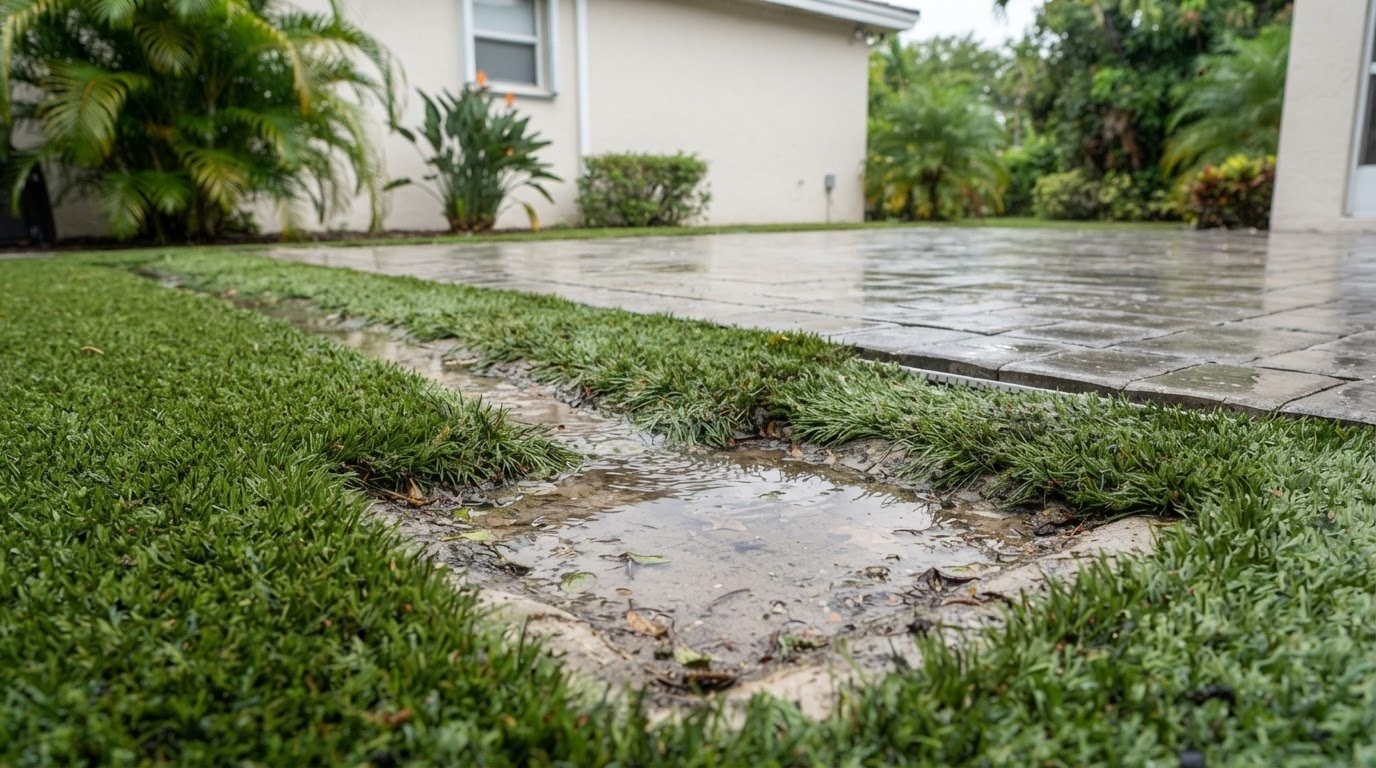
Synthetic putting greens typically rely on surface drainage rather than pipes beneath the green. Shape the surface to guide water toward suitable surrounding areas instead of leaving depressions where it can collect. A slight turtle-backed contour, with the center gently higher than the edges, can help shed water and limit conditions that encourage algae formation.
Drainage planning also considers nearby hard surfaces and the direction water naturally moves across the property. A green beside a patio, for example, needs a shape that directs runoff away from the play area and avoids holding water at its edge. Gravel and aggregate support the construction, but the finished grade determines how surface water leaves the green.
For a small-yard installation, professionals coordinate the base depth, compaction, surface shape, and surrounding grade as one system. A well-planned foundation supports both reliable ball roll and effective water movement. Plan your backyard putting green installation with a design that accounts for the base and drainage from the start.
Pro Turf Greens: Backyard Putting Greens
Pro Turf Greens designs and installs backyard putting greens for homeowners who want a professionally planned practice surface suited to their yard. When you’re ready to move from layout decisions to a finished green, the team considers turf, putting speed, contours, and drainage as parts of one design.
Share how you expect to use the space, whether for short-game practice, casual play with guests, or both. The yard’s footprint and existing features help shape a layout that balances playability with the surrounding outdoor area. Pro Turf Greens also designs tee lines and driving ranges, recreational turf, and lawn and pet turf as separate projects.
For a small yard, a thoughtful design can make the available area work harder without losing sight of how the space functions day to day. Contact Pro Turf Greens to discuss a backyard putting green for your property.
Shape a Green Around the Way You’ll Use Your Yard
The best putting green design for small yards starts with a clear picture of how you want the space to feel and function. Decide whether you’re planning a quiet practice area, a place to welcome guests, or a backyard feature that complements other outdoor activities. Those priorities give the design conversation a useful starting point.
Pro Turf Greens designs Backyard Putting Greens, Playgrounds & Recreational Turf, and Tee Lines & Driving Ranges. If your plans extend beyond putting, these options can bring different recreational uses into the overall vision for your property.
Bring your goals for the yard into the conversation, and explore a design that feels considered, practical, and distinctly yours. Contact Pro Turf Greens to discuss your project and take the next step toward a backyard made for practice and time together.
Frequently Asked Questions
Synthetic or Natural Grass?
Synthetic turf is often the more practical choice for a backyard putting surface because it avoids mowing. Natural putting grass requires close, frequent care, including daily mowing during the growing season at about 1/8 inch or lower. The right fit depends on whether you prioritize reduced mowing or prefer managing living grass. For a small yard used for entertaining, consider how much time you want to spend maintaining the playing surface.
What putting green designs work best for small backyards?
Kidney-shaped and figure-eight layouts can make compact yards more engaging. A kidney shape offers curved edges and varied approach angles, while a figure eight separates play into two zones. For example, placing one zone near a patio keeps putting within view of guests while preserving another area for focused practice. The best layout depends on the yard’s shape, access, and intended use.
How much space is needed for a backyard putting green?
A simple green can fit into about 100 to 150 square feet, while a compact practice area commonly uses 200 to 400 square feet. The smaller footprint suits single-hole practice; the larger range offers more room to vary starting positions. In South Florida, including Fort Lauderdale, Miami, Palm Beach, Boca Raton, Delray Beach, Jupiter, Palm Beach Gardens, Weston, and Coral Gables, usable space and yard features shape the final footprint.
What are good putting green dimensions for a small yard?
About 10×10 or 10×15 feet is a practical starting footprint for a small residential green. A roughly 100-to-150-square-foot area can serve a single hole, while 200 to 400 square feet allows longer putts and more starting angles. Dimensions should describe playable space, not just the turf outline: the design also needs room for edges, safe circulation, and nearby seating.
Artificial turf vs natural grass for a small putting green: which is better?
Artificial turf suits homeowners seeking a consistent practice surface without mowing, while natural grass may appeal to golfers who value a living surface and accept intensive upkeep. Turf selection also affects roll: standard nylon typically measures 11 feet or less on the Stimpmeter, and sand-filled nylon can approach 13 feet. Choose according to preferred speed and the maintenance routine you can sustain.
How do professionals design slopes, breaks, and hole placement in a small putting green?
Professionals coordinate cup locations with the green’s contours and likely putting lines, so each position offers a playable challenge. In a multi-hole layout, cups should have 8 to 10 feet of separation. A low area or ridge can change the break, but it must also work with the surface’s water movement. The result balances variety, approach angles, and practical use of the available footprint.