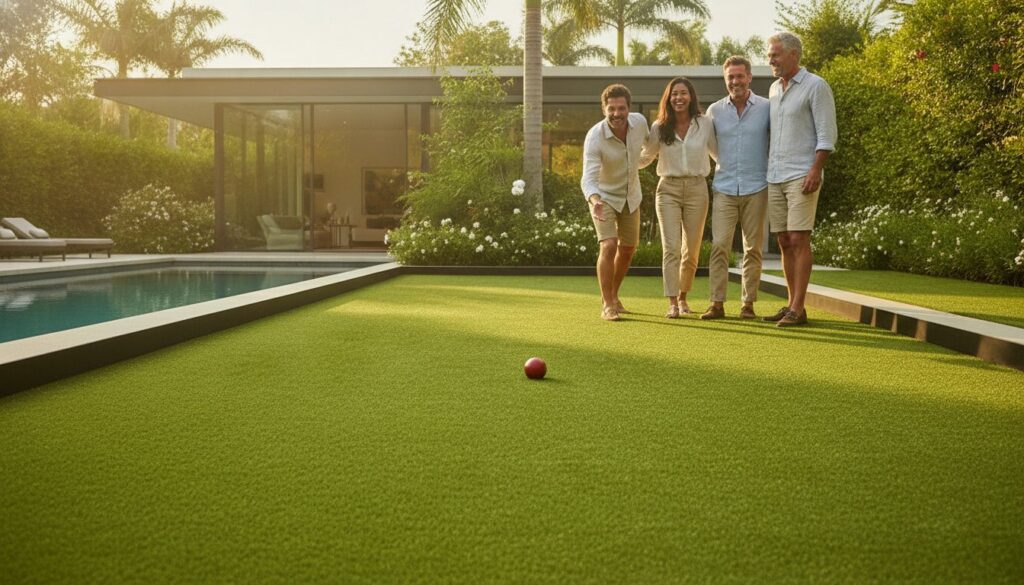
What if your weekend bocce match didn’t have to start with an hour of raking and leveling under the blistering South Florida sun? Most enthusiasts agree that while the tradition of clay or oyster shell is charming, the reality of maintaining those surfaces in our tropical climate is a relentless chore. You’ve likely dealt with the frustration of standing water after a sudden downpour or found the court surface too hot to touch during the peak of July. It’s time to trade those maintenance pains for synthetic grass for bocce ball courts, a solution that prioritizes consistent playability and aesthetic excellence.
In this 2026 design guide, you’ll discover how to select and install a professional-grade surface that can withstand the unique challenges of the Miami and Fort Lauderdale environments. We’ll provide a detailed look at the precision engineering required for a true-roll surface, focusing on advanced drainage systems and heat-reduction technologies that ensure your court is ready for action year-round. From understanding the nuances of sub-base preparation to choosing the right fiber density, this guide serves as your steady guide in creating a durable, high-end amenity that enhances both your property value and your aspirational lifestyle.
Key Takeaways
- Understand why discerning homeowners are moving away from the constant leveling of clay toward the resilient, maintenance-free performance of modern synthetic surfaces.
- Learn the technical nuances of infilled versus non-infilled systems to determine which synthetic grass for bocce ball courts delivers the precise ball roll and speed your game requires.
- Discover how specialized athletic turf serves as a high-value amenity for South Florida HOAs, offering a durable solution that withstands daily play without losing its aesthetic excellence.
- Identify the advanced installation techniques, including tile subsurface systems and specialized drainage, that keep your court functional even after the most intense South Florida rainstorms.
- Explore the meticulous site preparation and custom design standards required to transform your outdoor space into a professional-grade recreational retreat.
Why Synthetic Grass for Bocce Ball Courts is Replacing Traditional Surfaces
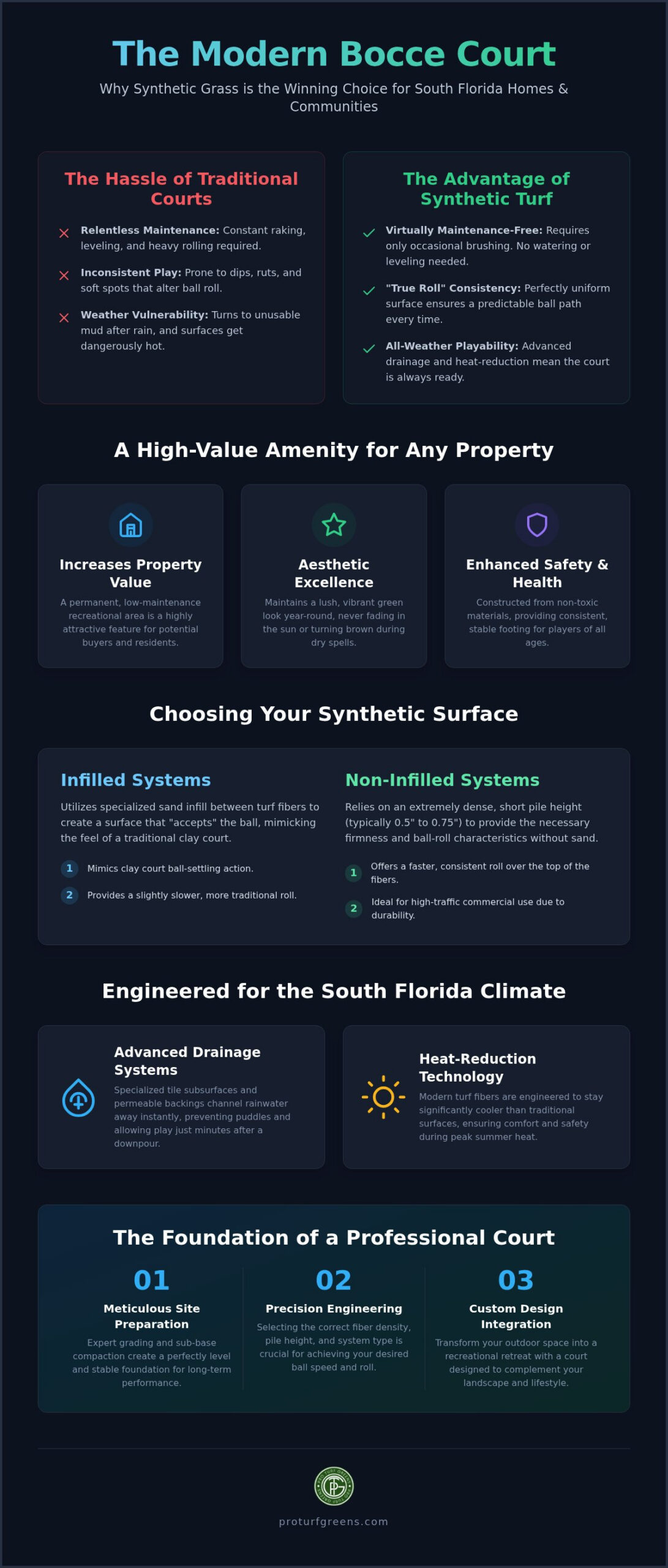
The traditional game of Bocce has long been associated with surfaces of crushed stone, oyster shells, or natural clay. While these materials offer a classic aesthetic, they demand a level of maintenance that many modern property owners find unsustainable. In response, synthetic grass for bocce ball courts has emerged as the premier choice for those seeking a professional-grade experience without the constant labor. This specialized surface consists of a high-density, short-pile polypropylene or nylon carpet, specifically engineered to provide the firm, fast, and consistent roll required for competitive play.
The primary advantage lies in the reliability of the “True Roll.” Natural surfaces are prone to developing dips, ruts, and soft spots over time, which can unpredictably alter the path of a ball. Synthetic fibers eliminate these inconsistencies by providing a perfectly uniform texture across the entire court. Because these systems aren’t susceptible to the erosion or compaction issues of clay, players enjoy a predictable surface every time they step onto the court. This transition to modern materials ensures that the focus remains on the strategy of the game rather than the flaws of the ground.
Maintenance comparisons reveal a stark contrast between traditional and synthetic options. To keep a clay court playable, owners must commit to a cycle of regular raking, heavy rolling, and the periodic replenishment of expensive oyster shells. Synthetic grass for bocce ball courts effectively removes these burdens from your schedule. Beyond an occasional brushing to keep the fibers upright, the surface requires zero leveling or watering. In the volatile South Florida climate, this durability is essential; while clay courts often turn into unusable mud pits after a typical afternoon thunderstorm, synthetic surfaces remain ready for play almost immediately after the rain stops.
The Evolution of Bocce Surfaces
The sport has moved far beyond its origins in dust and debris. Today, the industry has shifted toward high-performance polymers that mimic the best characteristics of traditional courts while adding modern resilience. Utilizing high-performance sports turf is now the standard for luxury residential amenities and high-end commercial centers alike. This evolution also supports environmental stewardship. By choosing synthetic options, property owners eliminate the need for chemical pesticides and the heavy water usage required to keep natural courts from cracking in the heat.
Key Benefits for Residential and Commercial Owners
Investing in a professional-grade bocce court provides a significant lifestyle upgrade that resonates with discerning guests and residents. Consider these specific advantages:
- Property Value: A custom-designed, low-maintenance recreational area serves as a permanent, high-value amenity that appeals to future buyers.
- Aesthetic Excellence: The lush, vibrant green appearance of the turf remains consistent throughout the year, never fading under the intense Florida sun or turning brown during dry spells.
- Safety and Health: Modern synthetic systems use non toxic artificial grass materials and provide consistent footing, creating a safe environment for family members of all ages.
Infilled vs. Non-Infilled: Choosing Your Synthetic Bocce Surface
Selecting the right configuration for synthetic grass for bocce ball courts involves more than just aesthetic preference. It’s a technical decision that dictates the physics of the ball’s roll and the court’s longevity. Most professional installations fall into two distinct categories: infilled and non-infilled systems. Infilled systems utilize specialized sand to mimic the “acceptance” of a traditional clay court, where the ball settles into the surface rather than skipping or bouncing. Conversely, non-infilled systems rely on extremely dense pile heights, usually between 0.5 and 0.75 inches, to provide the necessary resistance. For high-traffic commercial environments, nylon fibers are often the preferred choice due to their high melting point and superior resilience against matting under constant use.
The Role of Round-Grain Sand Infill
Infill isn’t merely a weight to hold the turf in place; it’s the primary factor in court performance. Professionals exclusively use round-grain sand because angular sand possesses sharp edges that act like tiny saws, prematurely wearing down synthetic fibers. By achieving a 75% infill depth, you create a “heavy” roll that feels authentic to seasoned players. This specific depth allows the ball to track straight while preventing the “trampoline effect” common in lower-quality setups. Maintaining this balance requires an occasional light brushing to redistribute the sand, ensuring the roll stays true across the entire court. This attention to detail is why many organizations cite the long-term cost-effectiveness of these systems, as documented in a University of California study on turf regarding sports surface maintenance and extensive use.
Padded vs. Unpadded Turf Options
The choice of backing significantly alters the sensory experience of the game. A 5mm foam backing is a popular addition for residential courts because it dampens the “clack” of the balls and reduces joint impact for players. This padding provides consistent shock absorption that a standard stone base alone cannot replicate. However, if you’re installing over an existing concrete or asphalt pad, unpadded turf might be the more stable choice to prevent “ghost breaks” in the ball’s path. If you aren’t sure which configuration fits your specific site, the specialists at Pro Turf Greens can help you evaluate your existing base to ensure a perfect match.
Pile density also plays a vital role in lateral movement. A denser carpet prevents the ball from falling into the “grain” of the turf, which ensures that a shot aimed at the pallino stays on its intended line. Whether you prefer a lightning-fast surface or a slower, more tactical court, adjusting the infill grain shape and depth allows for a custom-tailored playing experience that natural surfaces simply can’t replicate.
Synthetic Turf for Community Parks and Commercial Amenity Centers
High-end commercial properties and HOAs in South Florida are increasingly viewing recreation as a core asset. Synthetic grass for bocce ball courts offers a high return on investment (ROI) by significantly reducing the annual maintenance budget required for traditional clay or oyster shell courts. Unlike natural surfaces that require daily grooming and frequent material replenishment, synthetic turf withstands the rigors of high-volume community play without losing its structural integrity or aesthetic appeal. This durability makes it a preferred choice for property managers who value long-term reliability and consistent performance.
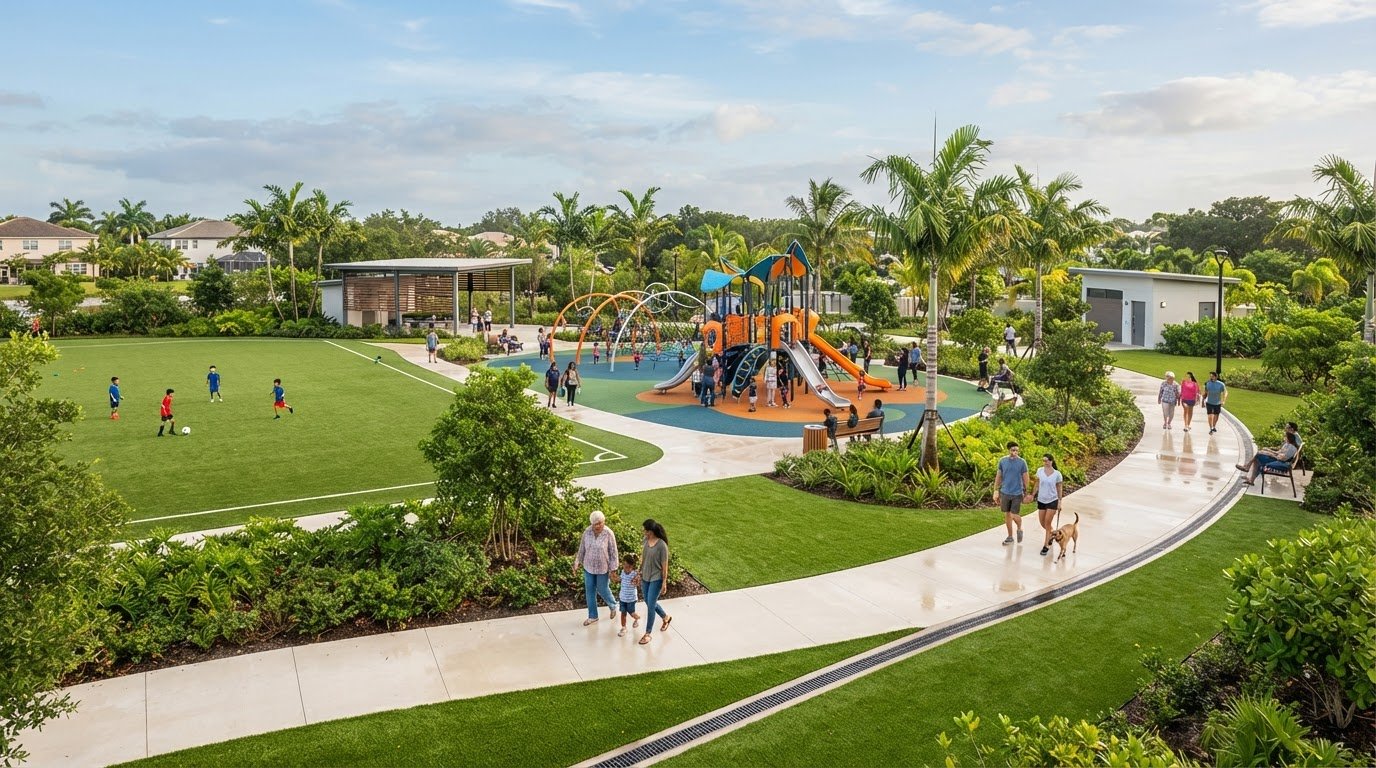
For park planners, selecting a surface that resists matting and fiber fatigue is essential. Pairing these courts with synthetic turf for community parks creates a cohesive recreational environment that serves multiple demographics simultaneously. Synthetic surfaces are also naturally ADA-compliant because they provide a stable, firm ground that accommodates wheelchairs and walkers. This ensures the amenity is inclusive for all residents, moving beyond simple utility to provide a truly accessible community feature.
Designing Multi-Generational Community Spaces
Bocce is a uniquely effective low-impact sport, making it a favorite for senior living communities and family-oriented parks. During the design phase, we prioritize court orientation to minimize sun glare during peak playing hours. Strategic placement near existing shade trees or the addition of custom pergolas can transform a simple court into a primary social hub. Surrounding the court with synthetic turf “social zones” allows for comfortable seating areas that remain lush and mud-free, even with heavy foot traffic. This holistic approach to design ensures the space feels like an intentional lifestyle upgrade rather than just a sports installation.
Compliance and Safety for Public Use
Public installations require strict adherence to local regulations and safety protocols. Our systems meet playground turf safety standards in Florida, ensuring that every material used is non-toxic and lead-free. This is a critical factor for municipal procurement officers and HOA boards focused on resident health and environmental safety. For a comprehensive overview of the latest Florida regulations governing safe turf materials, the 2026 checklist for non toxic artificial grass in Florida outlines the specific certifications and PFAS-free standards now required for compliant installations. Professional-grade synthetic grass for bocce ball courts offers high resistance to vandalism and wear, maintaining its polished look despite constant exposure to the elements. The resilience of these materials ensures that the community’s investment remains a pristine and functional asset for years to come.
South Florida Installation Essentials: Drainage and Heat Defense
A professional-grade bocce court in South Florida is an engineered system, not just a surface. While the quality of the synthetic grass for bocce ball courts is vital for playability, the court’s longevity depends on what lies beneath the fibers. In our tropical climate, standard installation methods often fail because they don’t account for the sheer volume of water during flash floods or the intensity of the midday sun. A high-performance installation must balance rapid drainage with advanced thermal protection to remain functional and comfortable year-round.
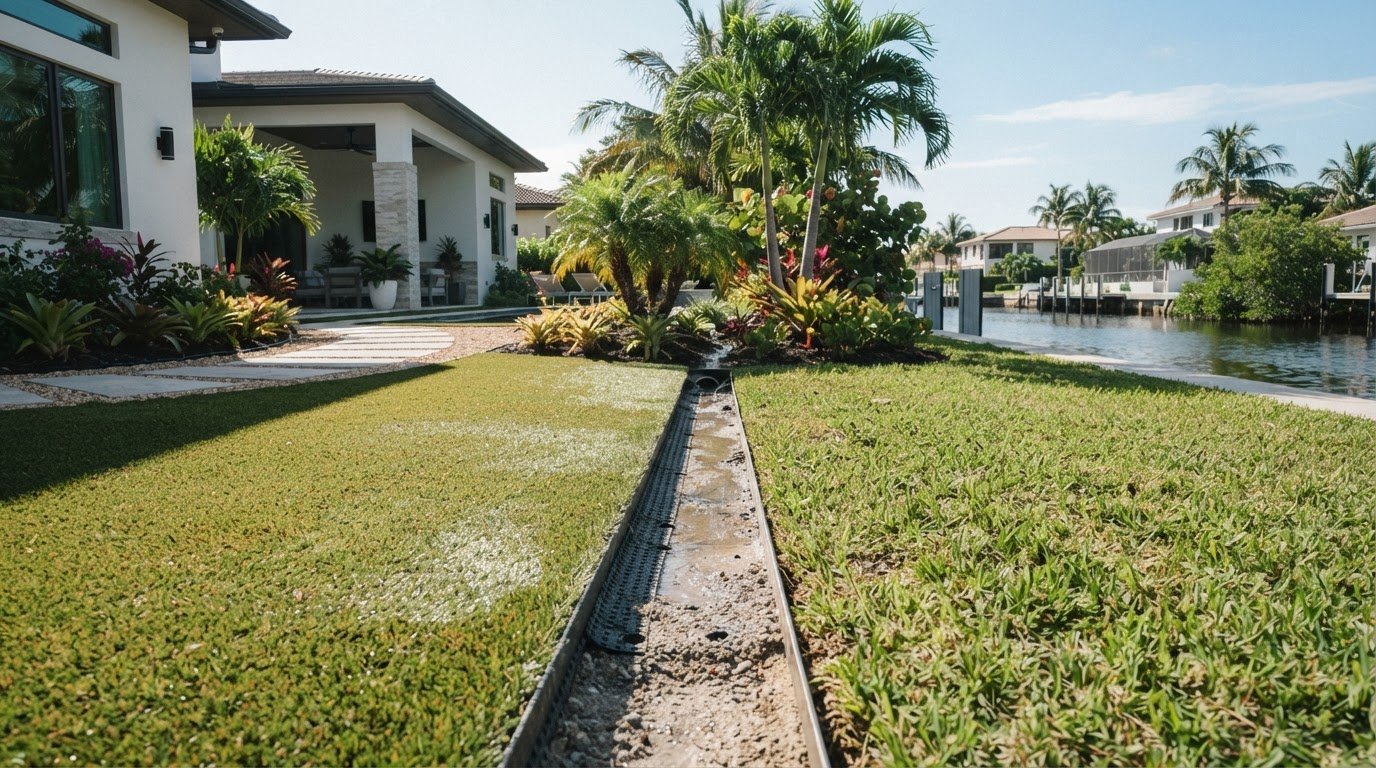
Many homeowners believe that a perforated turf backing is sufficient for drainage. However, vertical drainage is only the first step. For courts installed over non-porous surfaces like concrete, we utilize tile subsurface systems. These specialized drainage tiles create a void between the turf and the base, allowing water to move laterally toward a designated exit point. This prevents the surface puddling and “ghost breaks” that can occur when water becomes trapped, ensuring your court is ready for a match even minutes after a heavy downpour.
Managing Tropical Rainfall
The foundation of a resilient court starts with meticulous base construction. We utilize a stable, crushed stone base composed of clean granite or limestone. These materials are chosen for their maximum porosity and structural integrity under South Florida’s unique soil conditions. By designing a precise “slope and drain” system, we facilitate rapid water evacuation away from the court’s center. This professional grading is essential to prevent “bubbling,” a common issue where heavy moisture causes the turf to lift or shift if it hasn’t been properly secured to a well-drained sub-base.
Combatting the South Florida Sun
The intense sunlight in Fort Lauderdale and Miami can quickly degrade inferior materials. We utilize UV-stabilized fibers that are specifically engineered to prevent color fading and fiber brittleness. To ensure the court remains usable during the summer months, we incorporate modern heat reduction technology. These advanced fibers stay up to 17.5°F cooler than standard synthetic turf, making the surface much more comfortable for players. When paired with heat-reflective infill options, this “Heat Block” technology transforms a backyard court into a refreshing retreat rather than a heat trap.
If you’re ready to upgrade your outdoor space with a climate-resilient solution, the expert installers at Pro Turf Greens provide the technical craftsmanship required to handle South Florida’s toughest conditions.
Professional Design and Construction with Pro Turf Greens
Pro Turf Greens approaches every project as a meticulous craftsman and a dedicated partner, ensuring that your vision for a recreational retreat becomes a functional reality. We understand that a high-end court is more than just a place to play; it’s a lifestyle upgrade that adds significant aesthetic and financial value to your property. By focusing on specialized engineering and custom-tailored solutions, we deliver a finished product that meets the highest standards of professional play. Our team takes quiet pride in every installation, from the initial grading to the final application of the surface fibers.
Customization is at the heart of our design process. While the United States Bocce Federation sets regulation dimensions at 91 feet by 13 feet, we frequently adapt these measurements to fit the unique footprints of South Florida backyards or community amenity centers. Residential courts often range between 60 and 76 feet in length, maintaining the necessary width to ensure a proper game. To complete the polished look, we offer seamless border integration using premium materials such as poured concrete, pressure-treated wood, or decorative stone. These borders don’t just define the field of play; they provide a sophisticated frame that complements your existing landscaping.
From Consultation to First Roll
The journey toward a pristine court begins with a comprehensive artificial turf consultation. During this phase, our experts conduct a detailed site analysis to evaluate soil stability, existing drainage patterns, and sun exposure. Precision installation follows, where we focus on expert grading and base compaction to ensure a perfectly level surface. We carefully secure the synthetic grass for bocce ball courts and apply the exact infill ratio required for your desired ball speed. Once the project is complete, we provide simple post-installation care tips, such as light brushing, to keep your court in PGA-caliber condition for years to come.
Why Local Expertise Matters
Serving Fort Lauderdale, Miami, and Palm Beach requires more than just technical skill; it demands a thorough understanding of the specific environmental challenges facing coastal properties. Local expertise is indispensable when navigating building codes and municipal drainage requirements that are unique to the South Florida region. We’re a reliable local authority that understands how our intense humidity and salt air affect material longevity. By choosing a specialist who is deeply invested in the community, you gain a partner who ensures your synthetic grass for bocce ball courts remains a durable and beautiful asset despite the rigors of our tropical climate.
Elevate Your Game with a Professional-Grade Recreational Retreat
Transitioning to synthetic grass for bocce ball courts represents more than just a reduction in maintenance; it’s an investment in a consistent, high-performance playing experience that withstands the unique demands of our tropical climate. By prioritizing advanced drainage systems and heat-reduction technology, you ensure that your court remains a functional and beautiful asset throughout the year. Whether you’re designing a private backyard sanctuary or a high-traffic community amenity, the shift toward modern synthetic materials provides the “True Roll” and aesthetic excellence that traditional surfaces simply can’t match.
At Pro Turf Greens, we combine professional-grade athletic turf expertise with a deep understanding of South Florida’s environmental requirements. As local specialists, we take pride in delivering custom design and precision installation services that transform your vision into a durable reality. We’re dedicated to being your partner through every phase of the process, ensuring that your project meets the highest standards of craftsmanship and reliability. If you’re ready to start your transformation, Request Your Free Bocce Court Consultation today. We look forward to helping you create a space where memories are made and games are played for years to come.
Frequently Asked Questions
What is the best base for a synthetic bocce ball court?
The ideal foundation consists of a four-inch to six-inch layer of compacted crushed stone, such as granite or limestone screenings. This base provides the necessary structural stability for a perfectly level court while ensuring maximum porosity. In South Florida’s sandy soil, this engineered layer prevents the court from shifting over time. It also facilitates rapid drainage, which is critical for maintaining a high-performance surface during the rainy season.
How much does a synthetic bocce court installation cost in South Florida?
Total investment depends on several variables, including the extent of site preparation, accessibility for heavy equipment, and the choice of turf density. Factors like the depth of the aggregate base and the complexity of the drainage system also influence the final project scope. While high-quality synthetic grass for bocce ball courts requires an upfront investment, the long-term savings on water and labor provide a significant return for property owners.
Can I install synthetic bocce turf over an existing concrete patio?
You can install professional turf over concrete, provided you incorporate a specialized subsurface drainage tile system. These tiles create a vital air gap between the concrete and the turf backing, allowing water to escape laterally. Without this layer, moisture becomes trapped, leading to mold growth or surface bubbling. This method is particularly effective for transforming underutilized pool decks or patios into high-end recreational amenities that stay dry and functional.
How do you clean and maintain a synthetic bocce court?
Maintenance is remarkably simple, requiring only an occasional brushing to keep the fibers upright and the infill evenly distributed. A standard leaf blower easily removes organic debris like leaves or twigs that might accumulate. Unlike traditional clay courts that need daily raking and watering, synthetic grass for bocce ball courts stays pristine with minimal effort. This allows you to spend more time playing and less time on labor-intensive upkeep throughout the year.
Does synthetic bocce turf get too hot in the Miami sun?
Modern synthetic fibers are engineered with heat-reduction technology to remain comfortable even under the intense Miami sun. These specialized materials can stay up to 17.5°F cooler than standard turf products by reflecting infrared light. When paired with high-performance, heat-reflective infill, the surface remains usable throughout the summer. This thermal protection ensures that your court doesn’t become a heat trap, preserving a comfortable environment for barefoot play or evening matches.
What is the difference between bocce turf and putting green turf?
While both surfaces prioritize a true roll, bocce turf typically features a slightly higher pile density and different infill requirements to handle heavier ball impacts. Putting greens focus on ball speed and stimp ratings for golf, whereas bocce surfaces must absorb the energy of a tossed ball to prevent excessive bouncing. Choosing a dedicated athletic turf ensures the physics of the game remain authentic, providing the “thud” and settling characteristic of professional play.
How long does a professional synthetic bocce court last?
A professionally installed court utilizing UV-stabilized fibers typically lasts between 15 and 20 years. The longevity of the system depends on the quality of the initial site preparation and the resilience of the polymer used. Because these surfaces are designed to withstand high-traffic commercial use, they don’t mat or degrade easily. Our craftsmanship focuses on creating a durable amenity that retains its vibrant aesthetic excellence and structural integrity despite decades of exposure to Florida weather.
Is synthetic bocce turf permeable to water?
The entire system is designed to be highly permeable to water. The turf itself features a perforated backing that allows moisture to pass through at a rate of several inches per hour. This water then enters the porous crushed stone base, where it’s either absorbed into the ground or directed away via the slope and drain system. This rapid evacuation prevents standing water and puddling, ensuring the court is ready for play immediately after a storm.