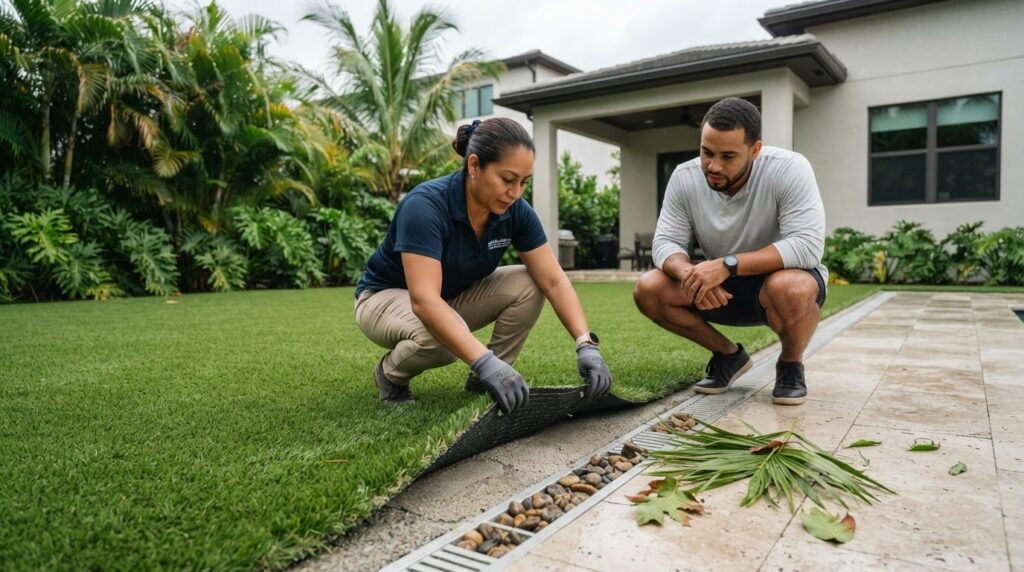
A pre-storm inspection should start with drainage, edges, and seams, not just the turf fibers. Before hurricane season, clear debris, check how water drains, and look for pooling, lifted edges, or separating seams. A hurricane resistant artificial turf installation also needs a porous base and supporting layers that let water pass through. The U.S. National Library of Medicine notes that all components of outdoor synthetic-turf installations should be porous to allow surface drainage.
Check gutters, downspouts, and yard drains as well, since water flow around the turf matters during heavy rain. This guide covers a practical inspection, from spotting slow drainage and weak seams to identifying issues that need attention before a storm. It also explains what to examine in the turf’s backing, infill, and edging, so you can assess the installation and prepare the surrounding space with greater confidence.
Key Takeaways
- Look for lifting, gaps, or movement along turf edges and seams, and address weak spots before hurricane season.
- Perimeter nails and an average sand infill of 2 lbs per sq. are recommended for turf intended to withstand a hurricane.
- Secure or remove nearby loose items so patio furniture, toys, and potted plants don’t become hazards in strong winds.
- After a storm, check for embedded debris, lifted edges, and drainage problems before returning the turf to regular use.
Checking turf drainage and pooling
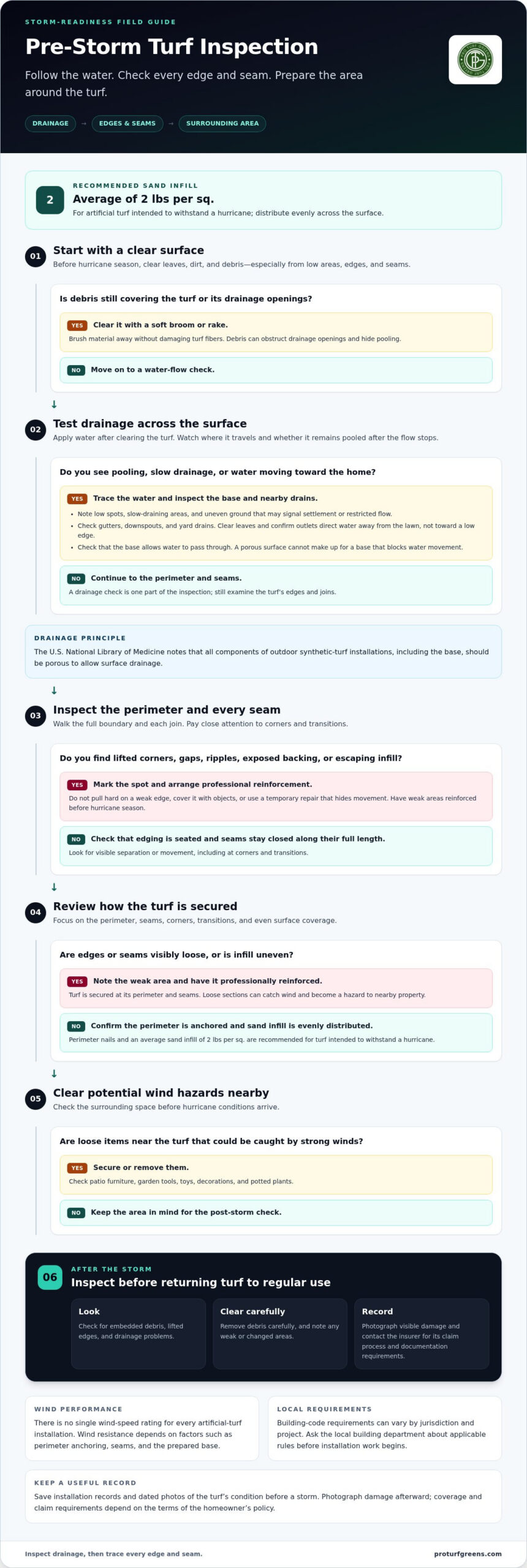
- Before hurricane season, remove leaves, dirt, and debris from the turf. Brush material away from low areas, edges, and seams. Debris can obstruct drainage openings and hide spots where water collects. Use a soft broom or rake to avoid damaging turf fibers.
- Test drainage by applying water across the surface after clearing it. Watch where water travels and whether it remains pooled after the flow stops. Note low spots, slow-draining areas, and water moving toward the home. These observations help distinguish surface pooling from runoff entering the yard.
- Check the base as well as the visible turf. The U.S. National Library of Medicine says all components, including the base, should be porous for outdoor synthetic-turf surface drainage. A porous surface cannot compensate for a base that blocks water movement. Look for uneven areas that may signal settlement or restricted flow.
- Clear gutters, downspouts, and yard drains around the turf before hurricane season. Check that each outlet directs water away from the lawn rather than toward a low edge. Leaves in a drain or a downspout emptying beside the turf can worsen pooling during heavy rain.
- Local building-code requirements can vary by jurisdiction and project. Artificial-turf guidance alone doesn’t establish whether permits or other requirements apply. Ask the local building department about applicable rules before installation work begins.
- There isn’t one wind-speed rating that applies to every artificial-turf installation. Wind resistance depends on factors such as perimeter anchoring, seams, and the prepared base. A stated installation method alone doesn’t establish performance at a particular wind speed.
- Insurance coverage and storm-damage claims depend on the terms of the homeowner’s policy. Keep installation records and dated photos of the turf’s condition before a storm. Photograph damage afterward, then contact the insurer for its claim process and documentation requirements.
Inspecting loose turf edges and seams
Inspect the perimeter and every seam before hurricane season, then check them again after a storm. Look for lifting, gaps, loose infill, and debris that could contribute to damage.
-
Inspect Turf Backing, Infill, and Edging
Walk the perimeter and examine each seam where turf pieces meet. Look for lifted corners, widening gaps, ripples, exposed backing, or infill escaping through a join. These signs can reveal movement before a section loosens further. Don’t pull hard on a weak edge; note its location instead. For hurricane-prone areas, perimeter nails and an average sand infill of 2 lbs per sq. are recommended. Have weak areas professionally reinforced before hurricane season.
-
Secure Turf Against Hurricane Winds
Check that the edging sits firmly and seams remain closed along their full length. Pay special attention to corners and transitions, where a small lift can expose more material to wind. Don’t cover a loose edge with objects or attempt a temporary repair that could hide movement. Turf is secured at its perimeter and seams, so look for visible separation and arrange professional reinforcement for weak spots before hurricane conditions arrive.
-
Check for Airborne Turf and Damage Risks
Treat lifted or detached turf as a potential wind hazard. A loose section can catch wind, become airborne, and strike nearby property; the risk depends on its condition and exposure. Before a hurricane, secure or remove patio furniture, garden tools, toys, decorations, and potted plants near the turf. After a storm, inspect for embedded debris, lifted edges, and drainage problems. Clear debris carefully, then record damage with photos. If you’re planning repairs, turf installation planning can help frame the work.
Inspect each section methodically, following the perimeter and every seam. Note corners or joins that appear lifted, widened, or loose, and arrange professional reinforcement where needed rather than pulling at the turf or concealing a weak area. Florida homeowners are advised to inspect synthetic turf edges and seams before hurricane season and have weak areas professionally reinforced if needed. Check the same spots after a storm, and record visible changes so damage needing attention is not overlooked.
How is artificial turf secured to resist hurricane-force winds?
- Start by mapping the installation area. Mark corners, boundaries, seams, and transitions to concrete or other surfaces. These spots need close attention because wind can get underneath exposed edges. Note visible gaps or unsupported areas before work begins. A hurricane resistant artificial turf installation must account for the entire perimeter, not just the center.
- Prepare a stable, even foundation before laying turf. Remove debris and address soft or uneven ground that could leave sections unsupported. The base should also let water pass through, helping prevent trapped water from adding pressure to weak areas during heavy rain.
- Lay the turf smoothly, without folds or slack that could catch the wind. Align adjoining pieces and inspect each seam along its full length. A join may look neat at one end but separate elsewhere, so check the entire connection, not just the corners.
- Secure the perimeter with turf-installation nails. Check that the edging remains seated and no section has pulled away. A tidy border alone does not show whether the turf is firmly secured. Inspect corners and transitions, where an exposed edge may be easier to lift.
- Distribute sand infill evenly across the surface. An average sand infill of 2 lbs per sq. is recommended for artificial turf intended to withstand a hurricane. Check for bare patches or concentrated piles, which can leave surface coverage uneven. Follow the installation plan for consistent distribution.
- Walk the perimeter and review every seam when installation is complete. Look for movement, raised corners, open joins, or exposed backing. A hurricane resistant artificial turf installation depends on the whole system, including its base, seams, and perimeter. Address weak areas before hurricane conditions arrive, and secure or remove nearby loose items before a storm.
What turf backing, infill, and edging systems are best for hurricane-prone areas?
- Choose backing and base components that support water flow. The U.S. National Library of Medicine notes that all components of outdoor synthetic-turf installations, including the base, should be porous for surface drainage. Assess the complete system rather than the visible turf alone. Porous backing cannot compensate for a base that blocks water.
- Ask how the backing connects to the prepared base and perimeter. Check whether the installed layers remain supported and allow water to pass through. Do not rely on backing material alone as proof of wind resistance. A firm, even foundation and secure edges work together to limit places where wind can get underneath.
- Use the recommended infill amount as a planning reference: an average sand infill of 2 lbs per sq. is recommended for artificial turf intended to withstand a hurricane. Spread infill evenly, rather than leaving bare patches or heavy piles. Uneven coverage can make the surface inconsistent and obscure areas needing inspection.
- Choose perimeter edging that allows the turf boundary to be firmly secured. Perimeter nails are recommended for hurricane-intended artificial turf. Inspect corners, transitions, and edges beside hard surfaces for gaps or movement. A decorative border is not structural restraint unless it is part of the installation’s securing system.
- Review the backing, infill, and edging together before completing the installation. Confirm that seams meet cleanly, the surface lies flat, and the base remains porous. Even a well-secured edge needs drainage through the underlying layers. Check that infill coverage and perimeter fastening are consistent across the entire area.
- Before choosing a system, map the turf’s shape, drainage direction, and boundary conditions. Curves, corners, and transitions affect how the perimeter can be fastened. For a project-specific review of an artificial turf system, discuss your turf installation needs.
Synthetic turf is described as draining quickly, but its drainage system should still be checked before Florida’s hurricane season. Include this in a complete system inspection alongside the backing, infill, and edging. Do not assume the turf’s stated drainage performance means the installed layers need no inspection.
Pro Turf Greens: Backyard Putting Greens
Pro Turf Greens designs and installs Backyard Putting Greens for homeowners planning a new artificial turf feature. If your inspection reveals recurring concerns with drainage, edges, or seams, a new project offers an opportunity to consider how the surface, base, and layout work together. The right design depends on the intended use and the shape of your yard, not just the turf material.
Pro Turf Greens also offers Playgrounds & Recreational Turf, Tee Lines & Driving Ranges, and Lawns & Pet Turf. Each serves a different purpose, so consider how you plan to use the space before choosing a design. For a backyard putting green or another turf project, contact Pro Turf Greens to discuss your plans.
Plan the Next Step for Your Turf
Use your inspection findings to decide whether the next step is maintenance, reinforcement, or a new surface. A hurricane resistant artificial turf installation should suit the intended use and site conditions, so consider how the area needs to function after the project is complete. A putting area, recreational space, and practice zone each call for a design suited to its purpose.
Pro Turf Greens offers Backyard Putting Greens, Playgrounds & Recreational Turf, and Tee Lines & Driving Ranges. If one of these projects fits your plans, share the intended use and the space you have in mind. That gives the conversation a practical starting point, since every yard is different.
For a thoughtful next step, contact Pro Turf Greens to discuss your turf project. A clear plan can help you move forward with confidence.
Frequently Asked Questions
What drainage and flood-preparation features should artificial turf have in hurricane zones?
Choose a turf system with porous layers and a clear route for water to leave the yard. Consider where runoff will flow from the turf’s low side and whether it could collect beside a building or patio. Keep existing yard-drain outlets accessible, and plan the surface layout around them. Before storm season, clear debris that could obstruct the outlets or interrupt water flow.
What wind speeds can properly installed artificial turf withstand?
There is no single wind-speed rating for every artificial-turf installation. Wind resistance depends on factors such as perimeter anchoring, seams, and the prepared base.